


 一键配货
一键配货
化合物详情
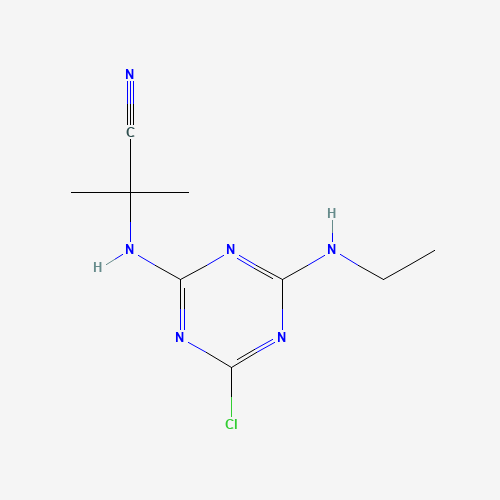
CAS21725-46-2
分子式C9H13ClN6
分子量240.69 g/mol g/mol
危化品
Cyanazine can cause developmental toxicity according to state or federal government labeling requirements.
科学粮草官-词典编辑部,修订于:2026-07-06
Toxicity
ToxicityEPA Ecotoxicity
Pesticide Ecotoxicity Data from EPA: 30
Ecotoxicity Values
USDA APHIS Chemical Effects: collection=usda_chemeffect&query_type=synonym&query='^21725-46-2$'
Fate Summary
ATMOSPHERIC FATE: According to a model of gas/particle partitioning of semivolatile organic compounds in the atmosphere(1), cyanazine, which has a vapor pressure of 1.38X10⁻⁷ mm Hg at 25 °C(2), will exist in both the vapor and particulate phases in the ambient atmosphere. Vapor-phase cyanazine is degraded in the atmosphere by reaction with photochemically-produced hydroxyl radicals(SRC); the half-life for this reaction in air is estimated to be 41 hours(SRC), calculated from its rate constant of 9.31X10⁻¹² cu cm/molecule-sec at 25 °C(SRC), determined using a structure estimation method(3). Particulate-phase cyanazine may be removed from the air by wet and dry deposition(SRC). Cyanazine has been detected in widespread rainwater monitoring studies(4); degradation rates while associated wi...
Soil Adsorption / Mobility
An experimentally determined Koc of 200 has been reported (soil type not given)(1). A Koc of 182 was measured in a silty soil(2). Using soil TLC, an intermediate mobility was measured in a silty clay loam (Rf of 0.39) and a high mobility was measured in a sandy loam (Rf of 0.74)(3); the avg Koc for these two soils was reported as 372(4). A Koc of 97 was measured for a silt loam soil from a corn field(5); in field studies using this soil (0.70% organic carbon), a max of 0.04% of surface application was lost through subsurface tile drains(5). In field studies, cyanazine did not leach below a 0.20 m depth in a sandy loam soil(6) or below a 0.30 m depth in a silt loam soil(7). However, cyanazine leached through 0.90 m of a soil composed of 29% clay, 49% silt and 22% sand(8). Cyanazine is re...
Environmental Biodegradation
AEROBIC: The persistence and fate of cyanazine was studied in a model aquatic ecosystem(1); after 35 days, only 18% of the initial cyanazine remained(1); the following metabolites were identified(1): 60% N-deethylcyanazine, 0.8% cyanazine amide, 0.3% N-deethylcyanazine amide, 1.2% unknown polar metabolites, and 19% unextractable metabolites(1); degradation of the triazine ring to CO2 proceeded slowly(1); cyanazine and its metabolites did not bioconcentrate in the food chain(1). Cyanazine was found to resist microbial degradation in distilled water amended with various inocculum under aerobic and anaerobic conditions in laboratory experiments(2). A half-life of 30-40 days was measured for cyanazine in constructed wetlands; the cyanazine metabolites deethylcyanazine and cyanazine amide we...
Environmental Bioconcentration
An estimated BCF of 5 was calculated for cyanazine(SRC), using a log Kow of 2.22(1) and a regression-derived equation(2). According to a classification scheme(3), this BCF suggests the potential for bioconcentration in aquatic organisms is low. In a model ecosystem study, cyanazine did not bioaccumulate in any of the organisms in the ecosystem that included algae, clam, crab, daphnia, elodea, fish, mosquito and snail(4).
Volatilization from Water / Soil
The Henry's Law constant for cyanazine is 2.57X10⁻¹⁰ atm-cu m/mole(1). This Henry's Law constant indicates that cyanazine is expected to be essentially nonvolatile from water surfaces(2). Cyanazine is not expected to volatilize from dry soil surfaces(SRC) based upon a vapor pressure of 1.38X10⁻⁷ mm Hg(3).
Environmental Abiotic Degradation
The aqueous hydrolysis of cyanazine was studied over a temperature range of 25-75 °C and a pH range of 1.5-12(1); at 25 °C and a pH range of 5.5-9.9, the hydrolysis half-life is at least 200 days(1); at 25 °C and pH 4 the half-life is 205 hr(1); an end-product of both base and acid-catalyzed hydrolysis was 2-hydroxy-4-carboxyisopropylamino-6-ethylamino-1,3,5-triazine(1); 2-chloro-4-amidoisopropylamino-6-ethylamino-1,3,5-triazine was isolated during alkaline hydrolysis(1). These half-lives indicate that hydrolysis will not be an important removal mechanism unless it is catalyzed by some agent in the environment(SRC). Hydrolysis studies conducted at 50 °C with a variety of acid catalysts have demonstrated that the second-order catalytic hydrolysis rate is related to the pKa of the acid ca...
Environmental Water Concentrations
RAIN/SNOW/FOG: Collection of 14 to 24 rainwater samples at each of four US sites (West Lafayette, IN; Tiffin, OH; Parsons, WV; Potsdam, NY) in the spring and summer of 1985 resulted in cyanazine detections ranging from 0.1 (detection limit) to 1.0 ug/l(1); cyanazine was found in nearly 35% of all samples collected(1). Cyanazine was not detected in samples of rain collected in 1996 at a location in Hannover, Germany that was approximately 15 km away from any agricultural areas(2). Cyanazine was detected in 7.2% of 2085 samples collected between March 1990 and September 1991 from 81 National Atmospheric Deposition Program/National Trends Network Sites located throughout the U.S.; percentiles of the measured concentrations were (ug/l): 90th, <0.05; 95th, 0.07; 99th, 0.27; max, 2.0(3).
Effluent Concentrations
In a study of two watersheds in GA, seasonal losses of cyanazine via field runoff have been reported to range from 0.07 to 1.0% of total field application(1). The daily flux of cyanazine to the Mississippi River and 6 of its tributaries from agricultural use was estimated for the period between May 1991 through March 1992; the estimated daily fluxes over the 11 month period were summed to produce the following total estimated discharges over the 11 month period: Minnesota River: 5.9 kg; White River: 1.6 kg; Illinois River: 23 kg; Platte River: 12 kg; Missouri River: 40 kg; Ohio River: 11 kg; Mississippi River at Clinton, IA: 9.1 kg; Mississippi River at Thebes, IL: 99 kg; Mississippi River at Baton Rouge, LA: 130 kg(2).
ICSC Environmental Data
The substance is toxic to aquatic organisms. This substance does enter the environment under normal use. Great care, however, should be taken to avoid any additional release, for example through inappropriate disposal.
Artificial Pollution Sources
Cyanazine's use as a pesticide for the control of annual grasses and broadleaf weeds(1) is expected to result in its direct release to the environment(SRC). However, in the US, registration is canceled as of January 1, 2000(2). Sale and distribution of existing stock may continue through September 30, 2002, and all use is prohibited after December 31, 2002(2).
Sediment/Soil Concentrations
SEDIMENT: Cyanazine was not detected in sediment samples collected from a small agricultural catchment in Sweden between 1990-1991 (detection limit 20-100 ug/kg, dry weight); the average concentration of cyanazine in surface water within the catchment was 0.09 to 0.03 ug/l for 1990 and 1991, respectively(1). Cyanazine was found at 90 percent of the sites examined in a survey of 28 agrochemical dealerships in Iowa; the maximum concentration was 4,600 ppb(2).
Probable Routes of Human Exposure
Occupational exposure to cyanazine occurs through dermal contact and inhalation of aerosols and dust, especially to workers applying the compound as a herbicide(1). Monitoring data indicate that the general population may be exposed to cyanazine via ingestion of contaminated drinking water(SRC).
Environmental Fate / Exposure Summary
Cyanazine's use as a pesticide is expected to result in its direct release to the environment. If released to air, a vapor pressure of 1.38X10⁻⁷ mm Hg at 25 °C indicates cyanazine will exist in both the vapor and particulate phases in the ambient atmosphere. Vapor-phase cyanazine will be degraded in the atmosphere by reaction with photochemically-produced hydroxyl radicals; the half-life for this reaction in air is estimated to be 41 hours. Particulate-phase cyanazine will be removed from the atmosphere by wet and dry deposition. If released to soil, cyanazine is expected to have moderate mobility based upon a range of measured Koc's of 182-372. Volatilization from moist soil surfaces is not expected to be an important fate process based upon a Henry's Law constant of 2.57X10⁻¹⁰ atm-cu...
Toxicity Data
LCLo (rat) > 4,900 mg/m3
Adverse Effects
ACGIH Carcinogen - Confirmed Animal.
Exposure Routes
The substance can be absorbed into the body by inhalation, through the skin and by ingestion.
Toxicity Summary
Organic nitriles decompose into cyanide ions both in vivo and in vitro. Consequently the primary mechanism of toxicity for organic nitriles is their production of toxic cyanide ions or hydrogen cyanide. Cyanide is an inhibitor of cytochrome c oxidase in the fourth complex of the electron transport chain (found in the membrane of the mitochondria of eukaryotic cells). It complexes with the ferric iron atom in this enzyme. The binding of cyanide to this cytochrome prevents transport of electrons from cytochrome c oxidase to oxygen. As a result, the electron transport chain is disrupted and the cell can no longer aerobically produce ATP for energy. Tissues that mainly depend on aerobic respiration, such as the central nervous system and the heart, are particularly affected. Cyanide is also...
RAIS Toxicity Values
Oral Slope Factor Reference: HEAST Current
Carcinogen Classification
No indication of carcinogenicity to humans (not listed by IARC).
Non-Human Toxicity Excerpts
Triazine Compounds /such as/ cyanazine ... are widely used, incidents of poisoning are uncommon. Occasionally, accidental exposure of animals to large dosages (eg, open containers, spills) can cause toxic effects and even death.
1 or Cancer Risk Level 1E-06
Fraction of Contaminant Absorbed Dermally from Soil: 0.1
Antidote and Emergency Treatment
Treatment of poisoning with cyanazine would be symptomatic.
Hazard Quotient Level 3 or Cancer Risk Level 1E-04
Fraction of Contaminant Absorbed Dermally from Soil: 0.1
USGS Health-Based Screening Levels for Evaluating Water-Quality
Reference: Smith, C.D. and Nowell, L.H., 2024. Health-Based Screening Levels for evaluating water-quality data (3rd ed.). DOI:10.5066/F71C1TWP









