

 一键配货
一键配货
化合物详情
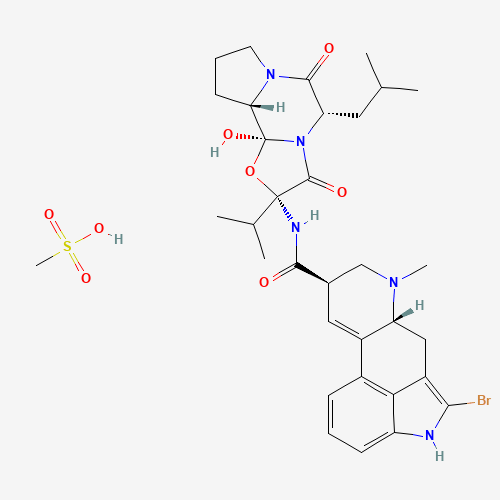
CAS22260-51-1
分子式C32H40BrN5O5.CH3SO3H
分子量750.7 g/mol g/mol
危化品
Bromocriptine methanesulfonate is a methanesulfonate salt. It has a role as an antiparkinson drug. It contains a bromocriptine.
科学粮草官-词典编辑部,修订于:2026-07-06
Toxicity
ToxicitySymptoms
Side effects of bromocriptine include nausea, headache, dizziness, fatigue, lightheadedness, vomiting, abdominal cramps, nasal congestion, constipation, diarrhea and drowsiness. Convulsive ergotism can cause painful seizures and spasms, diarrhea, paresthesias, itching, headaches, nausea and vomiting. Usually the gastrointestinal effects precede the central nervous system effects. As well as seizures there can be hallucinations and mental effects including mania or psychosis. Gangrenous ergotism causes dry gangrene as a result of vasoconstriction induced in the more poorly vascularized distal structures, such as the fingers and toes. Symptoms include desquamation, weak periphery pulse, loss of peripheral sensation, edema and ultimately the death and loss of affected tissues. (L1920, L1827)
Treatment
Treatment of overdose consists of removal of the drug by emesis (if conscious), gastric lavage, activated charcoal, or saline catharsis. Careful supervision and recording of fluid intake and output is essential. Hypotension should be treated by placing the patient in the Trendelenburg position and administering I.V. fluids. If satisfactory relief of hypotension cannot be achieved by using the above measures to their fullest extent, vasopressors should be considered. (L1827)
Health Effects
A slight hypotensive effect may accompany bromocriptine treatment. Few cases of cerebrospinal fluid rhinorrhea have been reported in patients receiving bromocriptine for treatment of large prolactinomas. Bromocriptine use has been associated with causing or worsening psychotic symptoms and fibrosis of multiple organs. Ingestion of ergoline alkaloids is known to cause the disease ergotism. Ergotism occurs in two forms, gangrenous and convulsive, likely depending on the different kinds and amounts of ergoline alkaloids present. (A2913, L1827, L1934)
Exposure Routes
Oral (L1934). Approximately 28% of the oral dose is absorbed; however due to a substantial first pass effect, only 6% of the oral dose reaches the systemic circulation unchanged. Bromocriptine and its metabolites appear in the blood as early as 10 minutes following oral administration and peak plasma concentration are reached within 1-1.5 hours. Serum prolactin may be decreased within 2 hours or oral administration with a maximal effect achieved after 8 hours. Growth hormone concentrations in patients with acromegaly is reduced within 1-2 hours with a single oral dose of 2.5 mg and decreased growth hormone concentrations persist for at least 4-5 hours.
Toxicity Summary
The dopamine D<sub>2</sub> receptor is a 7-transmembrane G-protein coupled receptor associated with G<sub>i</sub> proteins. In lactotrophs, stimulation of dopamine D<sub>2</sub> receptor causes inhibition of adenylyl cyclase, which decreases intracellular cAMP concentrations and blocks IP3-dependent release of Ca<sup>2+</sup> from intracellular stores. Decreases in intracellular calcium levels may also be brought about via inhibition of calcium influx through voltage-gated calcium channels, rather than via inhibition of adenylyl cyclase. Additionally, receptor activation blocks phosphorylation of p42/p44 MAPK and decreases MAPK/ERK kinase phosphorylation. Inhibition of MAPK appears to be mediated by c-Raf and B-Raf-dependent inhibition of MAPK/ERK kinase. Dopamine-stimulated growth horm...
Carcinogen Classification
No indication of carcinogenicity to humans (not listed by IARC).
Drug Induced Liver Injury
References: DOI:10.1016/j.drudis.2016.02.015