


 一键配货
一键配货
化合物详情
CAS23184-66-9
分子式C17H26ClNO2
分子量311.85 g/mol g/mol
危化品
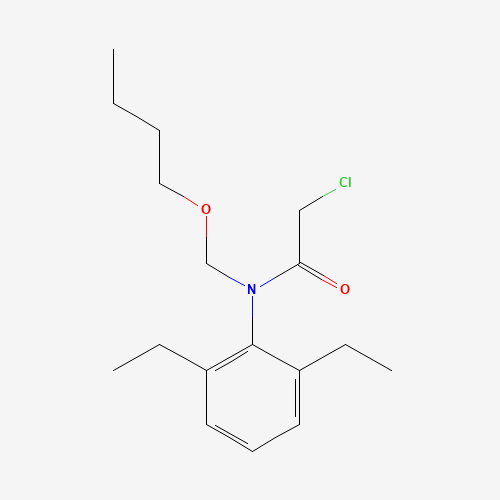
Butachlor is an aromatic amide that is 2-choro-N-(2,6-diethylphenyl)acetamide in which the amide nitrogen has been replaced by a butoxymethyl group. It has a role as a herbicide, a xenobiotic and an environmental contaminant. It is a tertiary carboxamide, an organochlorine compound and an aromatic amide. It is functionally related to a N-phenylacetamide.
科学粮草官-词典编辑部,修订于:2026-07-06
Toxicity
ToxicityFate Summary
ATMOSPHERIC FATE: According to a model of gas/particle partitioning of semivolatile organic compounds in the atmosphere(1), butachlor, which has a vapor pressure of 2.990X10⁻⁶ mm Hg at 25 °C(2), will exist in both the vapor and particulate phases in the ambient atmosphere. Vapor-phase butachlor is degraded in the atmosphere by reaction with photochemically-produced hydroxyl radicals(SRC); the half-life for this reaction in air is estimated to be 6.8 hours(SRC), calculated from its rate constant of 5.7X10⁻¹¹ cu cm/molecule-sec at 25 °C(SRC) that was derived using a structure estimation method(3). Particulate-phase butachlor may be removed from the air by wet and dry deposition(SRC). Butachlor does not absorb UV light >290 nm and therefore direct photolysis is not expected(4).
Soil Adsorption / Mobility
The Koc of butachlor is estimated as 6700(SRC), using a log Kow of 4.5(1) and a regression-derived equation(2). According to a classification scheme(3), this estimated Koc value suggests that butachlor is expected to be immobile in soil(SRC).
Environmental Biodegradation
ANAEROBIC: Anaerobic incubation of uniformly C14-ring-labeled butachlor in 2 Korean soils for 3 months produced very little C14-labeled carbon dioxide and volatile products, indicating that the ring structure of butachlor remained intact(1). 37-45% of the radioactivity was methanol-extractable in the viable soil, whereas 59-78% was extractible in sterile controls(1). The major metabolite was 2,6-diethyl-N-(butoxymethyl)acetanilide; minor metabolites were 2,6-diethylaniline and 2,6-diethylacetanilide(1).
Environmental Bioconcentration
An estimated BCF of 1500 was calculated for butachlor(SRC), using a log Kow of 4.5(1) and a regression-derived equation(2). According to a classification scheme(3), this BCF suggests the potential for bioconcentration in aquatic organisms is very high(SRC).
Volatilization from Water / Soil
The rate of volatilization from a glass surface was 3.1X10⁻⁷ g/hr(1). Little butachlor volatilization occurred from dry soil surfaces exposed to a constant 3.2 kph, 21 degC air stream; the volatilization half-lives for Ray silt and Wabash silty clay soil were 116 and 217 days, respectively(2). In contrast, the volatilization half-lives from continuously moist soil under similar exposure conditions were 22 and 62 days(2). Therefore, significant volatilization losses would occur from wet, exposed soil under windy conditions. Such conditions would be transitory in the field as it would lead to drying of the soil surface and a reduction in volatilization(3).
Environmental Abiotic Degradation
The rate constant for the vapor-phase reaction of butachlor with photochemically-produced hydroxyl radicals has been estimated as 5.7X10⁻¹¹ cu cm/molecule-sec at 25 °C(SRC) using a structure estimation method(1). This corresponds to an atmospheric half-life of about 6.8 hours at an atmospheric concentration of 5X10+5 hydroxyl radicals per cu cm(1). Butachlor is not expected to undergo hydrolysis in the environment due to the lack of hydrolyzable functional groups(2) nor to directly photolyze due to the lack of absorption in the environmental UV spectrum (>290 nm)(3).
Environmental Water Concentrations
SURFACE WATER: Butachlor residues in the River Koise and its tributaries in Japan in 1985 were detected mainly before the rainy season from May to early June(1). Concns were not reported. Butachlor was detectable in water in the Ishikari River in Japan from early May to mid July and reached a maximum level of 4.4 ppb on May 21, approximately one week after its application on paddy fields(2).
Ecotoxicity Excerpts
/FIELD STUDIES/ The effects of pesticide contamination on the population size and denitrification activity of denitrifying bacteria (DNB) were studied with three types of paddy soil (Huangsong paddy soil, red earth paddy soil and purple paddy soil) treated with carbofuran, carbendazim and butachlor for four weeks. The results showed that the population size of DNB in purple paddy soil, Huangsong paddy soil and red earth paddy soil varied in the range of 59.04 x 10(4)-157.59 x 10(4), 42.89 x 10(4)-108.97 x 10(4) and 32.14 x 10(4)-75.30 x 10(4) cfu.g-1 dried soil, respectively, which was positively related to the quantity of consumed nitrate in paddy soils. The population size and denitrification activity of DNB were increased by adding carbofuran (1 mg.kg-1 dried soil) or butachlor (1 mg...
Plant Concentrations
After the paddy cultivation period, the residue of butachlor in brown rice fell below the detection limit(1). Another investigaor similarly found no butachlor residues in rice grains, leaves and stalks at harvest(2).
Effluent Concentrations
In a field study in Thailand in which 4.0 kg/ha was applied to cultivated fields containing clay loam soil (8-10% slope) and clay soil (25-28% slope) during the rainy season, the maximum concn of butachlor in runoff was 61.5 and 15.5 ug/L, respectively(1). 52.2% of the butachlor in the runoff was in the water phase(1). The highest amounts of herbicide was lost 1-3 days after application(1).
Fish/Seafood Concentrations
Butachlor was detectable in shellfish (Corbicula japonica) from the Ishikari River in Japan from early May to mid July and reached a maximum level of nearly 1 ppm in mid May, a little over a week after its application on paddy fields(1).
Artificial Pollution Sources
Butachlor's production may result in its release to the environment through various waste streams; its former use(1) as a preemergence herbicide(2) may have resulted in its direct release to the environment(SRC).
Probable Routes of Human Exposure
Occupational exposure to butachlor occur through dermal contact with this compound at workplaces where butachlor is produced. In the past, the general population may have been exposed to butachlor via dermal contact with this compound and other products containing butachlor. Current general population exposure in the United States is expected to be low or non-existent since butachlor is no longer used in the US. (SRC)
Environmental Fate / Exposure Summary
Butachlor's production may result in its release to the environment through various waste streams; its former use as a preemergence herbicide resulted in its direct release to the environment. If released to air, a vapor pressure of 2.90X10⁻⁶ mm Hg at 25 °C indicates that butachlor will exist in both the vapor and particulate phases. Vapor-phase butachlor will be degraded in the atmosphere by reaction with photochemically-produced hydroxyl radicals; the half-life for this reaction in air is estimated to be 6.8 hours. Particulate-phase butachlor will be removed from the atmosphere by wet and dry deposition. Butachlor does not absorb UV light >290 nm and therefore direct photolysis is not expected. If released to soil, butachlor is expected to have no mobility based upon an estimated Koc...
Symptoms
CNS excitation, seizures, tremor, ataxia, agitation, nervousness, and amnesia may occur. Kelthane, perthane, methoxychlor, and hexachlorobenzene have little CNS toxicity; in significant overdose CNS depression may occur. Nausea, vomiting, and diarrhea may follow ingestion (T36).
Treatment
Consider gastric lavage, as well was dilution with milk or water after ingestion. Administer charcoal as a slurry following ingestion; however, activated charcoal should not be given to patients ingesting strong acidic or basic caustic chemicals. In case of inhalation, move patient to fresh air. Monitor for respiratory distress. If cough or difficulty breathing develops, evaluate for respiratory tract irritation, bronchitis, or pneumonitis. Administer oxygen and assist ventilation as required. Treat bronchospasm with inhaled beta2 agonist and oral or parenteral corticosteroids. Irrigate exposed eyes with copious amounts of room temperature water for at least 15 minutes. Following dermal exposure, remove contaminated clothing and wash exposed area thoroughly with soap and water. Treat de...
Health Effects
Coronary spasm, hypotension, and sinus tachycardia may occur following exposure. Aspiration of insecticide containing petroleum distillate may result in pneumonitis. Pancreatitis can result from ingestion. (T36).
Adverse Effects
Occupational hepatotoxin - Secondary hepatotoxins: the potential for toxic effect in the occupational setting is based on cases of poisoning by human ingestion or animal experimentation.
Exposure Routes
Dermal (A572); eye contact (A572); inhalation (A572).
Toxicity Summary
Binds to nAChRs in nervous systems. Also causes endocrine disruption in humans by binding to and inhibiting the estrogen receptor. (T10, A590)
Carcinogen Classification
No indication of carcinogenicity (not listed by IARC). (L135)
Antidote and Emergency Treatment
Persons exceptionally exposed to organochlorine pesticides by any route should be observed for sensory disturbances, incoordination, speech slurring, mental aberrations, and involuntary motor activity that would warn of imminent convulsions. If convulsions occur, place the victim in the left lateral decubitus position with the head down. Move away furniture or other solid objects that may be a source of injury. If jaw movements are violent, place padded tongue blades between the teeth to protect the tongue. Whenever possible, remove dentures and other removable dental work. Aspirate oral and pharyngeal secretions, and, when possible, insert an oropharyngeal airway to maintain an open passage unobstructed by the tongue. Minimize noise and any manipulation of the patient that may trigger...
USGS Health-Based Screening Levels for Evaluating Water-Quality
Reference: Smith, C.D. and Nowell, L.H., 2024. Health-Based Screening Levels for evaluating water-quality data (3rd ed.). DOI:10.5066/F71C1TWP









