


 一键配货
一键配货
化合物详情
CAS23214-92-8
分子式C27H29NO11
分子量543.52 g/mol
非危品
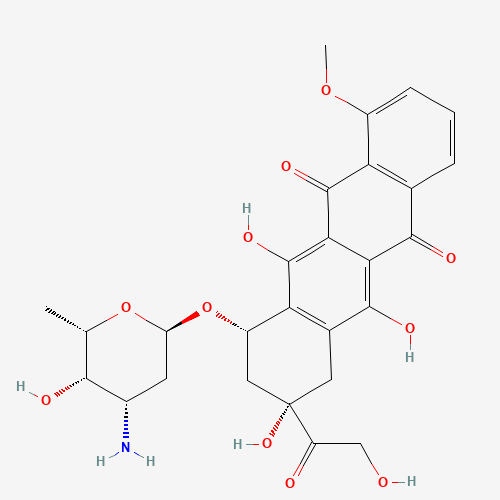
Doxorubicin is a primary alpha-hydroxy ketone, a tertiary alpha-hydroxy ketone, a member of p-quinones, a deoxy hexoside, an aminoglycoside, an anthracycline, an anthracycline antibiotic and a member of tetracenequinones. It has a role as an Escherichia coli metabolite. It is functionally related to an Adriamycinone. It is a conjugate base of a doxorubicin(1+). It derives from a hydride of a tetracene.
科学粮草官-词典编辑部,修订于:2026-07-06
Toxicity
ToxicityEcotoxicity Values
EC50; Species: Daphnia magna (Water flea); Concentration: 2.0 mg/L; Effect: immobilization /Conditions of bioassay not specified in source examined/
Fate Summary
ATMOSPHERIC FATE: According to a model of gas/particle partitioning of semivolatile organic compounds in the atmosphere(1), doxorubicin, which has an estimated vapor pressure of 2.5X10⁻²³ mm Hg at 25 °C(SRC), determined from a fragment constant method(2), is expected to exist solely in the particulate phase in the ambient atmosphere. Particulate-phase doxorubicin may be removed from the air by wet or dry deposition(SRC). Doxorubicin absorbs light at wavelengths >290 nm(4), and therefore may be susceptible to direct photolysis by sunlight(SRC).
Soil Adsorption / Mobility
Using a structure estimation method based on molecular connectivity indices(1), the Koc of doxorubicin can be estimated to be 6,000(SRC). According to a classification scheme(2), this estimated Koc value suggests that doxorubicin is expected to be immobile in soil. Estimated values for pKa1, pKa2, and pKa3 of 7.34, 8.46, and 9.46, respectively(3), indicate that this compound will exist almost entirely in the cation form in the environment and cations generally adsorb more strongly to soils containing organic carbon and clay than their neutral counterparts(4).
Environmental Bioconcentration
An estimated BCF of 0.5 was calculated in fish for doxorubicin(SRC), using a log Kow of 1.27(1) and a regression-derived equation(2). According to a classification scheme(3), this BCF suggests the potential for bioconcentration in aquatic organisms is low(SRC).
Volatilization from Water / Soil
Estimated values for pKa1, pKa2, and pKa3 of 7.34, 8.46, and 9.46, respectively(1), indicate that doxorubicin will exist almost entirely in the cation form at pH values of 5 to 9 and therefore volatilization from water or moist soil surfaces is not expected to be an important fate process(2). Doxorubicin is not expected to volatilize from dry soil surfaces(SRC) based upon an estimated vapor pressure of 2.5X10⁻²³ mm Hg(SRC), determined from a fragment constant method(3).
Environmental Abiotic Degradation
Doxorubicin is not expected to undergo hydrolysis in the environment due to the lack of functional groups that hydrolyze under environmental conditions(1). However in an acid environment, doxorubicin breaks up into adriamycinone and daunosamine(2). Doxorubicin absorbs light at wavelengths >290 nm(3), and therefore may be susceptible to direct photolysis by sunlight(SRC).
Environmental Water Concentrations
The literature suggests that some pharmaceutically active compounds originating from human and veterinary therapy are not eliminated completely in municipal sewage treatment plants and are therefore discharged into receiving waters(1). Wastewater treatment processes often were not designed to remove them from the effluent(2). Selected organic waste compounds may be degrading to new and more persistent compounds that may be released instead of or in addition to the parent compound(2). /Pharmaceuticals/
Milk Concentrations
Doxorubicin was excreted in the milk of one lactating patient, with peak milk concentration at 24 hours after treatment being approximately 4.4-fold greater than the corresponding plasma concentration. Doxorubicin was detectable in the milk up to 72 hours after therapy with 70 mg/sq m of doxorubicin given as a 15-minute intravenous infusion and 100 mg/sq m of cisplatin as a 26-hour intravenous infusion. The peak concentration of doxorubicinol in milk at 24 hours was 0.11 ug/mL and AUC up to 24 hours was 9.0 ug.hr/mL while the AUC for doxorubicin was 5.4 ug.hr/mL.
Ecotoxicity Excerpts
/AQUATIC SPECIES/ The fate and effects of cytostatic (anticancer or antineoplastic) pharmaceuticals in the environment are largely unknown, but they can contaminate wastewater treatment effluents and consequently aquatic ecosystems. In this paper, we have focused on five cytostatic compounds used in high amounts (cyclophosphamide, cisplatin, 5-fluorouracil, doxorubicin, and etoposide), and we have investigated their ecotoxicity in bacterial Pseudomonas putida growth-inhibition test, algal Pseudokirchneriella subcapitata growth-inhibition test, and Daphnia magna acute immobilization test. Genotoxicity also was assessed with Escherichia coli SOS-chromotest (with and without metabolic activation) and the GreenScreen Assay using yeast S. cerevisiae. All tested compounds showed significant e...
Effluent Concentrations
Doxorubicin is estimated to be present in a Swiss hospital wastewater effluent at a mean concentration of 0.09 ug/L(1).
Artificial Pollution Sources
Doxorubicin's production and use as an antineoplastic(1) may result in its release to the environment through various waste streams(SRC).
Probable Routes of Human Exposure
/PRECAUTIONS FOR ANTINEOPLASTIC AGENTS:/ The danger to health-care personnel from handling a hazardous drug stems from a combination of its inherent toxicity and the extent to which workers are exposed to the drug in the course of carrying out their duties. This exposure may be through inadvertent ingestion of the drug on foodstuffs (eg, workers' lunches), inhalation of drug dusts or droplets or direct skin contact. /Antineoplastic agents/
Environmental Fate / Exposure Summary
Doxorubicin's production and use as an antineoplastic may result in its release to the environment through various waste streams. Doxorubicin is isolated from the bacterium Streptomyces peucetius var. caesius following chemical mutation. If released to air, an estimated vapor pressure of 2.5X10⁻²³ mm Hg at 25 °C indicates doxorubicin will exist solely in the particulate phase in the atmosphere. Particulate-phase doxorubicin will be removed from the atmosphere by wet or dry deposition. Doxorubicin absorbs light at wavelengths >290 nm, and therefore may be susceptible to direct photolysis by sunlight. If released to soil, doxorubicin is expected to have no mobility based upon an estimated Koc of 6,000. Estimated values for pKa1, pKa2, and pKa3 of 7.34, 8.46, and 9.46, respectively, indica...
Symptoms
The most common side effects from antibiotics are diarrhea, nausea, vomiting. Fungal infections of the mouth, digestive tract and vagina can also occur with antibiotics
Treatment
Treatment of acute overdosage consists of treatment of the severely myelosuppressed patient with hospitalization, antibiotics, platelet and granulocyte transfusions, and symptomatic treatment of mucositis. (L1712)
Toxicity Data
LD50: 21 800 ug/kg (Subcutaneous, Rat) (A308)
Health Effects
Antibiotic resistance
Adverse Effects
Doxorubicin-induced irreversible cardiomyopathy occurs within a few months of the end of treatment but has also been reported to occur up to twenty years after treatment termination. Congestive heart failure may also occur. Risk factors for doxorubicin-induced congestive heart failure include a higher cumulative drug dose, extremes of age, combination chemotherapy with other cardiotoxic drugs, pre-existing left ventricular dysfunction, hypertension, and previous radiation to the mediastinal region. When congestive heart failure develops after doxorubicin administration, the 1-year mortality rate is approximately 50%.
Exposure Routes
Parenteral (intravenous)
Toxicity Summary
Doxorubicin has antimitotic and cytotoxic activity through a number of proposed mechanisms of action: Doxorubicin forms complexes with DNA by intercalation between base pairs, and it inhibits topoisomerase II activity by stabilizing the DNA-topoisomerase II complex, preventing the religation portion of the ligation-religation reaction that topoisomerase II catalyzes.
Carcinogen Classification
2A, probably carcinogenic to humans. (L135)
Drug Induced Liver Injury
References: DOI:10.1016/j.drudis.2019.09.022
Evidence for Carcinogenicity
Adriamycin (Doxorubicin Hydrochloride): reasonably anticipated to be a human carcinogen. /Doxorubicin Hydrochloride/
Antidote and Emergency Treatment
/SRP:/ Advanced treatment: Consider orotracheal or nasotracheal intubation for airway control in the patient who is unconscious, has severe pulmonary edema, or is in severe respiratory distress. Positive-pressure ventilation techniques with a bag valve mask device may be beneficial. Consider drug therapy for pulmonary edema ... . Consider administering a beta agonist such as albuterol for severe bronchospasm ... . Monitor cardiac rhythm and treat arrhythmias as necessary ... . Start IV administration of D5W /SRP: "To keep open", minimal flow rate/. Use 0.9% saline (NS) or lactated Ringer's if signs of hypovolemia are present. For hypotension with signs of hypovolemia, administer fluid cautiously. Watch for signs of fluid overload ... . Treat seizures with diazepam or lorazepam ... . Use...
Effects During Pregnancy and Lactation
A telephone follow-up study was conducted on 74 women who received cancer chemotherapy at one center during the second or third trimester of pregnancy to determine if they were successful at breastfeeding postpartum. Only 34% of the women were able to exclusively breastfeed their infants, and 66% of the women reported experiencing breastfeeding difficulties. This was in comparison to a 91% breastfeeding success rate in 22 other mothers diagnosed during pregnancy, but not treated with chemotherapy. Other statistically significant correlations included: 1. mothers with breastfeeding difficulties had an average of 5.5 cycles of chemotherapy compared with 3.8 cycles among mothers who had no difficulties; and 2. mothers with breastfeeding difficulties received their first cycle of chemothera...









