


 一键配货
一键配货
化合物详情
CAS23696-28-8
分子式C12H13N3O4
分子量263.25 g/mol g/mol
危化品
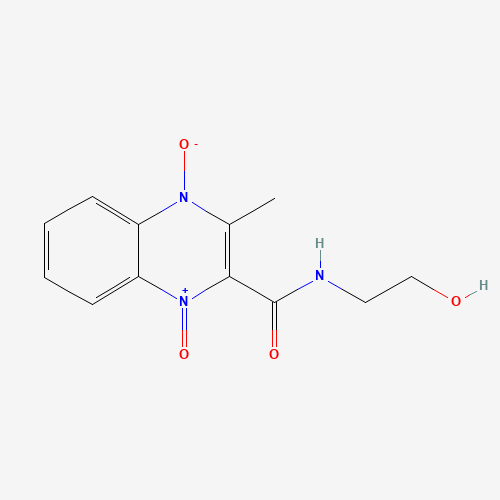
Olaquindox [BAN:INN] is a quinoxaline derivative.
科学粮草官-词典编辑部,修订于:2026-07-06
Toxicity
ToxicityEcotoxicity Values
LD50; Species: Ctenopharyngodon idella (Grass Carp); Conditions: freshwater, injection; Concentration: 959.5 mg/kg bw /formulation/
Fate Summary
ATMOSPHERIC FATE: According to a model of gas/particle partitioning of semivolatile organic compounds in the atmosphere(1), olaquindox, which has an estimated vapor pressure of 3.0X10⁻¹⁴ mm Hg at 25 °C(SRC), determined from a fragment constant method(2), is expected to exist solely in the particulate phase. Particulate-phase olaquindox may be removed from the air by wet and dry deposition(SRC). Olaquindox absorbs UV light at 375 nm(3) and, therefore, may be susceptible to direct photolysis by sunlight(SRC).
Soil Adsorption / Mobility
Olaquindox exhibited measured Koc values of 104, 116, 86 and 46 in sandy loam (Askov; clay 11.3%, silt 10.7%, fine sand 37.9% OC 1.6%, pH 6.1); sandy loam (Flakkebjerg; clay 16.9%, silt 19.1%, fine sand 38.5% OC 1.1%, pH 5.6); sand (Lundgaard; clay 5.2%, silt 4.8%, fine sand 24.4% OC 1.4%, pH 5.6) and loamy sand (Borris; clay 5.8%, silt 8.7%, fine sand 42.6% OC 1.5%, pH 6.3), respectively(1). According to a classification scheme(2), these Koc values suggest that olaquindox is expected to have high to very high mobility in soil(SRC). Log Kd values of 1.31 and 0.08 have been measured in pig manure and sandy soil-sandy loam soil, respectively(3). Another study reported Kd values of 0.007 in Lundgaard and Askov soils(4).
Environmental Biodegradation
[Table#6639]: IlNvaWwgdHlwZSIsIiUgT0M7IHBIOyAldy93IGNsYXksIHNpbHQsIGZpbmUgc2FuZCIsIiUgbWFudXJlIiwiSGFsZi1saWZlIChkYXlzKSIKIkFrc292IiwiMS42OyA2Ljc4OyAwLjExMywgMC4xMDcsIDAuNDc5IiwiMCIsIjYuMzsgNS45IgoiQXNrb3YiLCIiLCIxIiwiNy4xOyA4LjgiCiJBc2xrb3YiLCIiLCIxMCIsIjguNzsgNy4wIgoiTHVuZGdhYXJkIiwiMS40OyA2LjM0OyAwLjA1MiwgMC4wNDgsIDAuMjQ0IiwiMCIsIm5vdCBkZXRlcm1pbmVkOyA1LjgiCiJMdW5kZ2FhcmQiLCIiLCIxIiwiNi4zOyA2LjYiCiJMdW5kZ2FhcmQiLCIiLCIxMCIsIjcuNTsgNi4wIgo=
Environmental Bioconcentration
An estimated BCF of 3 was calculated in fish for olaquindox(SRC), using an estiamted log Kow of -2.13(1) and a regression-derived equation(1). According to a classification scheme(2), this BCF suggests the potential for bioconcentration in aquatic organisms is low(SRC).
Volatilization from Water / Soil
The Henry's Law constant for olaquindox is estimated as 1.4X10⁻²⁷ atm-cu m/mole(SRC) using a fragment constant estimation method(1). This Henry's Law constant indicates that olaquindox is expected to be essentially nonvolatile from water or moist soil surfaces(2). Olaquindox is not expected to volatilize from dry soil surfaces(SRC) based upon an estimated vapor pressure of 3.0X10⁻¹⁴ mm Hg(SRC), determined from a fragment constant method(3).
Environmental Abiotic Degradation
Olaquindox may undergo hydrolysis in the environment due to the presence of functional groups that hydrolyze under environmental conditions(1). Olaquindox absorbs UV light at 375 nm(2) and, therefore, may be susceptible to direct photolysis by sunlight(SRC). After 10 hours exposure to day light, 10 mg/L of olaquindox in aqueous solution was completely removed and several metabolites were formed(3).
Ecotoxicity Excerpts
/AQUATIC SPECIES/ The acute and chronic toxicity of nine antibiotics used both therapeutically and as growth promoters in intensive farming was investigated on the freshwater crustacean Daphnia magna. The effect of the antibiotics metronidazole (M), olaquindox (OL), oxolinic acid (OA), oxytetracycline (OTC), streptomycin (ST), sulfadiazine (SU), tetracycline (TC), tiamulin (TI) and tylosin (TY) was tested in accordance to the ISO (1989) and OECD (1996) standard procedures. The acute toxicities (48-hr EC50 value, mg/L) in decreasing order were OA (4.6), TI (40), SU (221), ST (487), TY (680) and OTC (approximately 1000). NOECs were 340 mg/L for TC and 1000 mg/L for M and OL. Toxic effect on reproduction occurred generally at concentrations, which were one order of magnitude below the acut...
Effluent Concentrations
Olaquindox was tested for but not detected in effluents from 8 waste water treatment plants located in five Canadian cities, specifically the Greater Vancouver Regional District, British Columbia; Calgary, Alberta; Burlington, Peterborough and Windsor, Ontario; sampling was conducted in 2002(1).
Artificial Pollution Sources
Olaquindox's production may result in its release to the environment through various waste streams(SRC). Its use as a growth stimulant fed to pigs(1) will result in its direct release to the environment through the use of swine manure as fertilizer on farm fields(SRC).
Probable Routes of Human Exposure
Occupational exposure to olaquindox may occur through inhalation and dermal contact with this compound at workplaces where olaquindox is produced or used(SRC). The general population exposure via ingestion of food-producing animals fed olaquindox should be low or non-existent; the drug is rapidly metabolized in animals and intended to be withheld from finisher feeds(1,2)
Environmental Fate / Exposure Summary
Olaquindox's production may result in its release to the environment through various waste streams. Its use as a growth stimulant fed to pigs will result in its direct release to the environment through the use of swine manure as fertilizer on farm fields. If released to air, an estimated vapor pressure of 3.0X10⁻¹⁴ mm Hg at 25 °C indicates olaquindox will exist solely in the particulate phase in the atmosphere. Particulate-phase olaquindox will be removed from the atmosphere by wet and dry deposition. Olaquindox absorbs UV light at 375 nm and, therefore, may be susceptible to direct photolysis by sunlight. If released to soil, olaquindox is expected to have very high to high mobility based upon a Koc range of 46-116. Volatilization from moist soil surfaces is not expected to be an impo...
Lethal Dose
collection=toxvaldb&kind=^LD$
Adverse Effects
Dermatotoxin - PACD (photoallergic contact dermatitis).
Toxicity Summary
IDENTIFICATION AND USE: Olaquindox, an antibiotic belonging to the quinoxaline group, is a growth promoter used in pig breeding. HUMAN EXPOSURE AND TOXICITY: There has been reports of both allergic contact dermatitis and photocontact dermatitis following occupational exposure to olaquindox. A farmer developed a photoallergic contact eczema to olaquindox, which progressed to a persistent light reaction. In another case, olaquindox caused a photoallergic contact eczema and subsequently a chronic photosensitive dermatitis with increased UV-A- and UV-B-sensitivity in a breeder of small pigs. ANIMAL STUDIES: Male mice were given oral doses of 2500-5000 mg/kg bw olaquindox. Only 1/10 mice died at the lowest dose used while 100% lethality was noted at the highest dose. Signs of toxicity includ...
Human Toxicity Excerpts
/CASE REPORTS/ The antibiotic olaquindox, an ingredient added to porker feed to increase overall performance, caused a photoallergic contact eczema and subsequently a chronic photosensitive dermatitis with increased UV-A- and UV-B-sensitivity in a breeder of small pigs. Through the use of sun creams he developed an additional (photo)allergic contact eczema to the sunscreens contained in the creams.
Non-Human Toxicity Values
LD50 Rabbit (male + female) oral 1000-2000 mg/kg bw
Non-Human Toxicity Excerpts
/LABORATORY ANIMALS: Acute Exposure/ Groups of two rabbits, each presumably 1 male and 1 female, were dosed orally with olaquindox in 2% methylcarboxycellulose. No deaths occurred at the lowest dose of 500 mg/kg bw while in those given 1000 or 2000 mg/kg b.w., 1/2 animals died. All the animals given 4000 mg/kg bw died. Similar observations were made in groups of two cats given 500, 1000 or 2000 mg/kg bw, with both animals given the highest dose dying. Emesis was the main toxicological sign noted. Dogs given oral doses of up to 100 mg/kg bw olaquindox showed no signs of toxicity but those given 250-2000 vomited; no lethalities occurred. Vehicle controls or undosed animals did not appear to have been used in these studies.
Antidote and Emergency Treatment
Emergency and supportive measures. 1. Maintain an open airway and assist ventilation if necessary. 2. Treat coma, seizures, hypotension, anaphylaxis, and hemolysis if they occur. 3. replace fluid losses resulting from gastroenteritis with IV crystalloids. 4. Maintain steady urine flow with fluids to alleviate crystalluria from overdoses of sulfonamides, ampicillin, or amoxicillin. /Antibacterial agents/









