

 一键配货
一键配货
化合物详情
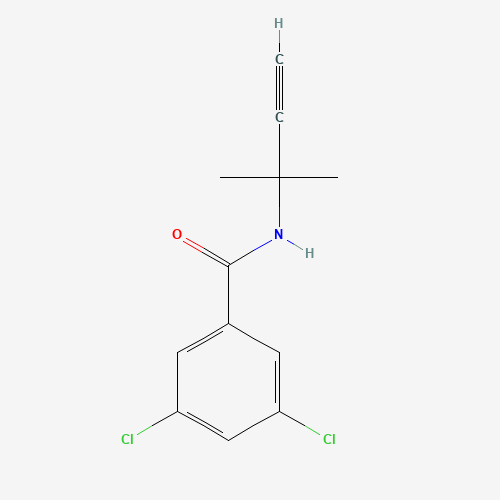
CAS23950-58-5
分子式C12H11Cl2NO
分子量256.13 g/mol
非危品
Pronamide can cause cancer according to The Environmental Protection Agency (EPA).
科学粮草官-词典编辑部,修订于:2026-07-06
Toxicity
ToxicityEPA Ecotoxicity
Pesticide Ecotoxicity Data from EPA: 59
Soil Adsorption / Mobility
Very little leaching of pronamide occurs in most soil types as it is readily adsorbed on organic matter and other colloidal exchange sites(1). Adsorption distribution experiments with 18 different soil types has shown that, in general, pronamide adsorption increases proportionately with an increase in organic matter content(2). Soil partition coefficients were measured for pronamide in seven soils (organic carbon ranged from 0.01-16.9%; pH from 5.2-7.2); Kd values ranged from 0.04-72.2 with higher values corresponding to soils with higher organic carbon content(Koc values of 400-427(SRC))(3). Koc values of 204(4) and 800(5) were measured in soil for this compound. Pronamide had a pesticide leaching potential index value of 36 out of 100 indicating that this pesticide is not likely to le...
Environmental Biodegradation
Pronamide is degraded via both biotic and abiotic pathways to a number of transformation products in soils. Initial transformation reactions in soil include cyclization to form 2-(3,5-dichlorophenyl)-4,4-dimethyl-5-methyleneoxazoline followed by hydrolysis to N-(1,1-dimethylacetonyl)-3,5-dichlorobenzamide(1). These two transformation products and small amounts of unchanged pronamide represented over 96% of the herbicide recovered 90 days after soil treatment(1). Other degradation products were present in trace amounts and were the result of alterations in the terminal carbons of the propynyl side chain(1). Bioassays of soils treated with pronamide have demonstrated the presence of significant residues after six to seven months(1). Pronamide had increasingly rapid initial biodegradation...
Environmental Bioconcentration
Pronamide has measured BCF values from 6-20(1). An estimated BCF value of 135 was calculated for pronamide(SRC), using an experimental log Kow of 3.43(2) and a recommended regression-derived equation(3). According to a classification scheme(4), these BCF values suggest that bioconcentration in aquatic organisms is low(SRC).
Volatilization from Water / Soil
The Henry's Law constant for pronamide is estimated as 1.9X10⁻⁶ atm-cu m/mole(SRC) from its experimental values for vapor pressure, 8.5X10⁻⁵ mm Hg(1), and water solubility, 15 mg/L(2). This value indicates that pronamide will volatilize from water surfaces(3,SRC). Based on this Henry's Law constant, the volatilization half-life from a model river (1 m deep, flowing 1 m/sec, wind velocity of 3 m/sec) is estimated as approximately 31 days(3,SRC). The volatilization half-life from a model lake (1 m deep, flowing 0.05 m/sec, wind velocity of 0.5 m/sec) is estimated as approximately 230 days(3,SRC). Pronamide's values for vapor pressure(1) and Henry's Law constant(1,2,SRC) indicate that volatilization from dry and moist soil should not occur(SRC). However, volatilization of pronamide from so...
Environmental Abiotic Degradation
The ultraviolet absorption spectra of pronamide in ethanol solution exhibits an absorption maxima at about 280 nm with a band extending into the environmentally significant region above 290 nm(1) indicating a potential for direct photolysis in sunlight(SRC). Based on laboratory experiments, some loss of pronamide due to photodecomposition on soil surfaces may occur(2). A photodegradation half-life of approximately 180 hours was reported for pronamide on a bentonite support(3). Pronamide has an acid hydrolysis rate constant of 4.3X10⁻³/M hr, a neutral hydrolysis rate constant of <1.5X10⁻⁵/M hr, and a base hydrolysis rate constant of 7.4X10⁻²/M hr(4). Chemical cyclization of pronamide to 2-(3,5-dichlorophenyl)-4,4-dimethyl-5-methyleneoxazoline has been observed in soil and in aqueous solu...
Environmental Water Concentrations
GROUNDWATER: Groundwater from the Granta catchment in eastern England did not contain measurable quantities of pronamide although it had been applied to crop surfaces(1).
Food Survey Values
Pronamide was detected during monitoring of imported and domestic pears at unreported concentrations (1992-1993)(1). Pronamide was detected during the FDA's program for monitoring pesticide residues in raw agricultural commodities from 1978-82(2) and 1983-86(3), 1989(4), and 1990(5) (unreported concentration).
Natural Pollution Sources
Pronamide is not known to occur naturally. (SRC)
Atmospheric Concentrations
URBAN/SUBURBAN: Pronamide was detected in ambient air in Kitakyushu in 1991-1992 at concentrations from 0.17-0.28 ng/cu m(1).
Artificial Pollution Sources
Pronamide's production and use as a herbicide to control broadleaf and grass weeds(1) results in its direct release to the environment(SRC). This compound is used on alfalfa, apple, artichoke, grape, lettuce, raspberry, and seed crops(2).
Environmental Fate / Exposure Summary
Pronamide is released directly to the environment during its use as a herbicide to control weeds and grasses. If released to soil, pronamide undergoes transformation primarily by cyclization to yield 2-(3,5-dichlorophenyl)-4,4-dimethyl-5-methyleneoxazoline which is subsequently hydrolyzed. This cyclization appears to occur both chemically and microbially, although the transformation is significantly more rapid in the presence of soil microorganisms. Very little leaching will occur in most soil types although some leaching may occur in soils of very low organic content. Loss of pronamide from soil surfaces due to photodecomposition can occur; volatilization from soil surfaces under very hot and dry conditions has been observed. The resultant average persistence of pronamide when applied...
Symptoms
Propyzamide causes local irritation when applied to the skin.
Interactions
ACTIVATED CARBON PROTECTED NEW PLANTINGS OF RYEGRASS, TALL FESCUE, ORCHARD GRASS, KENTUCKY BLUEGRASS AND COLONIAL BENTGRASS AGAINST PRONAMIDE.
Toxicity Data
LD50 (oral, male rat) = 8350 mg/kg bw LD50 (oral, female rat) = 5620 mg/kg bw
Health Effects
Propyzamide is pratically non-toxic to mammals on an acute oral exposure basis., however a 2-generation reproduction study in rats found that propyzamide caused effects on both adult and offspring body size.
Adverse Effects
Occupational hepatotoxin - Secondary hepatotoxins: the potential for toxic effect in the occupational setting is based on cases of poisoning by human ingestion or animal experimentation.
RAIS Toxicity Values
Oral Subchronic Chronic Reference Dose Reference: HEAST Current
Human Toxicity Excerpts
THE WETTABLE POWDER FORMULATION IS ONLY MILDLY IRRITATING TO EYES & SKIN.
Carcinogen Classification
No indication of carcinogenicity to humans (not listed by IARC).
Non-Human Toxicity Values
LD50 Rat (female) oral 5.6 g/kg.
1 or Cancer Risk Level 1E-06
Fraction of Contaminant Absorbed Dermally from Soil: 0.1
Hazard Quotient Level 3 or Cancer Risk Level 1E-04
Fraction of Contaminant Absorbed Dermally from Soil: 0.1
USGS Health-Based Screening Levels for Evaluating Water-Quality
Reference: Smith, C.D. and Nowell, L.H., 2024. Health-Based Screening Levels for evaluating water-quality data (3rd ed.). DOI:10.5066/F71C1TWP