


 一键配货
一键配货
化合物详情
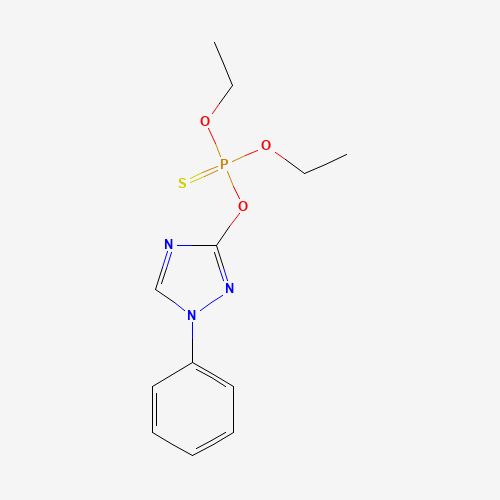
CAS24017-47-8
分子式C12H16N3O3PS
分子量313.31 g/mol g/mol
危化品
Physical Description | Yellowish oil. Used to control insects, mites, and nematodes. Not registered as a pesticide in the U.S. (EPA, 1998)
科学粮草官-词典编辑部,修订于:2026-07-06
Toxicity
ToxicityEcotoxicity Values
LD50; Species: /Coturnix japonica/ (Japanese quail) oral 4.2-27.1 mg/kg
Fate Summary
Triazophos degradation was studied in nine soils. In two different standard German soils, the half-life was calculated to be about 18 days and about 87 days. In nearly all soils, three unidentified cmpds and traces of the hydroxytriazole occurred rapidly and in amounts of 1-6% of the initial radioactivity. 14-CO2 was also recovered.
Soil Adsorption / Mobility
The Koc of triazophos has been reported to be 355(1). According to a classification scheme(2), this Koc value suggests that triazophos is expected to have moderate mobility in soil(SRC). S-type adsorption isotherms were determined for triazophos in two types of soil, a black soil(66.3 meq/100 g soil; 1.65% organic matter; 109.3 sq m/g soil; 29.7 me/100 g soil) and a red soil (1.35 meq/100 g soil; 1.24% organic matter; 23.9 sq m/g soil; 10.4 me/100 g soil)(3). The black soil had higher adsorptive capacity than the red soil; adsorptive strength was greatest for both soils at pH 6-7. Rate constants for the reaction of triazophos with both soils varied from 0.0227-0.0246/min(3). The addition of a 0.2 m water layer over two days to soil columns containing triazophos resulted in no leaching o...
Environmental Biodegradation
AEROBIC: Triazophos, incubated at 22 °C for 64 or 84 days, had half-lives of 17-23 days in five soils, in three soils half-lives were 39-46 days, and in one soil an extrapolated half-life of 87 days(1). Triazophos, incubated at 27 °C in a clay loam soil and in a loam soil, had half-lives of 2 and 5 days, respectively(1). Esterase activity, isolated from a mixed enrichment culture, was able to hydrolyze triazophos with an enzyme activity of 4350 nmol triazophos transformed/min/mg protein(2). It is believed that enzymatic hydrolysis occurs at the aryl P-O bond(3). Half-lives of <35 days were measured for triazophos both in water and in a slurry(4). Over the same time period, <4% of the total theoretical CO2 was produced(4).
Environmental Bioconcentration
An estimated BCF of 74 was calculated in fish for triazophos(SRC), using a log Kow of 3.34(1) and a regression-derived equation(2). According to a classification scheme(3), this BCF suggests the potential for bioconcentration in aquatic organisms is moderate(SRC).
Volatilization from Water / Soil
The Henry's Law constant for triazophos is estimated as 3.1X10⁻⁸ atm-cu m/mole(SRC) derived from its vapor pressure, 2.9X10⁻⁶ mm Hg(1), and water solubility, 39 mg/L(1). This Henry's Law constant indicates that triazophos is expected to be essentially nonvolatile from moist soil and water surfaces(2). Triazophos is not expected to volatilize from dry soil surfaces(SRC) based upon its vapor pressure(1).
Environmental Water Concentrations
RAIN: Triazophos was detected in five of eight rainwater samples at 0.021 to 0.1 ug/L, samples were taken May to July 1997 in South Holland, Netherlands(1).
Food Survey Values
Triazophos was not detected in grapefruit, lemon, mandarin/clementine, orange, apple, pear, quince, apricot, cherries, peach, nectarine, plum, grape, strawberry, blackberry, hip, boysenberry, elderberry, raspberry, rowanberry, bilberry, red and black current, gooseberry, banana, fig, kiwi, pomegranate, beetroot, carrot, celeriac, horseradish, parsnip, parsley root, radish, garlic, onion, spring onion, tomato, pepper, eggplant, cucumber, melon, watermelon, squash, sweet corn, broccoli, cauliflower, Brussel sprout, white, red, spring, Oxheart or Chinese cabbage, kale, lettuce, spinach, chive, dill, marjoram, oregano, parsley, rosemary, thyme, bean, pea, celery, leek, rhubarb, mushroom, sunflower seed or potato in the 1995-1996 Danish national pesticide monitoring program(1). A market bask...
Milk Concentrations
Triazophos was not detected (detection limit 1 ug/kg) in 298 raw milk samples obtained directly from tank trucks during delivery at nine Italian dairy plants, sampling took place Oct 2004, Jan and May 2005(1).
Ecotoxicity Excerpts
/OTHER TERRESTRIAL SPECIES/ Toxic to bees.
Plant Concentrations
Triazophos levels in wheat grain, and in leaf and stem material were 0.187-1.865, and 3.168-44.506 mg/kg, respectively, in 2003 and 0.023-1.396, and 2.040-12.909, respectively, in 2004(1).
Animal Concentrations
Triazophos was detected in 2% of honeybee samples at concentrations of 0.005 to 0.009 mg/kg, dead bee samples were collected in bags suspended under beehives (only worker bees were analyzed) in the district of Bologna, Italy(1).
Artificial Pollution Sources
Triazophos's production may result in its release to the environment through various waste streams; its use as an insecticide, acaricide or nematicide(1) will result in its direct release to the environment(SRC).
Sediment/Soil Concentrations
SOIL: In the Bangkok area of Thailand, triazophos was detected in the soil of onion fields at 435 to 638 ug/kg at unknown days after application(1). Triazophos was not detected in rice-farming soils adjacent to fruit crops treated with triazophos in Albufera National Park, Valencia, Spain for the period of April 1996 to Nov 1997(2).
Probable Routes of Human Exposure
Occupational exposure to triazophos may occur through inhalation and dermal contact with this compound at workplaces where triazophos is produced or used. Monitoring data indicate that the general population may be exposed to triazophos via ingestion of food containing residues. (SRC)
Other Environmental Concentrations
Triazophos was not detected in 292 samples of 30 types of herbal drug materials from China and Korea(1).
Environmental Fate / Exposure Summary
Triazophos's production may result in its release to the environment through various waste streams; its use as an insecticide, acaricide and nematicide will result in its direct release to the environment. If released to air, a vapor pressure of 2.9X10⁻⁶ mm Hg at 30 °C indicates triazophos will exist in both the vapor and particulate phases in the atmosphere. Vapor-phase triazophos will be degraded in the atmosphere by reaction with photochemically-produced hydroxyl radicals; the half-life for this reaction in air is estimated to be 4 hours. Particulate-phase triazophos will be removed from the atmosphere by wet or dry deposition. Triazophos does not contain chromophores that absorb at wavelengths >290 nm and, therefore, is not expected to be susceptible to direct photolysis by sunlight...
Toxicity Data
LC50 (rat) = 450 mg/m3/4h
Adverse Effects
Other Poison - Organophosphate
Average Daily Intake
Calculated daily ingestion of triazophos was 1.4 ng/person from citrus fruits, 17.8 ng/person from pitted and seedy fruits, and 86 ng/person from vegetables in the Region of Murcia in Spain(1).
Human Toxicity Excerpts
/OTHER TOXICITY INFORMATION/ The clinical signs associated with organophosphorus compound poisoning are due to accumulation of acetylcholine and hence over-stimulation of the parasympathetic nervous system. /Organophosphorus insecticides/
Acceptable Daily Intakes
FAO/WHO ADI: 0.0002 mg/kg









