


 一键配货
一键配货
化合物详情
CAS24579-73-5
分子式C9H20N2O2
分子量188.27 g/mol g/mol
危化品
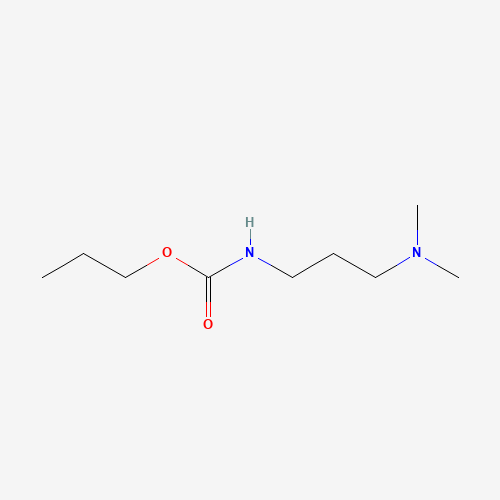
Propamocarb is a carbamate ester that is the propyl ester of 3-(dimethylamino)propylcarbamic acid. It is a systemic fungicide, used (normally as the hydrochloride salt) for the control of soil, root and leaf diseases caused by oomycetes, particularly Phytophthora and Pythium species. It has a role as a xenobiotic, an environmental contaminant and an antifungal agrochemical. It is a carbamate ester, a tertiary amino compound and a carbamate fungicide. It is functionally related to a propan-1-ol.
科学粮草官-词典编辑部,修订于:2026-07-06
Toxicity
ToxicityEPA Ecotoxicity
Pesticide Ecotoxicity Data from EPA: 2
Fate Summary
ATMOSPHERIC FATE: According to a model of gas/particle partitioning of semivolatile organic compounds in the atmosphere(1), propamocarb, which has a vapor pressure of 5.48X10⁻² mm Hg at 25 °C(2), is expected to exist solely as a vapor in the ambient atmosphere. Vapor-phase propamocarb is degraded in the atmosphere by reaction with photochemically-produced hydroxyl radicals(SRC); the half-life for this reaction in air is estimated to be 4 hours(SRC), calculated from its rate constant of 9.9X10⁻¹¹ cu cm/molecule-sec at 25 °C(SRC) that was derived using a structure estimation method(2). Propamocarb is stable to photolysis(2).
Soil Adsorption / Mobility
Using a structure estimation method based on molecular connectivity indices(1), the Koc of propamocarb can be estimated to be 100(SRC). According to a classification scheme(2), this estimated Koc value suggests that propamocarb is expected to have high mobility in soil(SRC). A Koc of 309 was reported for propamocarb hydrochloride(3).
Environmental Biodegradation
PURE CULTURE: 14C-Propamocarb was not biodegraded by any of eleven species of soil microorganisms following incubation for 28 days(1).
Environmental Bioconcentration
An estimated BCF of 2.5 was calculated in fish for propamocarbl(SRC), using a log Kow of 1.12(1) and a regression-derived equation(2). According to a classification scheme(3), this BCF suggests the potential for bioconcentration in aquatic organisms is low(SRC).
Volatilization from Water / Soil
The Henry's Law constant for propamocarb is 1.48X10⁻⁹ atm-cu m/mole(1). This Henry's Law constant indicates that propamocarb is expected to be essentially nonvolatile from water and moist soil surfaces(2). Propamocarb is not expected to volatilize from dry soil surfaces(SRC) based upon a vapor pressure of 5.48X10⁻² mm Hg(1).
Environmental Abiotic Degradation
The rate constant for the vapor-phase reaction of propamocarb with photochemically-produced hydroxyl radicals has been estimated as 9.9X10⁻¹¹ cu cm/molecule-sec at 25 °C(SRC) using a structure estimation method(1). This corresponds to an atmospheric half-life of about 4 hours at an atmospheric concentration of 5X10+5 hydroxyl radicals per cu cm(1). A base-catalyzed second-order hydrolysis rate constant of 4.9X10⁻⁶ L/mole-sec(SRC) was estimated using a structure estimation method(1); this corresponds to half-lives of 4.5X10+4 and 4500 yrs at pH values of 7 and 8, respectively(1). Propamocarb is stable to hydrolysis in the environmen(2). Propamocarb is stable to photolysys(2).
Environmental Water Concentrations
No reports of surface water or ground water monitoring studies that included propamocarb were found in searches of the United States Geological Survey (USGS) online National Water Quality Assessment Data Warehouse (NAWQA) database, nor the EPA publication, EPA Pesticides in Ground Water, A Compilation of Monitoring Studies 1971-1991 National Summary(1).
Fish/Seafood Concentrations
... Propamocarb HCl concentrations varied greatly among species; from 0.530 ug/kg in striped sea bream to 34.170 ug/kg in sea bass. The level of PBO ranged from 0.001 ug/kg for fourlined terapon to 0.013 ug/kg for sardine. No measurable oxamyl residue was found in any of the muscles of sampled fish species (except sardine). ... /Propamocarb hydrochloride/
Artificial Pollution Sources
Propamocarb's production may result in its release to the environment through various waste streams; its use as a fungicide(1) for turf in the US(2) will result in its direct release to the environment(SRC).
Probable Routes of Human Exposure
In order to assess the prevalence of pesticide contamination and the risk of florists' exposure when handling cut flowers, sampling and analysis of 90 bouquets of the most commonly sold cut flowers in Belgium (50 bouquets of roses; 20 of gerberas, and 20 of chrysanthemums) were carried out. The bouquets were collected from 50 florists located in the seven largest cities of Belgium (Antwerp, Brussels, Charleroi, Ghent, Leuven, Liege, and Namur) and from five supermarkets located in the different regions. To have a better understanding of the route of exposure and professional practices a questionnaire was also addressed to a group of 25 florists who volunteered to take part in the survey. All florists were interviewed individually when collecting the questionnaire. The residual pesticide...
Environmental Fate / Exposure Summary
Propamocarb's production may result in its release to the environment through various waste streams; its use as a turf fungicide will result in its direct release to the environment. If released to air, a vapor pressure of 5.48X10⁻² mm Hg at 25 °C indicates propamocarb will exist solely as a vapor in the atmosphere. Vapor-phase propamocarb will be degraded in the atmosphere by reaction with photochemically-produced hydroxyl radicals; the half-life for this reaction in air is estimated to be 4 hrs. Propamocarb is stable to photolysis. If released to soil, propamocarb is expected to have high mobility based upon an estimated Koc of 100. Volatilization from moist soil surfaces is not expected to be an important fate process based upon a Henry's Law constant of 1.48X10⁻⁹ atm-cu m/mole. Prop...
Symptoms
As with organophosphates, the signs and symptoms are based on excessive cholinergic stimulation. Unlike organophosphate poisoning, carbamate poisonings tend to be of shorter duration because the inhibition of nervous tissue acetylcholinesterase is reversible, and carbamates are more rapidly metabolized. Muscle weakness, dizziness, sweating and slight body discomfort are commonly reported early symptoms. Headache, salivation, nausea, vomiting, abdominal pain and diarrhea are often prominent at higher levels of exposure. Contraction of the pupils with blurred vision, incoordination, muscle twitching and slurred speech have been reported. (L795)
Treatment
If the compound has been ingested, rapid gastric lavage should be performed using 5% sodium bicarbonate. For skin contact, the skin should be washed with soap and water. If the compound has entered the eyes, they should be washed with large quantities of isotonic saline or water. In serious cases, atropine and/or pralidoxime should be administered. Anti-cholinergic drugs work to counteract the effects of excess acetylcholine and reactivate AChE. Atropine can be used as an antidote in conjunction with pralidoxime or other pyridinium oximes (such as trimedoxime or obidoxime), though the use of '-oximes' has been found to be of no benefit, or possibly harmful, in at least two meta-analyses. Atropine is a muscarinic antagonist, and thus blocks the action of acetylcholine peripherally.
Interactions
Twenty-four pesticides were tested for interactions with the estrogen receptor (ER) and the androgen receptor (AR) in transactivation assays. Estrogen-like effects on MCF-7 cell proliferation and effects on CYP19 aromatase activity in human placental microsomes were also investigated. Pesticides (endosulfan, methiocarb, methomyl, pirimicarb, propamocarb, deltamethrin, fenpropathrin, dimethoate, chlorpyriphos, dichlorvos, tolchlofos-methyl, vinclozolin, iprodion, fenarimol, prochloraz, fosetyl-aluminum, chlorothalonil, daminozid, paclobutrazol, chlormequat chlorid, and ethephon) were selected according to their frequent use in Danish greenhouses. In addition, the metabolite mercaptodimethur sulfoxide, the herbicide tribenuron-methyl, and the organochlorine dieldrin, were included. Severa...
Health Effects
Acute exposure to cholinesterase inhibitors can cause a cholinergic crisis characterized by severe nausea/vomiting, salivation, sweating, bradycardia, hypotension, collapse, and convulsions. Increasing muscle weakness is a possibility and may result in death if respiratory muscles are involved. Accumulation of ACh at motor nerves causes overstimulation of nicotinic expression at the neuromuscular junction. When this occurs symptoms such as muscle weakness, fatigue, muscle cramps, fasciculation, and paralysis can be seen. When there is an accumulation of ACh at autonomic ganglia this causes overstimulation of nicotinic expression in the sympathetic system. Symptoms associated with this are hypertension, and hypoglycemia. Overstimulation of nicotinic acetylcholine receptors in the central...
Exposure Routes
Inhalation (L793); oral (L793); dermal (L793)
Toxicity Summary
Propamocarb is a cholinesterase or acetylcholinesterase (AChE) inhibitor. Carbamates form unstable complexes with chlolinesterases by carbamoylation of the active sites of the enzymes. This inhibition is reversible. A cholinesterase inhibitor suppresses the action of acetylcholine esterase. Because of its essential function, chemicals that interfere with the action of acetylcholine esterase are potent neurotoxins, causing excessive salivation and eye-watering in low doses. Headache, salivation, nausea, vomiting, abdominal pain and diarrhea are often prominent at higher levels of exposure. Acetylcholine esterase breaks down the neurotransmitter acetylcholine, which is released at nerve and muscle junctions, in order to allow the muscle or organ to relax. The result of acetylcholine ester...
Carcinogen Classification
No indication of carcinogenicity to humans (not listed by IARC).









