


 一键配货
一键配货
化合物详情
CAS24584-09-6
分子式C11H16N4O4
分子量268.27 g/mol g/mol
危化品
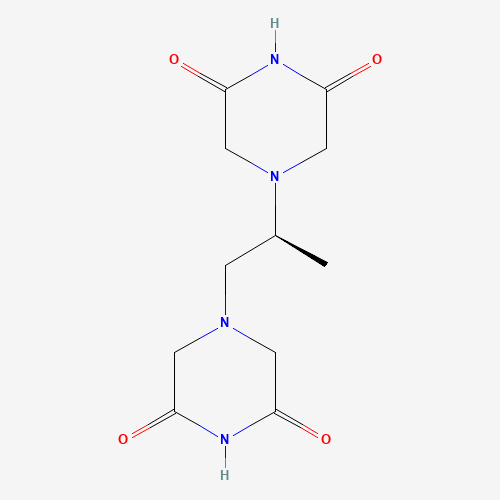
(+)-dexrazoxane is a razoxane. It has a role as a cardiovascular drug, an antineoplastic agent, an immunosuppressive agent and a chelator.
科学粮草官-词典编辑部,修订于:2026-07-06
Toxicity
ToxicityFate Summary
ATMOSPHERIC FATE: According to a model of gas/particle partitioning of semivolatile organic compounds in the atmosphere(1), dexrazoxane, which has an estimated vapor pressure of 2.0X10⁻¹⁵ mm Hg at 25 °C(SRC), determined from a fragment constant method(2), is expected to exist solely in the particulate phase in the ambient atmosphere. Particulate-phase dexrazoxane may be removed from the air by wet and dry deposition(SRC). Dexrazoxane does not contain chromophores that absorb light at wavelengths >290 nm and would not be expected to be susceptible to direct photolysis by sunlight(SRC).
Soil Adsorption / Mobility
The Koc of dexrazoxane is estimated as 24(SRC), using a log Kow of 0.025(1) and a regression-derived equation(2). According to a classification scheme(3), this estimated Koc value suggests that dexrazoxane is expected to have very high mobility in soil.
Environmental Bioconcentration
An estimated BCF of 3.2 was calculated for dexrazoxane(SRC), using a log Kow of 0.025(1) and a regression-derived equation(2). According to a classification scheme(3), this BCF suggests the potential for bioconcentration in aquatic organisms is low(SRC).
Volatilization from Water / Soil
The Henry's Law constant for dexrazoxane is estimated as 2.1X10⁻¹⁹ atm-cu m/mole(SRC) using a fragment constant estimation method(1). This Henry's Law constant indicates that dexrazoxane is expected to be essentially nonvolatile from water surfaces(2). Dexrazoxane is not expected to volatilize from dry soil surfaces(SRC) based upon a an estimated vapor pressure of 2.0X10⁻¹⁵mm Hg(SRC), determined from a fragment constant method(3).
Environmental Abiotic Degradation
Dexrazoxane is not expected to undergo hydrolysis in the environment due to the lack of hydrolyzable functional groups(1). Dexrazoxane does not contain chromophores that absorb light at wavelengths >290 nm and would not be expected to be susceptible to direct photolysis by sunlight(SRC).
Artificial Pollution Sources
Dexrazoxane's production and use as a cardioprotective agent(1) may result in its release to the environment through various waste streams(SRC).
Probable Routes of Human Exposure
Occupational exposure to dexrazoxane may occur through inhalation and dermal contact with this compound at workplaces where dexrazoxane is produced or used. Exposure to the drug among the general population may be limited to those being administered dexrazoxane (a cardioprotective agent). (SRC)
Environmental Fate / Exposure Summary
Dexrazoxane's production and use as a cardioprotective agent may result in its release to the environment through various waste streams. If released to air, an estimated vapor pressure of 2.0X10⁻¹⁵ mm Hg at 25 °C indicates dexrazoxane will exist solely in the particulate phase in the ambient atmosphere. Particulate-phase dexrazoxane will be removed from the atmosphere by wet and dry deposition. Dexrazoxane does not contain chromophores that absorb light at wavelengths >290 nm and would not be expected to be susceptible to direct photolysis by sunlight. If released to soil, dexrazoxane is expected to have very high mobility based upon an estimated Koc of 24. Volatilization from moist soil surfaces is not expected to be an important fate process based upon an estimated Henry's Law constan...
Symptoms
Intraperitoneal, mouse LD<sub>10</sub> = 500 mg/kg. Intravenous, dog LD<sub>10</sub> = 2 gm/kg.
Treatment
There is no known antidote for dexrazoxane. Instances of suspected overdose should be managed with good supportive care until resolution of myelosuppression and related conditions is complete. Management of overdose should include treatment of infections, fluid regulation, and maintenance of nutritional requirements. (L1712)
Interactions
There was no significant change in the pharmacokinetics of doxorubicin (50 mg/sq m ) and its predominant metabolite, doxorubicinol, in the presence of dexrazoxane (500 mg/sq m ) in a crossover study in cancer patients.
Toxicity Data
Intraperitoneal, mouse LD<sub>10</sub> = 500 mg/kg. Intravenous, dog LD<sub>10</sub> = 2 gm/kg.
Adverse Effects
Recently, there have been concerns about the risk, particularly in pediatric patients, with long-term effects of dexrazoxane, who continuously received doses to inhibit cardiotoxicity. Although very sporadic, the incidence of other primary malignancies (myelodysplastic syndrome and acute myeloid leukemia) in the patient group treated with dexrazoxane manifested a threefold increase compared with controls, which researchers documented in two randomized studies.
Exposure Routes
IV administration results in complete bioavailability.
Toxicity Summary
The mechanism by which dexrazoxane exerts its cardioprotective activity is not fully understood. Dexrazoxane is a cyclic derivative of EDTA that readily penetrates cell membranes. Results of laboratory studies suggest that dexrazoxane (a prodrug) is converted intracellularly to a ring-opened bidentate chelating agent that chelates to free iron and interferes with iron-mediated free radical generation thought to be responsible, in part, for anthracycline-induced cardiomyopathy. It should be noted that dexrazoxane may also be protective through its inhibitory effect on topoisomerase II.
Human Toxicity Excerpts
/HUMAN EXPOSURE STUDIES/ There have been no instances of drug overdose in the clinical studies ... The maximum dose administered during the cardioprotective trials was 1000 mg/m 2 every three weeks.
Carcinogen Classification
No indication of carcinogenicity to humans (not listed by IARC).
Non-Human Toxicity Excerpts
/GENOTOXICITY/ Dexrazoxane was not mutagenic in the Ames test but was found to be clastogenic to human lymphocytes in vitro and to mouse bone marrow erythrocytes in vivo (micronucleus test).
Antidote and Emergency Treatment
Advanced treatment: Consider orotracheal or nasotracheal intubation for airway control in the patient who is unconscious, has severe pulmonary edema, or is in respiratory arrest. Positive pressure ventilation techniques with a bag valve mask device may be beneficial. Monitor cardiac rhythm and treat arrhythmias as necessary ... . Start an IV with D5W /SRP: "To keep open", minimal flow rate/. Use lactated Ringer's if signs of hypovolemia are present. Watch for signs of fluid overload. Consider drug therapy for pulmonary edema ... . For hypotension with signs of hypovolemia, administer fluid cautiously. Watch for signs of fluid overload ... . Treat seizures with diazepam (Valium) ... . Use proparacaine hydrochloride to assist eye irrigation ... . /Poison A and B/
Effects During Pregnancy and Lactation
◉ Effects on Lactation and Breastmilk









