


 一键配货
一键配货
化合物详情
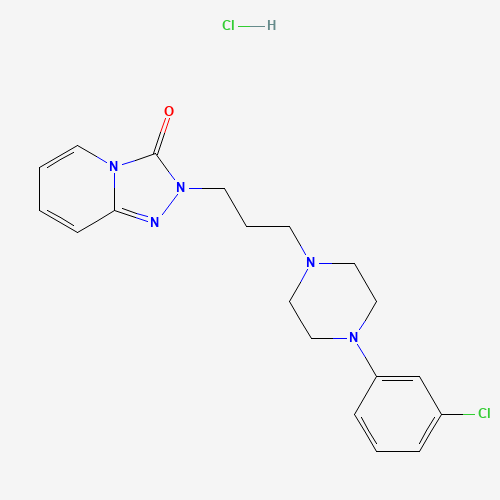
CAS25332-39-2
分子式C19H22ClN5O.HCl
分子量408.32 g/mol g/mol
危化品
Trazodone hydrochloride is a hydrochloride salt prepared from equimolar amounts of trazodone and hydrogen chloride. It has a role as an antidepressant, a sedative, an adrenergic antagonist, a H1-receptor antagonist and a serotonin uptake inhibitor. It contains a trazodone.
科学粮草官-词典编辑部,修订于:2026-07-06
Toxicity
ToxicityTreatment
There is no specific antidote for Trazodone. Treatment should be symptomatic and supportive in the case of hypotension or excessive sedation. Any patient suspected of having taken an overdose should have the stomach emptied by gastric lavage. Forced diuresis may be useful in facilitating elimination of the drug. (L1712)
Toxicity Data
LD50: 96mg/kg (Intravenous, Mouse) (A308)
Exposure Routes
Rapidly and almost completely absorbed following oral administration. Food may decrease the rate and extent of absorption.
Toxicity Summary
Trazodone binds at 5-HT2 receptor, it acts as a serotonin agonist at high doses and a serotonin antagonist at low doses. Like fluoxetine, trazodone's antidepressant activity likely results from blockage of serotonin reuptake by inhibiting serotonin reuptake pump at the presynaptic neuronal membrane. If used for long time periods, postsynaptic neuronal receptor binding sites may also be affected. The sedative effect of trazodone is likely the result of alpha-adrenergic blocking action and modest histamine blockade at H1 receptor. It weakly blocks presynaptic alpha2-adrenergic receptors and strongly inhibits postsynaptic alpha1 receptors. Trazodone does not affect the reuptake of norepinephrine or dopamine within the CNS.
Carcinogen Classification
No indication of carcinogenicity to humans (not listed by IARC).
Drug Induced Liver Injury
References: DOI:10.1016/j.drudis.2016.02.015









