


 一键配货
一键配货
化合物详情
CAS26225-79-6
分子式C13H18O5S
分子量286.34 g/mol
非危品
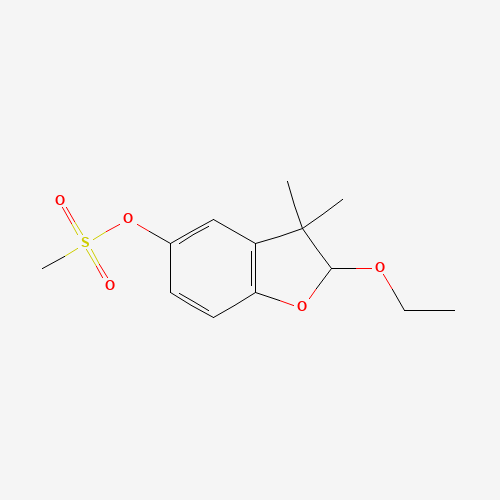
2-ethoxy-3,3-dimethyl-2,3-dihydro-1-benzofuran-5-yl methanesulfonate is a methanesulfonate ester that is methanesulfonic acid in which the hydrogen of the hydroxy group has been replaced by a 2-ethoxy-3,3-dimethyl-2,3-dihydro-1-benzofuran-5-yl group. It is a methanesulfonate ester, an ether and a member of 1-benzofurans.
科学粮草官-词典编辑部,修订于:2026-07-06
Toxicity
ToxicityEPA Ecotoxicity
Pesticide Ecotoxicity Data from EPA: 82
Fate Summary
ATMOSPHERIC FATE: According to a model of gas/particle partitioning of semivolatile organic compounds in the atmosphere(1), ethofumesate, which has a vapor pressure of 4.9X10⁻⁶ mm Hg at 25 °C(2), is expected to exist in both the vapor and particulate phases in the ambient atmosphere. Vapor-phase ethofumesate is degraded in the atmosphere by reaction with photochemically-produced hydroxyl radicals(SRC); the half-life for this reaction in air is estimated to be 7 hours(SRC), calculated from its rate constant of 5.3X10⁻¹¹ cu cm/molecule-sec at 25 °C(SRC) that was derived using a structure estimation method(3). Particulate-phase ethofumesate will be removed from the atmosphere by wet and dry deposition. The photodegradation half-life of ethofumesate was reported as 28 to 31 hours in aqueous...
Soil Adsorption / Mobility
The Koc value of ethofumesate measured in 10 different soils ranged from 55 to 500, with a mean value of 213(1). According to a classification scheme(2), these Koc values suggest that ethofumesate is expected to have high to moderate mobility in soil(SRC).
Environmental Biodegradation
AEROBIC: The microbial dissipation half-life of ethofumesate in soils under aerobic conditions was reported to range from 83 to 253 days(1). The 50% dissipation time (DT50) of ethofumesate in a sediment/water microcosm was reported as 125 days(2). The half-life of ethofumesate in soil at 22 to 25 °C was reported as 45 days(3).
Environmental Bioconcentration
An estimated BCF of 24 was calculated for ethofumesate(SRC), using a log Kow of 2.7(1) and a regression-derived equation(2). According to a classification scheme(3), this BCF suggests the potential for bioconcentration in aquatic organisms is low(SRC).
Volatilization from Water / Soil
The Henry's Law constant for ethofumesate is estimated as 3.7X10⁻⁸ atm-cu m/mole(SRC) derived from its vapor pressure, 4.9X10⁻⁶ mm Hg(1), and water solubility, 50 mg/L(2). This Henry's Law constant indicates that ethofumesate is expected to be essentially nonvolatile from water surfaces(3). Ethofumesate's estimated Henry's Law constant indicates that volatilization from moist soil surfaces is not expected to be an important environmental fate process(SRC). Ethofumesate is not expected to volatilize from dry soil surfaces(SRC) based on its vapor pressure(1).
Environmental Abiotic Degradation
The rate constant for the vapor-phase reaction of ethofumesate with photochemically-produced hydroxyl radicals has been estimated as 5.3X10⁻¹¹ cu cm/molecule-sec at 25 °C(SRC) using a structure estimation method(1). This corresponds to an atmospheric half-life of about 7 hours at an atmospheric concentration of 5X10+5 hydroxyl radicals per cu cm(1). Ethofumesate is stable to hydrolysis at pH 5, 7, and 9(2). The photodegradation half-life of ethofumesate was reported as 28 to 31 hours in aqueous solution and 165 hours in soil(2). The hydrolysis half-life of ethofumesate was reported as 940 days at pH 9(3).
Environmental Water Concentrations
RAIN/SNOW: Ethofumesate was detected in rainfall in the Axios River Basin, Greece at concns ranging from 0.003 to 0.38 ug/L, and a mean concn of 0.05 ug/L(1).
Artificial Pollution Sources
Ethofumesate's production may result in its release to the environment through various waste streams; it's use as an herbicide(1) will result in its direct release to the environment(SRC). Ethofumesate is currently registered for use on sugar beets, garden beets, table beets, carrots and various turf uses, including grass seed, sod and ornamental turf(1). It is also registered for use in seed production of Swiss Chard and spinach(1).
Probable Routes of Human Exposure
Occupational exposure to ethofumesate may occur through inhalation of dusts or dermal contact with this compound at workplaces where it is produced or used as an herbicide(SRC). The general public will be exposed to ethofumesate via dermal or through ingestion of contaminated drinking water(1).
Environmental Fate / Exposure Summary
Ethofumesate's production may result in its release to the environment through various waste streams; it's use as an herbicide will result in its direct release to the environment. If released to air, a vapor pressure of 4.9X10⁻⁶ mm Hg at 25 °C indicates ethofumesate will exist in both the vapor and particulate phases in the ambient atmosphere. Vapor-phase ethofumesate will be degraded in the atmosphere by reaction with photochemically-produced hydroxyl radicals; the half-life for this reaction in air is estimated to be 7 hours. Particulate-phase ethofumesate will be removed from the atmosphere by wet and dry deposition. Ethofumesate absorbs light greater than 290 nm and may be susceptible to direct photolysis in the atmosphere. If released to soil, ethofumesate is expected to have mode...
Toxicity Data
LC50 (rat) >3,970 mg/m3/4H
RAIS Toxicity Values
Oral Chronic Reference Dose Reference: OPP
Human Toxicity Excerpts
/OTHER TOXICITY INFORMATION: GENOTOXICITY/ A study of cytogenetic changes in Yugoslavian pesticide applicators was conducted. The cohort consisted of 27 male growers, mean age 39 years, in the Yugoslavian vineyard industry. They applied pesticide mixtures that contained herbicides such as ethofumesate and 2,4-D, fungicides such as triadimefon, vinclozolin, and cineb, and the insecticide diazinon. Controls consisted of 15 male school teachers from a nearby town, mean age 42.31 yr, and 20 males, mean age 38.9 yr, from Belgrade University. All subjects were nonsmokers. Blood samples were collected from the subjects before the start of the spraying season, after 1 month of spraying, and at the end of the spraying season. The lymphocytes were harvested from the samples and scored for chromos...
Carcinogen Classification
No indication of carcinogenicity to humans (not listed by IARC).
Non-Human Toxicity Values
LC50 Rat inhalation >3.97 mg/L air/4 hr
Antidote and Emergency Treatment
Advanced treatment: Consider orotracheal or nasotracheal intubation for airway control in the patient who is unconscious, has severe pulmonary edema, or is in severe respiratory distress. Positive-pressure ventilation techniques with a bag valve mask device may be beneficial. Consider drug therapy for pulmonary edema ... . Consider administering a beta agonist such as albuterol for severe bronchospasm ... . Monitor cardiac rhythm and treat arrhythmias as necessary ... . Start IV administration of D5W /SRP: "To keep open", minimal flow rate/. Use 0.9% saline (NS) or lactated Ringer's if signs of hypovolemia are present. For hypotension with signs of hypovolemia, administer fluid cautiously. Watch for signs of fluid overload ... . Treat seizures with diazepam or lorazepam ... . Use propar...









