


 一键配货
一键配货
化合物详情
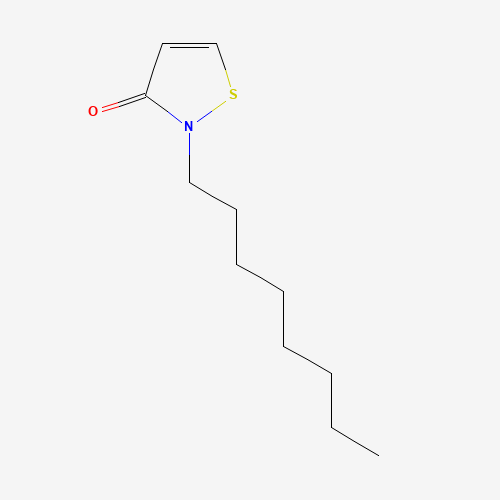
CAS26530-20-1
分子式C11H19NOS
分子量213.34 g/mol
非危品
Physical Description | 2-octyl-3-isothiazolone is a clear dark amber liquid. Used as a fungicide.
科学粮草官-词典编辑部,修订于:2026-07-06
Toxicity
ToxicityEPA Ecotoxicity
Pesticide Ecotoxicity Data from EPA: 34
Fate Summary
ATMOSPHERIC FATE: According to a model of gas/particle partitioning of semivolatile organic compounds in the atmosphere(1), octhilinone, which has a vapor pressure of 2.68X10⁻⁵ mm Hg at 25 °C(2), will exist in both the vapor and particulate phases in the ambient atmosphere. Vapor-phase octhilinone is degraded in the atmosphere by reaction with photochemically-produced hydroxyl radicals(SRC); the half-life for this reaction in air is estimated to be 10 hrs(SRC), calculated from its rate constant of 4.0X10⁻¹¹ cu cm/molecule-sec at 25 °C(SRC) that was derived using a structure estimation method(3). Particulate-phase octhilinone may be removed from the air by wet and dry deposition(SRC). Octhilinone absorbs UV light at wavelength 280 nm(4) and, therefore, is not expected to be susceptible t...
Soil Adsorption / Mobility
Using a structure estimation method based on molecular connectivity indices(1), the Koc of octhilinone can be estimated to be 850(SRC). According to a classification scheme(2), this estimated Koc value suggests that octhilinone is expected to have low mobility in soil(SRC). A Koc of 179.8 at 20 °C has also been reported(3). Octhilinone, at a concentration of 10 ug/L, was <90% absorbed over 6 hours using a German municipal waste water treatment plant activated sludge in a bench-scale test(4).
Environmental Biodegradation
AEROBIC: Octhilinone was confirmed to be biodegradable according to the standard test of the Japanese Ministry of Industry and Trade (MITI) that employs an inoculum obtained from sludge(1). Octhilinone, present at 1 mg/L, was 40-100% biodegraded in 4 weeks using the river die-away test(2). Biodegradation half-lives of 30 days, 360 hrs and 3,240 hours at 20 °C have been reported in soil, water and sediment, respectively(3).
Environmental Bioconcentration
An estimated BCF of 19 was calculated in fish for octhilinone(SRC), using a log Kow of 2.45(1) and a regression-derived equation(2). According to a classification scheme(2), this BCF suggests the potential for bioconcentration in aquatic organisms is low(SRC).
Volatilization from Water / Soil
The Henry's Law constant for octhilinone is estimated as 2.1X10⁻⁸ atm-cu m/mole(SRC) derived from its vapor pressure, 3.68X10⁻⁵ mm Hg(1), and water solubility, 500 mg/L(1). This Henry's Law constant indicates that octhilinone is expected to be essentially nonvolatile from water and moist soil surfaces(2). Octhilinone is not expected to volatilize from dry soil surfaces(SRC) based upon its vapor pressure(1).
Environmental Abiotic Degradation
The rate constant for the vapor-phase reaction of octhilinone with photochemically-produced hydroxyl radicals has been estimated as 4.0X10⁻¹¹ cu cm/molecule-sec at 25 °C(SRC) using a structure estimation method(1). This corresponds to an atmospheric half-life of about 10 hours at an atmospheric concentration of 5X10+5 hydroxyl radicals per cu cm(1). A half-life in air of 3.3 hours has also been reported(2). The rate constant for the vapor-phase reaction of octhilinone with ozone has been estimated as 1.8X10⁻¹⁸ cu cm/molecule-sec at 25 °C(SRC) that was derived using a structure estimation method(1). This corresponds to an atmospheric half-life of about 7 days at an atmospheric concentration of 7X10+11 ozone molecules per cu cm(3). Octhilinone is not expected to undergo hydrolysis in the...
Environmental Water Concentrations
SEAWATER: SeaNine 211, with 4,5-dichloro-2-n-octyl-4-isothiazolin-3-one (DCOIT) being the biocidal ingredient, is a widely-used antifouling agent to deter the undesirable biofouling phenomenon. It is commercially promoted as an environmentally acceptable antifoulant mainly due to its claimed rapid degradation in marine environment. However, increasing researches document varying degradative kinetics in different environments, proving that SeaNine 211 is actually not degraded equally fast around the world (half-life between <1day and 13.1days). Large-scale application of SeaNine 211 in antifouling coatings has also caused global contamination of marine environment in various compartments. For example, accumulation of SeaNine 211 is detected as high as 3700 ng/L in Spanish seawater and 28...
Effluent Concentrations
The emission sources of biocidal active substances in households have been under discussion since these substances have been detected frequently in municipal wastewater and receiving surface water bodies. Therefore, the goal of this study was to investigate the products responsible for the emission of these substances to wastewater. We analysed the wastewater of two streets for a set of biocidal active substances. Time-proportional sampling was conducted for one week of each season during one year in each street. The 14 substances analysed with liquid chromatography coupled with tandem mass spectrometry were 1,2-benzisothiazol-3(2H)-one (BIT), C12-benzalkonium chloride, carbendazim, 5-chloro-2-methyl-2H-isothiazol-3-one (CMIT), dichlorooctylisothiazolinone (DCOIT), N,N-diethyl-meta-tolu...
Artificial Pollution Sources
Ochilinone's production may result in its release to the environment through various waste streams; its use as a plant wound protectant, fungicide/bactericide(1) and cooling-tower biocide(2,3) will result in its direct release to the environment(SRC). Octhilinone's production and use as a biocide in paints, cutting oils and for leather preservation(1) may result in its release to the environment through various waste streams(SRC).
Probable Routes of Human Exposure
Occupational exposure to octhilinone may occur through inhalation and dermal contact with this compound at workplaces where octhilinone is produced or used. Use data indicate that the general population may be exposed to octhilinone via dermal contact with consumer products containing octhilinone. (SRC)
Other Environmental Concentrations
Recently, cases of contact dermatitis that were related to the use of polyvinyl alcohol (PVA) cooling towels containing isothiazolinone preservatives were reported in Japan. The aim of this investigation was to analyze the concentrations of five different isothiazolinone compounds present in PVA towels and to assess the effectiveness of washing in removing the preservatives from new towels prior to being used for the first time. Twenty-seven PVA towels were used in this study. Two groups (i.e., laboratory-simulation and volunteer) of washing experiments were conducted to evaluate the effect of washing procedures. Qualitative and quantitative analyses were performed by LC/MS/MS, which detected 2-methyl-4-isothiazolin-3-one (MI) and 5-chloro-2-methyl-4-isothaizolin-3-one (CMI) in 23 sampl...
Environmental Fate / Exposure Summary
Ochilinone's production may result in its release to the environment through various waste streams; its use as a plant wound protectant, fungicide/bactericide and cooling-tower biocide will result in its direct release to the environment. Octhilinone's production and use as a biocide in paints, cutting oils, and for leather preservation may result in its release to the environment through various waste streams. If released to air, a vapor pressure of 3.68X10⁻⁵ mm Hg at 25 °C indicates octhilinone will exist in both the vapor and particulate phases in the atmosphere. Vapor-phase octhilinone will be degraded in the atmosphere by reaction with photochemically-produced hydroxyl radicals; the half-life for this reaction in air is estimated to be 10 hrs. Particulate-phase octhilinone will be...
Toxicity Data
LC (rat) > 2,000 mg/m3
Adverse Effects
Skin Sensitizer - An agent that can induce an allergic reaction in the skin.
Toxicity Summary
IDENTIFICATION AND USE: Octhilinone is used as fungicide, and biocide in cooling-tower water, paints, cutting oils, cosmetics and shampoo, as well as for leather preservation. HUMAN STUDIES: Severe allergic contact dermatitis from a paint mildewcide, octhilinone, developed in a worker formulating latex paints within a paint manufacturing company. An outbreak of severe itching, erythematous and edematous dermatitis over the extremities and upper back developed in 8 of 17 workers in the raw-materials department of a paint manufacturing factory. ANIMAL STUDIES: Guinea pig maximization testing demonstrated this to be a moderate sensitizer. No teratogenic response reported in developmental studies in rats. Octhilinone induced chromosomal aberrations in Chinese hamster ovary cells with and wi...
Human Toxicity Excerpts
/EPIDEMIOLOGY STUDIES/ 2-N-octyl-4-isothiazolin-3-one (OIT) is an antimicrobial agent that is mainly used in industrial settings. The objective of the study was to find the significance of OIT contact allergy at our clinic of occupational dermatology. We looked through our patient material from 1991 for allergic reactions to OIT and analyzed the clinical records. We found 8 patients with ordinary allergic reactions to OIT and 1 late reaction. 2 workers in the manufacture of paints had occupational allergic contact dermatitis from OIT in biocides. 2 patients were machinists and 3 were female farmers: in these cases, however, we could not find any exposure. A sewing machine operator had patch test reactions to 2 of her mattress textiles, and chemical analysis of them showed 40-50 parts pe...
Non-Human Toxicity Values
LD50 Rat oral 550 mg/kg
Non-Human Toxicity Excerpts
/ALTERNATIVE and IN VITRO TESTS/ Monoacylglycerol lipase (MGL) is a presynaptic serine hydrolase that inactivates the endocannabinoid neurotransmitter, 2-arachidonoyl-sn-glycerol. Recent studies suggest that cysteine residues proximal to the enzyme active site are important for MGL function. In the present study, we characterize the role of cysteines in MGL function and identify a series of cysteine-reactive agents that inhibit MGL activity with nanomolar potencies by interacting with cysteine residue 208. A series of cysteine traps were screened for the ability to inhibit MGL in vitro. Rapid dilution assays were performed to determine reversibility of inhibition. Molecular modelling and site-directed mutagenesis were utilized to identify cysteine residues targeted by the inhibitors. Th...
Antidote and Emergency Treatment
/SRP:/ Advanced treatment: Consider orotracheal or nasotracheal intubation for airway control in the patient who is unconscious, has severe pulmonary edema, or is in severe respiratory distress. Positive-pressure ventilation techniques with a bag valve mask device may be beneficial. Consider drug therapy for pulmonary edema ... . Consider administering a beta agonist such as albuterol for severe bronchospasm ... . Monitor cardiac rhythm and treat arrhythmias as necessary ... . Start IV administration of D5W TKO /SRP: "To keep open", minimal flow rate/. Use 0.9% saline (NS) or lactated Ringer's (LR) if signs of hypovolemia are present. For hypotension with signs of hypovolemia, administer fluid cautiously. Watch for signs of fluid overload ... . Treat seizures with diazepam (Valium) or l...









