


 一键配货
一键配货
化合物详情
CAS26787-78-0
分子式C16H19N3O5S
分子量365.4 g/mol g/mol
危化品
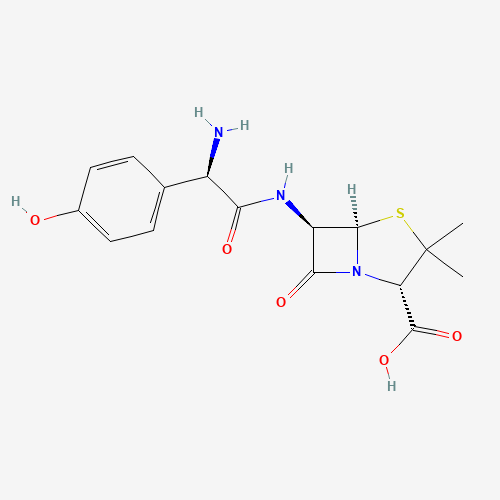
Amoxicillin is a penicillin in which the substituent at position 6 of the penam ring is a 2-amino-2-(4-hydroxyphenyl)acetamido group. It has a role as an antibacterial drug. It is a penicillin and a penicillin allergen. It is a conjugate acid of an amoxicillin(1-).
科学粮草官-词典编辑部,修订于:2026-07-06
Toxicity
ToxicityBody Burden
It has been reported that 60% of amoxicillin ingested is excreted in urine from the human body(1).
Fate Summary
ATMOSPHERIC FATE: According to a model of gas/particle partitioning of semivolatile organic compounds in the atmosphere(1), amoxicillin, which has an estimated vapor pressure of 4.7X10⁻¹⁷ mm Hg at 25 °C(SRC), determined from a fragment constant method(2), is expected to exist solely in the particulate phase in the ambient atmosphere. Particulate-phase amoxicillin may be removed from the air by wet and dry deposition(SRC). Amoxicillin contains chromophores that absorb at wavelengths >290 nm(4) and, therefore, may be susceptible to direct photolysis by sunlight(SRC).
Soil Adsorption / Mobility
Using a structure estimation method based on molecular connectivity indices(1), the Koc of amoxicillin can be estimated to be 100(SRC). According to a classification scheme(2), this estimated Koc value suggests that amoxicillin is expected to have high mobility in soil. An estimated Koc of 865.0 was reported in sludge(3).
Environmental Biodegradation
PURE CULTURE: Amoxicillin was shown to be biodegradable by Bacillis cereus, Enterobacter ludmigii and Enterobacter sp. strains which have previously been shown to biodegrade crude oil(1).
Environmental Bioconcentration
An estimated BCF of 3 was calculated in fish for amoxicillin(SRC), using a log Kow of 0.87(1) and a regression-derived equation(2). According to a classification scheme(3), this BCF suggests the potential for bioconcentration in aquatic organisms is low(SRC).
Volatilization from Water / Soil
The Henry's Law constant for amoxicillin is estimated as 2.5X10⁻²¹ atm-cu m/mole(SRC) using a fragment constant estimation method(1). This Henry's Law constant indicates that amoxicillin is expected to be essentially nonvolatile from water and moist soil surfaces(2). Amoxicillin is not expected to volatilize from dry soil surfaces(SRC) based upon an estimated vapor pressure of 4.7X10⁻¹⁷ mm Hg(SRC), determined from a fragment constant method(3).
Environmental Abiotic Degradation
Amoxicillin is expected to undergo hydrolysis in the environment due to the presence of functional groups that hydrolyze under environmental conditions(1). Completed mineralization by hydrolysis has been reported using the two biodegradability tests(2). Hydroylsis rate constants of 1.46X10⁻³/hr and 3.7X10⁻³/hr at pH 5.5 amd 7.5, respectively, were reported(3). Amoxicillin absorbs UV light at wavelengths >290 nm(3) and, therefore, may be susceptible to direct photolysis by sunlight(SRC). Predicted photolysis half-lives of 9 and 2 days in winter and summer (Naples, Italy), respectively, have been calculated(3). Amoxicillin, present at 10 mg/L, was removed easily in two biological wastewater reclamation systems, <0.15 and 0.10 mg/L in outflow; removal was attributed in part to bacterial hy...
Environmental Water Concentrations
SURFACE WATER: Amoxicillin was not detected in surface water samples from The Netherlands tested from 1996 to 2005(1). The compound was tested for but not detected in samples from the Lambro and Po Rivers, Italy(2). However, the compound was reported to have a mean detection frequency in river systems of 29.8%, with a median concentration of 59.9 ng/L, based on 5 observations(3). Amoxicillin was tested for but not detected in water samples from 18 sites from 8 north-central and northwestern Arkansas streams tested during March, April and August 2004(4).
Milk Concentrations
Because amoxicillin is distributed into milk and may lead to sensitization of infants, the drug should be used with caution in nursing women. Because of its general safety in infants, the CDC states that amoxicillin is an option for anti-infective prophylaxis in breast-feeding women when Bacillus anthracis is known to be penicillin susceptible and there is no contraindication to maternal amoxicillin use.
Ecotoxicity Excerpts
/AQUATIC SPECIES/ In aquaculture, disinfection of facilities, prevention of fish diseases, and stimulation of fish growth are priority goals and the most important sources of toxic substances to the environment, together with excretory products from fish. In the present study, embryos of two species of sea urchin (Paracentrotus lividus and Arbacia lixula) were exposed to serial dilutions of six antibiotics (amoxicillin (AMOX), ampicillin, flumequine (FLU), oxytetracycline (OTC), streptomycin (ST), and sulfadiazine [SFD]) and two disinfectants (sodium hypochlorite (NaClO) and formaldehyde [CH(2)O]). Alterations in larval development were studied, and the effective concentrations (ECs) were calculated to evaluate the toxicity of the substances. Both species showed similar sensitivities to...
Plant Concentrations
Amoxicillin, present at 1 mg/kg soil, was not detected in carrots and lettuce grown on light loamy sand soil (90.14% sand, 6.26% silt, 3.60% clay, pH 6.3, 0.4% organic carbon; Church Warsop, Nottinghamshire, UK collected in summer 2004); the study simulated soil treated with manure from animals administered veterinary medicines(1).
Effluent Concentrations
Based on an annual consumption of 198,086.80 kg/yr, the estimated amoxycillin elimination from primary and secondary treatment processes was 0.27 and 88%, respectively, from wastewater facilities in Spain in 2009, giving a predicted environmental occurrence of 326.70 ng/L. A measured value of 40 ng/L was reported for an unspecified aquatic environment(1). Amoxicillin was not detected in effluent or industrial wastewater samples from The Netherlands tested in 2002(2). The median influent and effluent loads of six wastewater treatment plants in Italy were 13 mg/day/1000 inhabitants and not detected, respectively, sampled in winter and summer 2004(3). The compound was present at a median concentration of 4.7 ng/L in effluent from 9 sewage treatment plants in Italy(4).
Fish/Seafood Concentrations
Amoxicillin was tested for but not detected in Australian farmed yellowtail kingfish (Seriola lalandi) and mulloway (Argyrosomus hololepidotus), from operations located in Arno Bay and Whyalla in the Spencer Gulf region of South Australia, sampled between Spet 2003 and July 2004(1).
Artificial Pollution Sources
Amoxicillin's production and administration as an antibiotic(1) may result in its release to the environment through various waste streams(SRC).
Probable Routes of Human Exposure
Occupational exposure to amoxicillin may occur through inhalation and dermal contact with this compound at workplaces where amoxicillin is produced or used. The general public is not likely to be exposed to amoxicillin unless by direct medical treatment. (SRC)
Environmental Fate / Exposure Summary
Amoxicillin's production and administration as an antibiotic may result in its release to the environment through various waste streams. If released to air, an estimated vapor pressure of 4.7X10⁻¹⁷ mm Hg at 25 °C indicates amoxicillin will exist solely in the particulate phase in the atmosphere. Particulate-phase amoxicillin will be removed from the atmosphere by wet and dry deposition. Amoxicillin absorbs UV light at wavelengths >290 nm and, therefore, may be susceptible to direct photolysis by sunlight. If released to soil, amoxicillin is expected to have high mobility based upon an estimated Koc of 100. Volatilization from moist soil surfaces is not expected to be an important fate process based upon an estimated Henry's Law constant of 2.5X10⁻²¹ atm-cu m/mole. Amoxicillin is not exp...
Hepatotoxicity
Likelihood score: B (highly likely but rare cause of clinically apparent liver injury).
Adverse Effects
High urine concentrations of amoxicillin can cause false-positive reactions in urine glucose tests using certain detection methods. Clinicians should consider using alternative enzymatic glucose oxidase-based tests.
Toxicity Summary
* Individuals should contact a poison control center at 1-800-222-1222 for updated information about an amoxicillin overdose.
Drug Induced Liver Injury
References: DOI:10.1016/j.drudis.2019.09.022
Populations at Special Risk
Prior studies have suggested an increased risk of oral clefts after exposure to amoxicillin in early pregnancy, but findings have been inconsistent. Among participants in the Slone Epidemiology Center Birth Defects Study from 1994 to 2008, we identified 877 infants with cleft lip with/without cleft palate and 471 with cleft palate alone. Controls included 6952 nonmalformed infants. Mothers were interviewed about demographic, reproductive and medical factors, and details of medication use. We estimated odds ratios (ORs) and 95% confidence intervals (CIs) associated with use of amoxicillin in the first trimester using conditional logistic regression and adjusting for known risk factors for oral clefts, as well as for infections, fever, and concomitant treatments. In the control group, 2.1...
Effects During Pregnancy and Lactation
A study of 25 breastfeeding mothers who had been taking amoxicillin for at least 2 days, with infants older than 4 weeks had 75 milk samples collected at multiple time points following amoxicillin administration. No impact was reported on maternal milk supply.









