


 一键配货
一键配货
化合物详情
CAS26839-75-8
分子式C13H24N4O3S
分子量316.42 g/mol
非危品
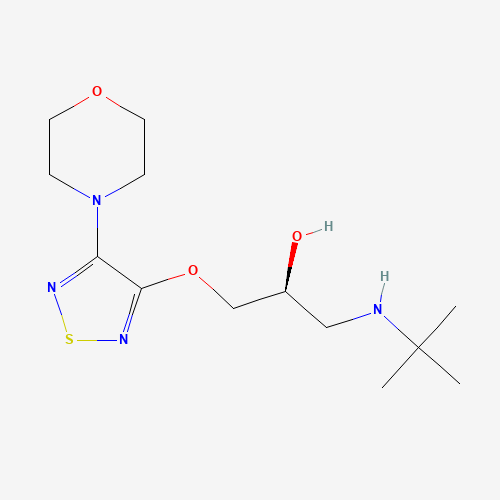
(S)-timolol (anhydrous) is the (S)-() (more active) enantiomer of timolol. A beta-adrenergic antagonist, both the hemihydrate and the maleate salt are used in the mangement of glaucoma, hypertension, angina pectoris and myocardial infarction, and for the prevention of migraine. It has a role as a beta-adrenergic antagonist, an antihypertensive agent, an anti-arrhythmia drug and an antiglaucoma drug. It is a conjugate base of a (S)-timolol(1+). It is an enantiomer of a (R)-timolol.
科学粮草官-词典编辑部,修订于:2026-07-06
Toxicity
ToxicityBody Burden
Timolol is distributed into milk.
Fate Summary
ATMOSPHERIC FATE: According to a model of gas/particle partitioning of semivolatile organic compounds in the atmosphere(1), timolol, which has an estimated vapor pressure of 1.4X10⁻⁸ mm Hg at 25 °C(SRC), determined from a fragment constant method(2), is expected to exist solely in the particulate phase in the ambient atmosphere. Particulate-phase timolol may be removed from the air by wet and dry deposition(SRC).
Soil Adsorption / Mobility
The Koc of timolol is estimated as 240(SRC), using a log Kow of 1.83(1) and a regression-derived equation(2). According to a classification scheme(3), this estimated Koc value suggests that timolol is expected to have moderate mobility in soil.
Environmental Bioconcentration
An estimated BCF of 1 was calculated for timolol(SRC), using a log Kow of 1.83(1) and a regression-derived equation(2). According to a classification scheme(3), this BCF suggests the potential for bioconcentration in aquatic organisms is low(SRC).
Volatilization from Water / Soil
The Henry's Law constant for timolol is estimated as 4.3X10⁻¹⁷ atm-cu m/mole(SRC) using a fragment constant estimation method(1). This Henry's Law constant indicates that timolol is expected to be essentially nonvolatile from water surfaces(2). Timolol's Henry's Law constant indicates that volatilization from moist soil surfaces is not expected to occur(SRC). Timolol is not expected to volatilize from dry soil surfaces(SRC) based upon an estimated vapor pressure of 1.4X10⁻⁸ mm Hg(SRC), determined from a fragment constant method(3).
Environmental Abiotic Degradation
Timolol is not expected to undergo hydrolysis in the environment due to the lack of hydrolyzable functional groups(1). A pKa of 9.21 has been reported(2) indicating that this compound will exist mainly as the protonated species at environmental pH values of 5 to 9(SRC).
Environmental Water Concentrations
Timolol was detected at concentrations of <0.003 to 0.010 ug/l in surface waters collected at several locations(1).
Milk Concentrations
Timolol is distributed into milk.
Effluent Concentrations
Timolol was detected at concentrations of <0.025 to 0.07 ug/l in sewage effluents at numerous locations(1).
Artificial Pollution Sources
Timolol's production and use as a pharmaceutical drug(1) may result in its release to the environment through various waste streams(SRC).
Probable Routes of Human Exposure
NIOSH (NOES Survey 1981-1983) has statistically estimated that 339 workers (100 of these are female) are potentially exposed to timolol in the US(1). Occupational exposure to timolol may occur through inhalation of dust and dermal contact with this compound at workplaces where timolol is produced or used(SRC). The general population may be exposed to timolol via ingestion of medicine and occular application of this compound and other consumer products containing timolol(SRC).
Environmental Fate / Exposure Summary
Timolol's production and use as a pharmaceutical drug may result in its release to the environment through various waste streams. If released to air, an estimated vapor pressure of 1.4X10⁻⁸ mm Hg at 25 °C indicates timolol will exist solely in the particulate phase in the ambient atmosphere. Particulate-phase timolol will be removed from the atmosphere by wet and dry deposition. If released to soil, timolol is expected to have moderate mobility based upon an estimated Koc of 240. Volatilization from moist soil surfaces is not expected to be an important fate process based upon an estimated Henry's Law constant of 4.3X10⁻¹⁷ atm-cu m/mole. Timolol is not expected to volatilize from dry soil surfaces based upon its vapor pressure. If released into water, timolol is not expected to adsorb t...
Hepatotoxicity
Likelihood score: E (unlikely cause of clinically apparent acute liver injury).
Adverse Effects
Clonidine: Beta-blockers may worsen rebound hypertension after clonidine withdrawal and should be discontinued several days before tapering off clonidine. Beta-blocker therapy may be resumed several days after stopping clonidine.
Toxicity Summary
The first step in managing β-blocker overdose is to secure the airway and administer cardiac life support if needed. Oxygen and bronchodilators can be used to treat patients with bronchospasm. Atropine should be given to patients experiencing bradycardia or requiring rapid intubation. Sodium bicarbonate and magnesium sulfate may also prove useful in managing the patient’s cardiac symptoms. IV fluids, including dextrose, glucagon, and calcium salts, can be used to treat the patient’s metabolic symptoms. High-dose insulin is used for managing shock caused by β-blocker overdose. Benzodiazepines can be a first-line treatment for any seizures the patient may experience. Gastrointestinal decontamination or administration of activated charcoal can help reduce the absorption of the β-blocker in...
Human Toxicity Excerpts
/SIGNS AND SYMPTOMS/ As with other beta-adrenergic blocking agents, symptomatic bradycardia, hypotension, bronchospasm, and acute cardiac failure may occur with timolol overdosage.
Drug Induced Liver Injury
References: DOI:10.1016/j.drudis.2019.09.022
Non-Human Toxicity Values
LD50 Rat female 900 mg/kg /Timolol maleate/
Antidote and Emergency Treatment
/SRP:/ Advanced treatment: Consider orotracheal or nasotracheal intubation for airway control in the patient who is unconscious, has severe pulmonary edema, or is in respiratory arrest. Positive pressure ventilation techniques with a bag valve mask device may be beneficial. Monitor cardiac rhythm and treat arrhythmias as necessary ... . Start an IV with D5W /SRP: "To keep open", minimal flow rate/. Use lactated Ringer's if signs of hypovolemia are present. Watch for signs of fluid overload. Consider drug therapy for pulmonary edema ... . For hypotension with signs of hypovolemia, administer fluid cautiously. Watch for signs of fluid overload ... . Treat seizures with diazepam (Valium) ... . Use proparacaine hydrochloride to assist eye irrigation ... . /Poison A and B/
Effects During Pregnancy and Lactation
Relevant published information on the effects of beta-blockade or timolol during normal lactation was not found as of the revision date. A study in 6 patients with hyperprolactinemia and galactorrhea found no changes in serum prolactin levels following beta-adrenergic blockade with propranolol.









