


 一键配货
一键配货
化合物详情
CAS27203-92-5
分子式C16H25NO2
分子量263.38 g/mol
非危品
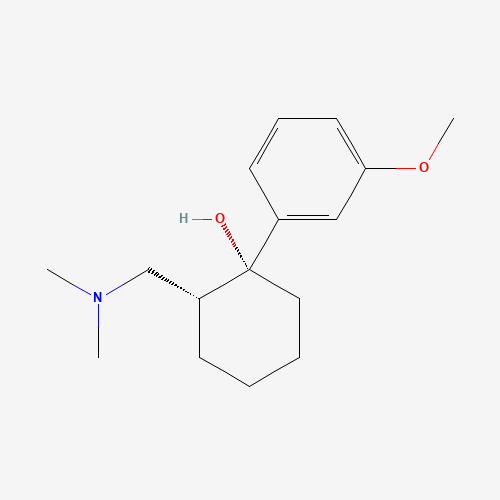
(R,R)-tramadol is a 2-[(dimethylamino)methyl]-1-(3-methoxyphenyl)cyclohexanol in which both stereocentres have R-configuration; the (R,R)-enantiomer of the racemic opioid analgesic tramadol, it exhibits ten-fold higher analgesic potency than the (S,S)-enantiomer. It has a role as a metabolite, an opioid analgesic, an adrenergic uptake inhibitor, a serotonergic antagonist, a muscarinic antagonist, a nicotinic antagonist, a serotonin uptake inhibitor, an antitussive, a mu-opioid receptor agonist, a kappa-opioid receptor agonist, a NMDA receptor antagonist, a delta-opioid receptor agonist and a capsaicin receptor antagonist. It is a conjugate base of a (R,R)-tramadol(1+). It is an enantiomer of a (S,S)-tramadol.
科学粮草官-词典编辑部,修订于:2026-07-06
Toxicity
ToxicityBody Burden
... In the peripheral blood, tramadol was measured in a concn of 9.6 mg/l exceeded at least 30-times the normal therapeutic range of 0.1-0.3 mg/l. ... /Salt not specified/
Fate Summary
ATMOSPHERIC FATE: According to a model of gas/particle partitioning of semivolatile organic compounds in the atmosphere(1), tramadol, which has an estimated vapor pressure of 4.6X10⁻⁷ mm Hg at 25 °C(SRC), determined from a fragment constant method(2), will exist in both the vapor and particulate phases in the ambient atmosphere. Vapor-phase tramadol is degraded in the atmosphere by reaction with photochemically-produced hydroxyl radicals(SRC); the half-life for this reaction in air is estimated to be 1 hour(SRC), calculated from its rate constant of 1.5X10⁻¹⁰ cu cm/molecule-sec at 25 °C(SRC) that was derived using a structure estimation method(3). Particulate-phase tramadol may be removed from the air by wet and dry deposition(SRC). A photodegradation half-life of 3.7 days in water unde...
Soil Adsorption / Mobility
A log Koc of 2.79 (Koc 616) Kd value of 22 L/kg was reported using an agricultural soil (pH 6.3) from Corrstown, Co Dublin, Ireland(1). According to a classification scheme(2), this Koc value suggests that tramadol is expected to have low mobility in soil. The estimated pKa1 of tramadol is 9.23(3), indicating that this compound will exist almost entirely in the cation form in the environment and cations generally adsorb more strongly to soils containing organic carbon and clay than their neutral counterparts(4). Sorption isotherms (Kd, L/kg) of 1.1X10+2 and 1.9X10+2 have been reported using primary and secondary sludge, respectively, from the Klagshamn waste water treatment plant in Malmo City, Sweden(5).
Environmental Bioconcentration
An estimated BCF of 25 was calculated in fish for tramadol(SRC), using an estimated log Kow of 3.01(1) and a regression-derived equation(1). According to a classification scheme(2), this BCF suggests the potential for bioconcentration in aquatic organisms is low(SRC).
Volatilization from Water / Soil
An estimated pKa of 9.23(1) indicates tramadol will exist almost entirely in the cation form at pH values of 5 to 9 and, therefore, volatilization from water surfaces is not expected to be an important fate process. Tramadol is not expected to volatilize from dry soil surfaces(SRC) based upon an estimated vapor pressure of 4.6X10⁻⁷ mm Hg(SRC), determined from a fragment constant method(2).
Environmental Water Concentrations
SURFACE WATER: Tramadol was present at a range of <25 to 381 ng/L in a river near Hesse, Germany sampled between January and September, 2010; detection limit = 25 ng/L(1,2). Over a 10-month testing period, tramadol was detected in surface waters (max concentration 7731 ng/L(5,6)) from the River Taff and the River Ely in South Wales, UK as a result of wastewater treatment plant discharge(3,4). Tramadol was detected at a range of <30-5,970 ng/L in unspecified surface water samples(5). Tramadol is one of the top 61 most freqently studied pharmaceutical in freshwater ecosystems, with a median concentration of 80.6 ng/L from 5 observations, and a detection frequency of 87.0%(6).
Effluent Concentrations
The presence of the anesthetic lidocaine (LDC), the analgesic tramadol (TRA), the antidepressant venlafaxine (VEN) and the metabolites O-desmethyltramadol (ODT) and O-desmethylvenlafaxine (ODV) was investigated in wastewater treatment plant (WWTP) effluents, in surface waters and in groundwater. The analytes were detected in all effluent samples and in only 64% of the surface water samples. The mean concentrations of the analytes in effluent samples from WWTPs with wastewater from only households and hospitals were 107 (LDC), 757 (TRA), 122 (ODT), 160 (VEN) and 637 ng L(-1) (ODV), while the mean concentrations in effluents from WWTPs treating additionally wastewater from pharmaceutical industries as indirect dischargers were for some pharmaceuticals clearly higher. WWTP effluents were i...
Artificial Pollution Sources
Tramadol's production and administration as an analgesic(1) may result in its release to the environment through various waste streams(SRC).
Probable Routes of Human Exposure
Occupational exposure to tramadol may occur through inhalation and dermal contact with this compound at workplaces where tramadol is produced or used. Monitoring data indicate that the general population may be exposed to tramadol via ingestion of contaminated drinking water. Use data indicate that some of the general public are likely to be exposed to tramadol by direct medical treatment. (SRC)
Environmental Fate / Exposure Summary
Tramadol's production and administration as an analgesic may result in its release to the environment through various waste streams. If released to air, an estimated vapor pressure of 4.6X10⁻⁷ mm Hg at 25 °C indicates tramadol will exist in both the vapor and particulate phases in the atmosphere. Vapor-phase tramadol will be degraded in the atmosphere by reaction with photochemically-produced hydroxyl radicals; the half-life for this reaction in air is estimated to be 1 hour. Particulate-phase tramadol will be removed from the atmosphere by wet and dry deposition. A photodegradation half-life of 3.7 days in water under natural sunlight conditions suggests that tramadol may be susceptible to direct photolysis by sunlight since. If released to soil, tramadol is expected to have low mobili...
Symptoms
Overdose symptoms of a tramadol overdose may include drowsiness, shallow breathing, slow heartbeat, extreme weakness, cold or clammy skin, feeling light-headed, fainting, or coma. (L1328)
Treatment
In treating an overdose, primary attention should be given to maintaining adequate ventilation along with general supportive treatment. While naloxone will reverse some, but not all, symptoms caused by overdosage with ULTRAM, the risk of seizures is also increased with naloxone administration. (L1712)
Toxicity Data
LD50: 300-350 mg/kg (Oral, Rat) (A2833)
Health Effects
Serious potential consequences of overdosage are respiratory depression, lethargy, coma, seizure, cardiac arrest and death. The respiratory depressant effects include carbon dioxide retention and secondary elevation of cerebrospinal fluid pressure, and may be markedly exaggerated in these patients (RxList, A308). Medical problems can include congested lungs, liver disease, tetanus, infection of the heart valves, skin abscesses, anemia and pneumonia. Death can occur from overdose.
Hepatotoxicity
Likelihood score: E* (unproven cause of liver injury in therapeutic doses but reported to cause liver injury with overdose).
Adverse Effects
Anticholinergic drugs: The concomitant use of anticholinergics with opioids may increase the risk of urinary retention and paralytic ileus.
Exposure Routes
Inhalation. Racemic tramadol is rapidly and almost completely absorbed after oral administration. The mean absolute bioavailability of a 100 mg oral dose is approximately 75%. The mean peak plasma concentration of racemic tramadol and M1 occurs at two and three hours, respectively, after administration in healthy adults.
Toxicity Summary
Tramadol and its O-desmethyl metabolite (M1) are selective, weak OP3-receptor agonists. Opiate receptors are coupled with G-protein receptors and function as both positive and negative regulators of synaptic transmission via G-proteins that activate effector proteins. As the effector system is adenylate cyclase and cAMP located at the inner surface of the plasma membrane, opioids decrease intracellular cAMP by inhibiting adenylate cyclase. Subsequently, the release of nociceptive neurotransmitters such as substance P, GABA, dopamine, acetylcholine and noradrenaline is inhibited. The analgesic properties of Tramadol can be attributed to norepinephrine and serotonin reuptake blockade in the CNS, which inhibits pain transmission in the spinal cord. The (+) enantiomer has higher affinity fo...
Carcinogen Classification
No indication of carcinogenicity to humans (not listed by IARC).
Drug Induced Liver Injury
References: DOI:10.1016/j.drudis.2019.09.022
Effects During Pregnancy and Lactation
Use or misuse of opioids in general has been shown to lower fertility in males. Studies have not been done to see if a male's use of tramadol could increase the chance of birth defects above the background risk. In general, exposures that fathers or sperm donors have are unlikely to increase the risks to a pregnancy. For more information, please see the MotherToBaby fact sheet Paternal Exposures at https://mothertobaby.org/fact-sheets/paternal-exposures-pregnancy/.
USGS Health-Based Screening Levels for Evaluating Water-Quality
Reference: Smith, C.D. and Nowell, L.H., 2024. Health-Based Screening Levels for evaluating water-quality data (3rd ed.). DOI:10.5066/F71C1TWP









