


 一键配货
一键配货
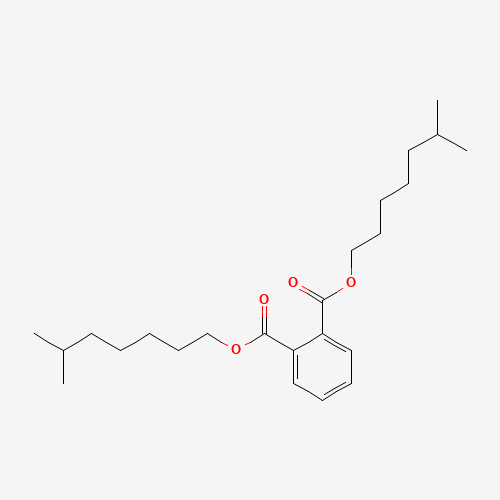
化合物详情
CAS27554-26-3
分子式C24H38O4
分子量390.56 g/mol
非危品
Physical Description | Di-isooctyl phthalate is an oily colorless liquid with a slight ester odor. Denser than water. Insoluble in water. (USCG, 1999)
科学粮草官-词典编辑部,修订于:2026-07-06
Toxicity
ToxicityFate Summary
ATMOSPHERIC FATE: According to a model of gas/particle partitioning of semivolatile organic compounds in the atmosphere(1), diisooctyl phthalate, which has a vapor pressure of 5.5X10⁻⁶ mm Hg at 25 °C(2), will exist in both the vapor and particulate phases in the ambient atmosphere. Vapor-phase diisooctyl phthalate is degraded in the atmosphere by reaction with photochemically-produced hydroxyl radicals(SRC); the half-life for this reaction in air is estimated to be 19 hours(SRC), calculated from its rate constant of 2.1X10⁻¹¹ cu cm/molecule-sec at 25 °C(SRC) that was derived using a structure estimation method(3). Particulate-phase diisooctyl phthalate may be removed from the air by wet or dry deposition(SRC). Diisooctyl phthalate does contain chromophores that absorb at wavelengths >29...
Soil Adsorption / Mobility
The Koc of diisooctyl phthalate is estimated as 1.6X10+4(SRC), using a water solubility of 0.09 mg/L(1) and a regression-derived equation(2). According to a classification scheme(3), this estimated Koc value suggests that diisooctyl phthalate is expected to be immobile in soil.
Environmental Biodegradation
AEROBIC: Microorganisms isolated from raw sewage and sludge were capable of utilizing diisooctyl phthalate as a growth medium(1,2). Enriched microbial cultures obtained from sewage degraded 75% diisooctyl phthalate in 96 hours(2). A shake flask experiment employing an acclimated inoculum of soil, sewage and activated sludge degraded 99% of diisooctyl phthalate initially present over a 28 day incubation period(3). In a semi-continuous activated sludge test (Soap and Detergent Association procedure), the mean percentage degradation for diisooctyl phthalate was 84.5% in 24 hours(4). Diisooctyl phthalate incubated for 28 days in fresh water/sediment degraded 2, <1-10, and 4% at 12, 22, and 28 °C, respectively(5).
Environmental Bioconcentration
A measured BCF value of 207 was reported for Mosquito fish exposed to 6.4 mg/L of diisooctyl phthalate over an unspecified exposure period(1). According to a classification scheme(2), this BCF value suggests that bioconcentration in aquatic organisms is high, assuming the compound is not metabolized by the organism(SRC). However, bioconcentration studies on compounds which are structurally similar suggest that bioconcentration may be lower than that indicated by the regression-derived equations due to the ability of aquatic organisms to readily metabolize this class of compounds(3).
Volatilization from Water / Soil
The Henry's Law constant for diisooctyl phthalate is estimated as 3.1X10⁻⁵ atm-cu m/mole(SRC) derived from its vapor pressure, 5.5X10⁻⁶ mm Hg(1), and water solubility, 0.09 mg/L(1). This Henry's Law constant indicates that diisooctyl phthalate is expected to volatilize from water surfaces(2). Based on this Henry's Law constant, the volatilization half-life from a model river (1 m deep, flowing 1 m/sec, wind velocity of 3 m/sec)(2) is estimated as 2.5 days(SRC). The volatilization half-life from a model lake (1 m deep, flowing 0.05 m/sec, wind velocity of 0.5 m/sec)(2) is estimated as 25 days(SRC). However, volatilization from water surfaces is expected to be attenuated by adsorption to suspended solids and sediment in the water column. The estimated volatilization half-life from a model...
Environmental Abiotic Degradation
The rate constant for the vapor-phase reaction of diisooctyl phthalate with photochemically-produced hydroxyl radicals has been estimated as 2.1X10⁻¹¹ cu cm/molecule-sec at 25 °C(SRC) using a structure estimation method(1). This corresponds to an atmospheric half-life of about 19 hours at an atmospheric concentration of 5X10+5 hydroxyl radicals per cu cm(1). A base-catalyzed second-order hydrolysis rate constant of 6.4X10⁻² L/mole-sec(SRC) was estimated using a structure estimation method(2); this corresponds to half-lives of 3.4 years and 130 days at pH values of 7 and 8, respectively(2). Diisooctyl phthalate does contain chromophores that absorb at wavelengths >290 nm(3) and therefore may be susceptible to direct photolysis by sunlight(SRC).
Environmental Water Concentrations
SURFACE WATER: Diisooctyl phthalate was identified, not quantified, in the Waal River in the Netherlands(1). Diisooctyl phthalate was found in 83% of surface water samples taken in 2000 from 12 sites in Taihu Lake, China at concns of 0.301 to 15.1 ppb(2).
Ecotoxicity Excerpts
/AQUATIC SPECIES/ Chronic toxicity studies were performed with commercial phthalate esters and Daphnia magna (14 phthalates) and rainbow trout (Oncorhynchus mykiss) (6 phthalates). ...For the higher-molecular-weight phthalate esters - dihexyl phthalate (DHP), butyl 2-ethylhexyl phthalate (BOP), di-(n-hexyl, n-octyl, n-decyl) phthalate (610P), di-(2-ethylhexyl) phthalate (DEHP), diisooctyl phthalate (DIOP), diisononyl phthalate (DINP), di-(heptyl, nonyl, undecyl) phthalate (711P), diisodecyl phthalate (DIDP), diundecyl phthalate (DUP), and ditridecyl phthalate (DTDP)-the GM-MATC values ranged from 0.042 to 0.15 mg/L. Survival was equally sensitive and sometimes more sensitive than reproduction. The observed toxicity to daphnids with most of the higher-molecular-weight phthalate esters ap...
Plant Concentrations
Diisooctyl phthalate was found in aquatic organisms June to Sept 1999 from False Harbor, Vancouver, British Columbia; green algae (Enteromorpha intestinalis) 3.85 ng/g lipid and brown algae (Nereocysitis luetkeana, Fucus gardneri) 3.19 ng/g lipid(1).
Effluent Concentrations
Effluent from a municipal waste incinerator in West Germany contained diisooctyl phthalate at a concn of 11.23 ug/cu m(1) and effluent from a hazardous waste incinerator contained concns of 371.93-454.41 ng/cu m(2). Leachate from a pesticide plant contained diisooctyl phthalate at concns of 0.015-30 mg/l(3). Diisooctyl phthalate was found in waste water effluent from a petrochemical plant at concns of not detected, 70.5, and 26.9 ug/L in July 1996, Jan 1997, and March 1997, respectively and found at not detected and 40.5 ug/L in industrial landfill leachate in Dec 1996 and March 1997(4). Diisooctyl phthalate has been identified, not quantified, in emissions of textile floor coverings(5), stack emissions of coal-burning steam plants(6) and fly ash from a municipal waste incinerator(7). D...
Atmospheric Concentrations
URBAN/SUBURBAN: Diisooctyl phthalate was identified, not quantified, in household dusts(1). A series of air concentration measurements made at three sites near Niagara Falls in September 1982 and January-February 1983 found the average concentration of diisooctyl phthalate in particulate matter was 4.7 and 2.3 ng/cu m, respectively and concentrations in the gas phase were 0.340 and 1.1 ng/cu m(2).
Fish/Seafood Concentrations
Diisooctyl phthalate was analyzed for in aquatic organisms June to Sept 1999 from False Harbor, Vancouver, British Columbia (species, concn in ng/g lipid): blue mussels (Mytilus edulis) 3.40, Pacific oysters (Crassostrea gigas) 3.70, geoduck clams (Panope abrupta) 4.05, manila clams (Tapes philippinarum) 3.67, dungeness crabs (Cancer magister) 2.57, purple seastar (Pisaster ochraccus) 2.33, juvenile shiner perch (Cyrnatogaster aggragata) 2.94, Pacific herring (Clupea harengus pallasi) 2.54, pile perch (Rhacochilus vacca) 3.39, striped seaperch (Embiotoca lateralis) 3.39, Pacific staghorn sculpin (Leptocottus armatus) 3.89, English sole (Pleuronectes ventulus) 3.62, white-spotted greenling (Hexogrammos stelleri) 3.23, spiny dogfish (Squalus acanthias) muscle 2.94, liver 2.48, embryo 1.23...
Artificial Pollution Sources
Diisooctyl phthalate's production and use as a plasticizer(1) may lead to its release to the environment through various waste streams(SRC).
Sediment/Soil Concentrations
SOIL: Diisooctyl phthalate was found in 17% of soil samples taken in 2000 from 12 sites in Taihu Lake, China at concns of 0.72 to 1.59 ppb(1). Soil near a pesticide plant contained diisooctyl phthalate at a concn of 1,100 ppb(2).
Probable Routes of Human Exposure
NIOSH (NOES Survey 1981-1983) has statistically estimated that 5416 workers (158 of these were female) were potentially exposed to diisooctyl phthalate in the US(1). Occupational exposure to diisooctyl phthalate may occur through inhalation and dermal contact with this compound at workplaces where diisooctyl phthalate is produced or used. Use data indicate that the general population may be exposed to diisooctyl phthalate via dermal contact with consumer products containing this compound(SRC).
Other Environmental Concentrations
Diisooctyl phthalate was identified, not quantified, in household dusts(1).
Environmental Fate / Exposure Summary
Diisooctyl phthalate's production and use as a plasticizer may lead to its release to the environment through various waste streams. If released to air, a vapor pressure of 5.5X10⁻⁶ mm Hg at 25 °C indicates diisooctyl phthalate will exist in both the vapor and particulate phases in the atmosphere. Vapor-phase diisooctyl phthalate will be degraded in the atmosphere by reaction with photochemically-produced hydroxyl radicals; the half-life for this reaction in air is estimated to be 19 hours. Particulate-phase diisooctyl phthalate will be removed from the atmosphere by wet or dry deposition. Diisooctyl phthalate does contain chromophores that absorb at wavelengths >290 nm and therefore may be susceptible to direct photolysis by sunlight. If released to soil, diisooctyl phthalate is expect...
Symptoms
Phthalate esters are endocrine disruptors and can cause a number of developmental malformations termed 'phthalate syndrome'. (A2883)
Toxicity Data
LD50: 13000 mg/kg (Oral, Rat) (A728)
Health Effects
Phthalate esters are endocrine disruptors. Animal studies have shown that they disrupt reproductive development and can cause a number of malformations in affected young, such as reduced anogenital distance (AGD), cryptorchidism, hypospadias, and reduced fertility. The combination of effects associated with phthalates is called 'phthalate syndrome’. (A2883)
Adverse Effects
Reproductive Toxin - A chemical that is toxic to the reproductive system, including defects in the progeny and injury to male or female reproductive function. Reproductive toxicity includes developmental effects. See Guidelines for Reproductive Toxicity Risk Assessment.
Exposure Routes
Oral (L1903); inhalation (L1903); dermal (L1903)
Toxicity Summary
Phthalate esters are endocrine disruptors. They decrease foetal testis testosterone production and reduce the expression of steroidogenic genes by decreasing mRNA expression. Some phthalates have also been shown to reduce the expression of insulin-like peptide 3 (insl3), an important hormone secreted by the Leydig cell necessary for development of the gubernacular ligament. Animal studies have shown that these effects disrupt reproductive development and can cause a number of malformations in affected young. (A2883)
Human Toxicity Excerpts
/OTHER TOXICITY INFORMATION/ An increase in toxic polyneuritis has been reported in workers exposed primarily to dibutyl phthalates. Lesser levels of exposure to dioctyl, diisooctyl, benzylbutyl phthalates, and tricresyl phosphate were also noted.
Carcinogen Classification
No indication of carcinogenicity to humans (not listed by IARC).
Non-Human Toxicity Values
LD50 Rabbit oral 13000m g/kg bw
Non-Human Toxicity Excerpts
/GENOTOXICITY/ At concentrations of 10, 100, 1000, 2000 ug/plate, diisooctyl phthalate was not mutagenic in Ames test with and without metabolic activation.









