


 一键配货
一键配货
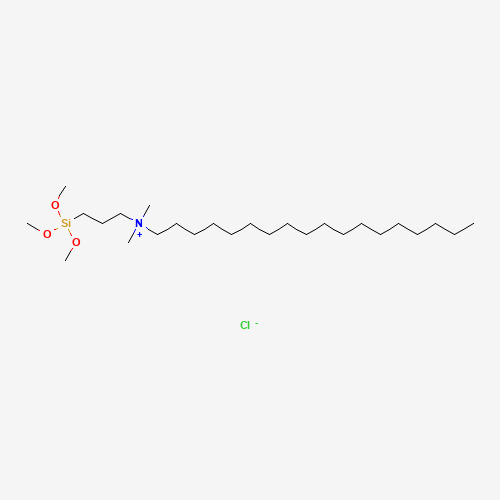
化合物详情
CAS27668-52-6
分子式C26H58ClNO3Si
分子量496.28 g/mol
非危品
structure in first source
科学粮草官-词典编辑部,修订于:2026-07-06
Toxicity
ToxicityEPA Ecotoxicity
Pesticide Ecotoxicity Data from EPA: 5
Ecotoxicity Values
EC50; Species: Daphnia magna (Water Flea) age <24 hr; Conditions: freshwater, static; Concentration: 720 ug/L for 48 hr (95% confidence interval: 600-850 ug/L); Effect: intoxication, immobilization /42% purity/
Fate Summary
ATMOSPHERIC FATE: According to a model of gas/particle partitioning of semivolatile organic compounds in the atmosphere(1), 3-(trimethyoxylsilyl)propyl dimethyl octadecyl ammonium chloride, which has an estimated vapor pressure of 5.8X10⁻¹⁴ mm Hg at 25 °C((SRC), determined from a fragment constant method(2), is expected to exist solely in the particulate phase in the ambient atmosphere. Particulate-phase 3-(trimethyoxylsilyl)propyl dimethyl octadecyl ammonium chloride may be removed from the air by wet and dry deposition(SRC). 3-(Trimethyoxylsilyl)propyl dimethyl octadecyl ammonium chloride does not contain chromophores that absorb at wavelengths >290 nm(3) and, therefore, is not expected to be susceptible to direct photolysis by sunlight(SRC).
Soil Adsorption / Mobility
As a cationic quaternary ammonium salt, 3-(trimethyoxylsilyl)propyl dimethyl octadecyl ammonium chloride will completely ionize in water at environmental pH. In water, it hydrolyzes rapidly and the hydrolytic cationic portion of the molecule (quaternary ammonium) will sorb readily to soil and sediment due to opposite electrical charges. The silyl portion of the molecule will become part of the soil and sediment matrices because of their high silica content(1).
Environmental Bioconcentration
In water, 3-(trimethyoxylsilyl)propyl dimethyl octadecyl ammonium chloride hydrolyzes rapidly(1) which will attenuate any bioconcentration of the parent compound(SRC).
Volatilization from Water / Soil
As a cationic quaternary ammonium salt, 3-(trimethyoxylsilyl)propyl dimethyl octadecyl ammonium chloride will completely ionize in an aqueous solution(1). Since ions do not volatilize, the compound is expected to be essentially nonvolatile from water surfaces and moist soil(SRC). In addition, 3-(trimethyoxylsilyl)propyl dimethyl octadecyl ammonium chloride hydrolyzes rapidly in water(1) which would attenuate the importance of volatilization from water if it was occurring(SRC). 3-(Trimethyoxylsilyl)propyl dimethyl octadecyl ammonium chloride is not expected to volatilize from dry soil surfaces(SRC) based upon an estimated vapor pressure of 5.8X10⁻¹⁴ mm Hg(SRC), determined from a fragment constant method(2).
Environmental Abiotic Degradation
3-(Trimethyoxylsilyl)propyl dimethyl octadecyl ammonium chloride hydrolyzes rapidly in water(1). In water, the trimethoxysilyl quaternary ammonium compounds (QACs) degrade quickly to the quaternary amine portion (active and soluble) and the other silyl portion (inactive and insoluble) with half-lives <1 hour(1). On contact with water, the methoxy groups attached to the silicon atom in the 3-(trimethyoxylsilyl)propyl dimethyl octadecyl ammonium chloride molecule react in a stepwise manner to form silanols(2). The silanol moieties are very reactive and can react through a condensation type reaction to form a variety of polymers(2). 3-(Trimethyoxylsilyl)propyl dimethyl octadecyl ammonium chloride does not contain chromophores that absorb at wavelengths >290 nm(1) and, therefore, is not exp...
Artificial Pollution Sources
3-(Trimethyoxylsilyl)propyl dimethyl octadecyl ammonium chloride's production and use as a material preservative treatment for materials such as human clothing, bedding, carpets and upholstery(1) may result in its release to the environment through various waste streams; its use as a bacteriastatic, algaestatic and fungistatic compound(1) will result in its direct release to the environment(SRC).
Probable Routes of Human Exposure
Occupational exposure to 3-(trimethyoxylsilyl)propyl dimethyl octadecyl ammonium chloride may occur through inhalation (e.g. spray application) and dermal contact with this compound at workplaces where 3-(trimethyoxylsilyl)propyl dimethyl octadecyl ammonium chloride is produced or used(1). Use data indicate that the general population may be exposed to 3-(trimethyoxylsilyl)propyl dimethyl octadecyl ammonium chloride via dermal contact with consumer products containing 3-(trimethyoxylsilyl)propyl dimethyl octadecyl ammonium chloride(SRC).
Environmental Fate / Exposure Summary
3-(Trimethyoxylsilyl)propyl dimethyl octadecyl ammonium chloride's production and use as a material preservative treatment for materials such as human clothing, bedding, carpets and upholstery may result in its release to the environment through various waste streams; its use as a bacteriastatic, algaestatic and fungistatic compound will result in its direct release to the environment. If released to air, an estimated vapor pressure of 5.8X10⁻¹⁴ mm Hg at 25 °C indicates 3-(trimethyoxylsilyl)propyl dimethyl octadecyl ammonium chloride will exist solely in the particulate phase in the atmosphere. Particulate-phase 3-(trimethyoxylsilyl)propyl dimethyl octadecyl ammonium chloride will be removed from the atmosphere by wet and dry deposition. 3-(Trimethyoxylsilyl)propyl dimethyl octadecyl am...
Toxicity Summary
IDENTIFICATION AND USE: 3-(Trimethoxysilyl)propyldimethyloctadecylammonium (Trimethoxysilyl quat) is registered for pesticide use in the USA. Trimethoxysilyl quat containing products are currently used as a material preservative treatment for materials such as those used in human clothing and bedding, carpets and upholstery. The trimethoxysilyl quats are used as surface treatments in household areas and bathroom areas. These products are also used in the manufacturing of paints, coatings, and in concrete. HUMAN EXPOSURE AND TOXICITY: There are no data avalable. ANIMAL STUDIES: Severe dermal irritation in rabbit, and severe ocular toxicity in rat. Oral administration as high as 1000 mg/kg/day did not produce teratogenicity or other indications of developmental toxicity in the rat concept...
Non-Human Toxicity Values
LC50 Rat inhalation >2.0 mg/L (1 hr) /Trimethoxysilyl Quats/
Non-Human Toxicity Excerpts
/GENOTOXICITY/ /Chromosome Aberration/ Chinese hamster cells: No association with the induction of structural chromosome aberrations /Trimethoxysilyl Quats/
Antidote and Emergency Treatment
/SRP:/ Advanced treatment: Consider orotracheal or nasotracheal intubation for airway control in the patient who is unconscious, has severe pulmonary edema, or is in severe respiratory distress. Positive-pressure ventilation techniques with a bag valve mask device may be beneficial. Consider drug therapy for pulmonary edema ... . Consider administering a beta agonist such as albuterol for severe bronchospasm ... . Monitor cardiac rhythm and treat arrhythmias as necessary ... . Start IV administration of D5W TKO /SRP: "To keep open", minimal flow rate/. Use 0.9% saline (NS) or lactated Ringer's (LR) if signs of hypovolemia are present. For hypotension with signs of hypovolemia, administer fluid cautiously. Watch for signs of fluid overload ... . Treat seizures with diazepam or lorazepam...









