

 一键配货
一键配货
化合物详情
CAS28159-98-0
分子式C11H19N5S
分子量253.37 g/mol g/mol
危化品
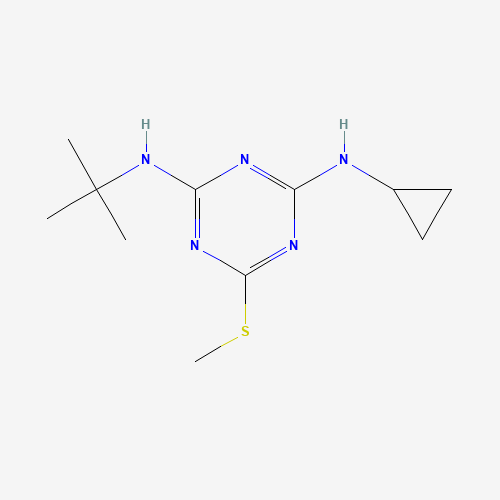
Irgarol 1051 is a diamino-1,3,5-triazine that is 1,3,5-triazine-2,4-diamine carrying a N-tert-butyl, N'-cyclopropyl and a methylsulfanyl group at position 6. It has a role as a xenobiotic, an antifouling biocide and an environmental contaminant. It is an aryl sulfide, a diamino-1,3,5-triazine and a member of cyclopropanes. It is functionally related to a 1,3,5-triazine-2,4-diamine. It derives from a hydride of a 1,3,5-triazine.
科学粮草官-词典编辑部,修订于:2026-07-06
Toxicity
ToxicityEPA Ecotoxicity
Pesticide Ecotoxicity Data from EPA: 41
Ecotoxicity Values
EC50; Species: Pseudokirchneriella subcapitata (Green Algae); Conditions: saltwater, static; Concentration: 10 ug/L for 72 hr; Effect: population, decreased abundance />98% purity/
Fate Summary
ATMOSPHERIC FATE: According to a model of gas/particle partitioning of semivolatile organic compounds in the atmosphere(1), Irgarol 1051, which has a vapor pressure of 6.6X10⁻⁷ mm Hg at 25 °C(2), will exist in both the vapor and particulate phases in the ambient atmosphere. Vapor-phase Irgarol 1051 is degraded in the atmosphere by reaction with photochemically-produced hydroxyl radicals(SRC); the half-life for this reaction in air is estimated to be 7 days(SRC), calculated from its rate constant of 2.4X10⁻¹² cu cm/molecule-sec at 25 °C(SRC) that was derived using a structure estimation method(3). Particulate-phase Irgarol 1051 may be removed from the air by wet or dry deposition(SRC).
Soil Adsorption / Mobility
Using a structure estimation method based on molecular connectivity indices(1), the Koc of Irgarol 1051 can be estimated to be 250(SRC). According to a classification scheme(2), this estimated Koc value suggests that Irgarol 1051 is expected to have moderate mobility in soil. In sediment, log Koc values of 2.16(3) and 2.4-4.8(4) were reported. These correspond to Koc values of 145 and 250-63,000, respectively. A Koc of 3100 in sediment was also reported(5). A log Koc value of 2.7 (Koc 500) was reported in secondary sewage sludge(6).
Environmental Biodegradation
ANAEROBIC: Irgarol 1051 did not degrade anaerobically when incubated for 42 days(1).
Environmental Bioconcentration
The BCFs in whole body tissue of sheepshead minnow (Cyprinodon variegatus) were 240 and 250 after exposure to 36 and 3.6 ug/L of Irgarol 1051, respectively(1). According to a classification scheme(2), these BCFs suggest the potential for bioconcentration in aquatic organisms is high. The average bioconcentration for Irgarol 1051 in marine microalgae (Tetraselmis suecica) was reported as 49,400(3).
Volatilization from Water / Soil
The Henry's Law constant for Irgarol 1051 is estimated as 3.1X10⁻⁸ atm-cu m/mole(SRC) derived from its vapor pressure, 6.6X10⁻⁷ mm Hg(1), and water solubility, 7 mg/L(2). This Henry's Law constant indicates that Irgarol 1051 is expected to be essentially nonvolatile from water and moist soil surfaces(3). Irgarol 1051 is not expected to volatilize from dry soil surfaces(SRC) based upon its vapor pressure(1).
Environmental Abiotic Degradation
[Table#8521]: IldhdGVyIHNvdXJjZSIsIlVWQiAoMzAwIG5tKSIsIlVWQSAoMzUwIG5tKSIsIlBvbmQgTmF0dXJhbCBDb25kaXRpb25zIgoiUG9ydCBvZiBNaWFtaSIsIjkuMzQgaG91cnMiLCI5LjQ2IGhvdXJzIiwibm8gZGF0YSIKIk1pYW1pIFJpdmVyIiwiMS4zOCBob3VycyIsIjcuNDkgaG91cnMiLCIyLjUzIGRheXMiCiJDb2NvbnV0IEdyb3ZlIiwiNy4wMiBob3VycyIsIjUuNzUgaG91cnMiLCIyLjI1IGRheXMiCiJEaXN0aWxsZWQgaW9uaXplZCB3YXRlciwgcEggOCIsIjE2LjQgaG91cnMiLCI5LjY0IGhvdXJzIiwiNi4zMSBkYXlzIgo=
Environmental Water Concentrations
... In 2001 we sampled the main rivers and shallow freshwater lakes (Broads) of East Anglia UK for Irgarol 1051, its metabolite GS26575 (2-methylamino-4-tert-butylamino-6-amino-s-triazine) and diuron in order to establish the baseline environmental concentrations of these compounds in freshwater systems of eastern UK and to investigate their possible effects on aquatic plants. Irgarol 1051, GS26575 and diuron were found in water samples collected from 21 locations. The highest concentrations were found in the Norfolk and Suffolk Broads in May. The rivers Great Ouse, Wissey, Bure and Yare also contained all three compounds, as did the Great Ouse Cut-off Channel. ...
Ecotoxicity Excerpts
/AQUATIC SPECIES/ The toxicity of the anti-fouling biocides tributyltin (TBTO), copper, and Irgarol 1051 (irgarol) at nominal concentrations ranging from 10 to 10,000 ug/L was investigated against the speed of encystment and successful formation of a protective cyst of the cercariae of Parorchis acanthus. For all biocide exposures, cercariae had a much slower rate of encystment and reduced cyst formation than controls. Exposure of the snail host Nucella lapillus for 7 days caused complete cessation of cercarial shedding in irgarol-exposed snails but had no effect on cercarial encystment from TBTO and copper-exposed snails. The mechanisms of toxicity of the biocides are briefly discussed.
Plant Concentrations
Irgarol 1051 was detected in macrophytes and algae (Potamogeton lucens, Potamogeton pectinatus, Vaucheria spp., Elodea nuttallii) at 53-103 ng/g dry weight in samples collected Sep 1994 to Apr 1995 from Port d'Ouchy, Switzerland(1). At Buchillon, an unpolluted reference site, Irgarol 1051 was detected in Zannichellia palustris at 4-5.2 ng/g(1).
Effluent Concentrations
Irgarol 1051 was detected in 7 of 24 sewage sludge samples collected Jan and May 2001 from 12 waste water treatment plants in Switzerland at 1.5-30.4 ug/kg dry weight(1). The concentration of Irgarol 1051 in leachates from short-term immersion, permanent immersion and irrigation test was 0.4-1.0, 1.2-3.4 and 0.5-1.7 mg/L, respectively(2). Influent and effluent concentrations of Irgarol 1051 from four German wastewater treatment plants collected Jun 2012 were 2.3-16 and 2.9-14 ng/L, respectively(3).
Fish/Seafood Concentrations
Irgarol 1051 was detected at approximately 0.2 ng/g in zebra mussel (Dreissena polymorpha) collected Aug 1994 to Apr 1995 from Port d'Ouchy and Buchillon, Lake Geneva, Switzerland(1). Irgarol 1051 was not detected (detection limit 0.76 ug/kg wet weight) in green mussel (Perna viridis) samples collected Apr 19-20, 2004 from six sites along the coast of Thailand(2).
Artificial Pollution Sources
Irgarol 1051's production and use as an antifouling agent in paint(1) may result in its release to the environment through various waste streams(SRC).
Sediment/Soil Concentrations
SEDIMENT: Irgarol 1051 was detected at <10-132 in sediment samples collected Sep 1993 from estuary and rivers of the Southern England coast(1). Irgarol 1051 concentrations decreased from 8 to <0.2 ng/g in sediment collected Aug 1994 to Apr 1995 from Port d'Ouchy, Lake Geneva, Switzerland(2). In sediment samples collected Apr-Nov 1996 from 3 sites in the Stockholm Archipelago, Irgarol 1051 was detected at only one site at <5-9 ng/g dry weight(3). In sediment samples collected Jul-Sep 1997 from marinas of the North and Baltic Sea, Irgarol 1051 was reported at <1.0-220 ng/g dry weight(4). Irgarol 1051 was detected at 0.01-0.11 ug/g dry weight in 6 of 27 sediment samples collected in 1998 from coastal locations of the UK(5). Irgarol 1051 was detected at <3.1-222.3 ppb in 15 sediment samples...
Probable Routes of Human Exposure
Occupational exposure to Irgarol 1051 may occur through dermal contact with this compound at workplaces where Irgarol 1051 is produced or used. Monitoring and use data indicate that the general population is not likely to be exposed to Irgarol 1051. (SRC)
Environmental Fate / Exposure Summary
Irgarol 1051's production and use as an antifouling agent in paint may result in its release to the environment through various waste streams. If released to air, a vapor pressure of 6.6X10⁻⁷ mm Hg at 25 °C indicates Irgarol 1051 will exist in both the vapor and particulate phases in the atmosphere. Vapor-phase Irgarol 1051 will be degraded in the atmosphere by reaction with photochemically-produced hydroxyl radicals; the half-life for this reaction in air is estimated to be 7 days. Particulate-phase Irgarol 1051 will be removed from the atmosphere by wet or dry deposition. If released to soil, Irgarol 1051 is expected to have moderate mobility based upon an estimated Koc of 250. Volatilization from moist soil surfaces is not expected based upon an estimated Henry's Law constant of 3.1X...
Effect Level
collection=toxvaldb&kind=^EL$
Interactions
The herbicides Irgarol 1051 (2-(tert-butylamino)-4-cyclopropylamino)-6-(methylthio)-1,3,5-triazine) and Diuron (3-(3',4'-dichlorophenyl)-1,1-dimethylurea) are commonly incorporated into antifouling paints to boost the efficacy of the compound towards algae. Previous investigations have identified environmental concentrations of these herbicides as being a threat to non-target organisms, such as seagrasses. Their individual toxicity has been assessed, but they can co-occur and interact, potentially increasing their toxicity and the threat posed to seagrass meadows. Chlorophyll fluorescence (Fv:Fm) and leaf specific biomass ratio (representing plant growth) were examined in Zostera marina L. after a 10-day exposure to the individual herbicides. The EC20 for each herbicide was determined a...
Toxicity Summary
IDENTIFICATION AND USE: Cybutryne is used as a booster algicide in antifouling paint. HUMAN STUDIES: Cybutryne induces HepG2 cell apoptosis through mitochondrial dysfunction and oxidative stress. ANIMAL STUDIES: Cybutryne inhibits the ATP synthesis. The analysis of the various steps involved in the ATP synthesis suggests that the inhibition is due to the opening of small-size pores. ECOTOXICITY STUDIES: When tested on early developmental stages of marine invertebrates cybutryne was found to be the least toxic among other commonly used 'booster'' biocides. However, it was more toxic when tested on the growth of autotrophic species. The toxicity of cybutryne towards periphyton and phytoplankton was shown to be higher than that of atrazine. It induced spermiotoxicity and embryotoxicity at...
Human Toxicity Excerpts
/ALTERNATIVE and IN VITRO TESTS/ In this study, HepG2 cells were exposed to 0.04-40 mg/L Irgarol 1051. Results show that Irgarol 1051 can damage cell morphology and cause a significant decrease in cell viability. Positive staining by Annexin V, caspase-3 activity enhancement, and the damage in cell ultrastructure indicated an apoptotic mode of cell death for 4.0 mg/L Irgarol 1051 treatment. At the same time, caspase-9 was also significantly induced by 0.4 and 4.0 mg/L Irgarol 1051 at 72 hr, which suggests that the intrinsic mitochondria pathway was involved in the apoptosis. The mitochondrial membrane potential decreased significantly after the HepG2 cells were exposed to Irgarol 1051 for 6 and 72 hr. Especially, the translocation of cytochrome c from mitochondria to cytosol was recorde...
Non-Human Toxicity Excerpts
/ALTERNATIVE and IN VITRO TESTS/ The interactions of Irgarol with rat liver mithocondrial have been investigated. The results indicate that Irgarol inhibits the ATP synthesis. The analysis of the various steps involved in the ATP synthesis suggests that the inhibition is due to the opening of small-size pores.
Antidote and Emergency Treatment
/SRP:/ Advanced treatment: Consider orotracheal or nasotracheal intubation for airway control in the patient who is unconscious, has severe pulmonary edema, or is in severe respiratory distress. Positive-pressure ventilation techniques with a bag valve mask device may be beneficial. Consider drug therapy for pulmonary edema ... . Consider administering a beta agonist such as albuterol for severe bronchospasm ... . Monitor cardiac rhythm and treat arrhythmias as necessary ... . Start IV administration of D5W TKO /SRP: "To keep open", minimal flow rate/. Use 0.9% saline (NS) or lactated Ringer's (LR) if signs of hypovolemia are present. For hypotension with signs of hypovolemia, administer fluid cautiously. Watch for signs of fluid overload ... . Treat seizures with diazepam (Valium) or l...