


 一键配货
一键配货
化合物详情
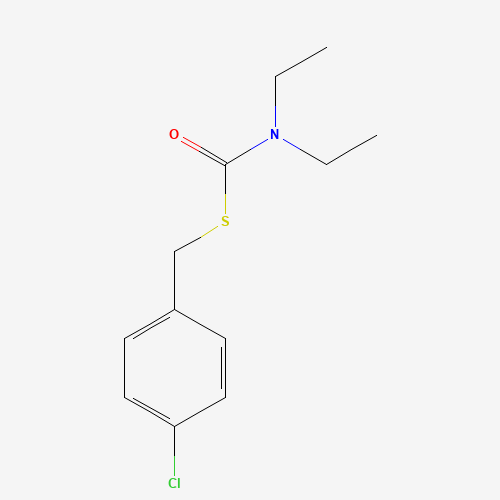
CAS28249-77-6
分子式C12H16ClNOS
分子量257.78 g/mol
非危品
Physical Description | Thiobencarb is a pale yellow to brownish yellow liquid. Non corrosive. Used as an herbicide.
科学粮草官-词典编辑部,修订于:2026-07-06
Toxicity
ToxicityEPA Ecotoxicity
Pesticide Ecotoxicity Data from EPA: 98
Fate Summary
ATMOSPHERIC FATE: According to a model of gas/particle partitioning of semivolatile organic compounds in the atmosphere(1), thiobencarb, which has a vapor pressure of 2.2X10⁻⁵ mm Hg at 25 °C(2), will exist in both the vapor and particulate phases in the ambient atmosphere. Vapor-phase thiobencarb is degraded in the atmosphere by reaction with photochemically-produced hydroxyl radicals(SRC); the half-life for this reaction in air is estimated to be 15 hrs(SRC), calculated from its rate constant of 2.5X10⁻¹¹ cu cm/molecule-sec at 25 °C(SRC), determined using a structure estimation method(3). Particulate-phase thiobencarb may be removed from the air by wet and dry deposition(SRC). Thiobencarb is susceptible to direct photolysis(4).
Soil Adsorption / Mobility
Koc values of 309 and 1043 were measured for thiobencarb in two Japanese soils (respective organic carbon contents of 1.35 and 4.24%)(1). The US Dept of Agric's Pesticide Properties Database has selected a recommended thiobencarb Koc value of 900 based on multiple reported Koc values(2). An average Koc of 5000 was measured in four different soil types (organic carbon content of 0.2-6.8%)(3). Using three Florida soils, Koc values of 765, 539 and 1195 were measured in Pahokee muck (48.6% organic carbon), Everglades muck (34.1% organic carbon) and Immokalee sand (1.1% organic carbon) respectively(4). According to a suggested classification scheme(5), Koc values ranging from 309-5000 suggest that thiobencarb is expected to have moderate to slight mobility in soil. In laboratory and greenhou...
Environmental Biodegradation
ANAEROBIC: Thiobencarb is stable under anaerobic aquatic conditions(1). The thiobencarb-calculated half-life in sediment was 5.4 years(1). In sediment from LA and CA, the half-lives for thiobencarb were 243 days and >181 days, respectively(1). Reported degradation half-lives for thiobencarb are 9-517 days in sediment, and 31 and 82 days in non-sterile and sterile water, respectively(1). The 9-day half-life in sterile sediment reported is not consistent with the other data that show thiobencarb to be more persistent in sterile test conditions than in non-sterile conditions(1). Thiobencarb, present at 97 uM, was 95% degraded in 30 days using anaerobic rice field soil microcosms amended with soil from the Sacramento Valley rice fields; half-lives in non-sterile soils ranged from 10 to 15 d...
Environmental Bioconcentration
Using a continuous-flow water system and a 14-day exposure period, a thiobencarb BCF of 170 was measured in a freshwater fish (topmouth gudgeon, Pseudorasbora parva)(1). Using a continuous-flow water system and a 14 day exposure period, a thiobencarb BCF of 66 was measured in a freshwater fish (willow shiner, Gnathopogon caerulescens)(2). Average BCFs of 209 and 523 were calculated for pale chub (Zacco platypus) and ayu sweetfish (Plecoglossus altivelis), respectively, collected from Japanese rivers by measuring the water concentration and the concentration in fish(3). Thiobencarb residues accumulated in juvenile bluegill sunfish (Lepomis macrochirus) exposed to 14C-thiobencarb at 0.05 mg/L, with maximum bioconcentration factors of 128, 639, and 411 for edible (muscle) tissue, nonedible...
Volatilization from Water / Soil
The Henry's Law constant for thiobencarb is estimated as 2.7X10⁻⁷ atm-cu m/mole(SRC) derived from its vapor pressure, 2.2X10⁻⁵ mm Hg(1), and water solubility, 28 mg/L(1). This Henry's Law constant indicates that thiobencarb is expected to be essentially nonvolatile from water surfaces(2). Thiobencarb's Henry's Law constant indicates that volatilization from moist soil surfaces is not expected to occur(SRC). Thiobencarb is not expected to volatilize from dry soil surfaces based upon its vapor pressure(SRC). During a 14 day water-based degradation study, <0.1% of added thiobencarb volatilized(3). In laboratory studies simulating flooded rice paddy conditions during summer months (eg 27.5 °C), only minor amounts of thiobencarb volatilized(4). The results of these volatilization tests indic...
Environmental Abiotic Degradation
Thiobencarb was shown to photolyze directly in sunlight or UV light exposure (365 nm) yielding 4-chlorobenzyl alcohol and 4-chlorobenzaldehyde as products(1). In aqueous photolysis studies, thiobencarb photolyzed slowly when exposed to sunlight (<10% during 10 hr of exposure) yielding thiobencarb S-oxide as an intermediate product(2); addition of small amounts of hydrogen peroxide or other photo-sensitizers (such as tryptophan and methylene blue) greatly increased the photodecomposition rate(2); in the presence of hydrogen peroxide, the photodecomposition half-life increased to 41 hr(2); the photo-oxidant responsible for the degradation was probably hydroxyl radicals(2); thiobencarb was not oxidized by molecular singlet oxygen(2). In aqueous solutions exposed to Oct sunlight (at Davis,...
Environmental Water Concentrations
RAIN: Thiobencarb was detected in rain water samples collected in both urban and agricultural areas of Mississippi in 1995 (concentrations not reported)(1). Thiobencarb was detected in rain water samples collected in eastern Japan between July 1999 and July 2000 at an average concentration 0.163 ug/L(2).
Ecotoxicity Excerpts
/AQUATIC SPECIES/ The midge Chironomus tepperi was used in laboratory experiments to assess the relative toxicity of formulated molinate, clomazone, and thiobencarb, three herbicides used in Australian rice crops. Static bioassays were initiated with first-instar larvae at herbicide concentrations between 0.0625 and 2 times the anticipated field concentrations (AFCs) expected from the registered application rates. Adult emergence success, development time, and wing length were used as indices of the effect of each herbicide. ... Thiobencarb reduced emergence success of adult C. tepperi at 0.0625 times the AFC (0.1875 mg/L) as well as decreasing male adult size and increasing development time for males and females at 0.125 times the AFC (p<0.05). Nontarget effects of the herbicides on aq...
Animal Concentrations
Mussels collected from the Tokyo Bay in Japan during May and Aug of 1983 and 1984 contained max thiobencarb levels of 0.20 ppm(1).
Effluent Concentrations
Thiobencarb has been observed to undergo surface runoff, with subsequent transport to rivers and lakes, after being applied as a herbicide(1,2); in one study, about 2% of the total thiobencarb application was removed from a field through surface runoff(2).
Atmospheric Concentrations
RURAL/REMOTE: The maximum concentration and percent detections of thiobencarb in air over the Mississippi River from New Orleans, LA to St. Paul, MN during June 1994 was 7.1 ng/cu m and 40%, respectively(1). Thiobencarb concentrations of approximately 1 to 25 ng/cu m were monitored in the air over Rolling Fork, MS during late April and may 1995(2).
Fish/Seafood Concentrations
Monitoring studies of pale chub (Zacco plastypus) and ayu sweetfish (Plecoglassus altivelis) from seven Japanese rivers flowing into Lake Biwa in 1988 and 1989 reported thiobencarb levels as high as 1124 ng/g, although levels were generally below 50 ng/g(1). Freshwater fish collected from the Sagami River in Japan contained thiobencarb levels of 0.03-0.25 ppm(2).
Artificial Pollution Sources
UNREVIEWED | Thiobencarb's production may result in its release to the environment through various waste streams; its use as a herbicide(1) will result in its direct release to the environment(SRC).
Sediment/Soil Concentrations
SEDIMENT: Thiobencarb concentrations of 2-13 ug/kg were detected sediments collected from the Shin River in Japan in 1999(1). Thiobencarb concentrations of <1 to 10 ug/kg dry wt were detected in sediments collected from Lake Biwa Japan in 2007(2).
Probable Routes of Human Exposure
Occupational exposure to thiobencarb occur through inhalation and dermal contact at areas where thiobencarb is used as a herbicide(1). The general population may be exposed to thiobencarb through ingestion of foods containing thiobencarb residues(1). Monitoring data indicate that the general population may also be exposed to thiobencarb via inhalation of ambient air, ingestion of drinking water and dermal contact with this compound(SRC).
Environmental Fate / Exposure Summary
Thiobencarb's production may result in its release to the environment through various waste streams; its use as a herbicide will result in its direct release to the environment. If released to air, a vapor pressure of 2.2X10⁻⁵ mm Hg at 25 °C indicates thiobencarb will exist in both the vapor and particulate phases in the ambient atmosphere. Vapor-phase thiobencarb will be degraded in the atmosphere by reaction with photochemically-produced hydroxyl radicals; the half-life for this reaction in air is estimated to be 15 hours. Particulate-phase thiobencarb will be removed from the atmosphere by wet and dry deposition. Thiobencarb is susceptible to direct photolysis in natural sunlight. If released to soil, thiobencarb is expected to have low-to-slight mobility based upon a range of experi...
Symptoms
As with organophosphates, the signs and symptoms are based on excessive cholinergic stimulation. Unlike organophosphate poisoning, carbamate poisonings tend to be of shorter duration because the inhibition of nervous tissue acetylcholinesterase is reversible, and carbamates are more rapidly metabolized. Muscle weakness, dizziness, sweating and slight body discomfort are commonly reported early symptoms. Headache, salivation, nausea, vomiting, abdominal pain and diarrhea are often prominent at higher levels of exposure. Contraction of the pupils with blurred vision, incoordination, muscle twitching and slurred speech have been reported. (L795)
Treatment
If the compound has been ingested, rapid gastric lavage should be performed using 5% sodium bicarbonate. For skin contact, the skin should be washed with soap and water. If the compound has entered the eyes, they should be washed with large quantities of isotonic saline or water. In serious cases, atropine and/or pralidoxime should be administered. Anti-cholinergic drugs work to counteract the effects of excess acetylcholine and reactivate AChE. Atropine can be used as an antidote in conjunction with pralidoxime or other pyridinium oximes (such as trimedoxime or obidoxime), though the use of '-oximes' has been found to be of no benefit, or possibly harmful, in at least two meta-analyses. Atropine is a muscarinic antagonist, and thus blocks the action of acetylcholine peripherally.
Target Organs
Urinary
Toxicity Data
LCLo (rat) > 7,700 mg/m3/4h
Health Effects
Acute exposure to cholinesterase inhibitors can cause a cholinergic crisis characterized by severe nausea/vomiting, salivation, sweating, bradycardia, hypotension, collapse, and convulsions. Increasing muscle weakness is a possibility and may result in death if respiratory muscles are involved. Accumulation of ACh at motor nerves causes overstimulation of nicotinic expression at the neuromuscular junction. When this occurs symptoms such as muscle weakness, fatigue, muscle cramps, fasciculation, and paralysis can be seen. When there is an accumulation of ACh at autonomic ganglia this causes overstimulation of nicotinic expression in the sympathetic system. Symptoms associated with this are hypertension, and hypoglycemia. Overstimulation of nicotinic acetylcholine receptors in the central...
Adverse Effects
Occupational hepatotoxin - Secondary hepatotoxins: the potential for toxic effect in the occupational setting is based on cases of poisoning by human ingestion or animal experimentation.
Exposure Routes
Inhalation (L793); oral (L793); dermal (L793)
Toxicity Summary
Thiobencarb is a cholinesterase or acetylcholinesterase (AChE) inhibitor. Carbamates form unstable complexes with chlolinesterases by carbamoylation of the active sites of the enzymes. This inhibition is reversible. A cholinesterase inhibitor suppresses the action of acetylcholine esterase. Because of its essential function, chemicals that interfere with the action of acetylcholine esterase are potent neurotoxins, causing excessive salivation and eye-watering in low doses. Headache, salivation, nausea, vomiting, abdominal pain and diarrhea are often prominent at higher levels of exposure. Acetylcholine esterase breaks down the neurotransmitter acetylcholine, which is released at nerve and muscle junctions, in order to allow the muscle or organ to relax. The result of acetylcholine ester...
RAIS Toxicity Values
Oral Chronic Reference Dose Reference: IRIS Current
Human Toxicity Excerpts
/GENOTOXICITY/ In a clastogenicity test using human lymphocytes, thiobencarb (96.0% a.i.) was tested at dose levels of 0, 5, 10, and 20 ug/mL without S9 activation and at dose levels of 0, 10, 20, and 40 ug/mL with S9 activation. No mutagenic activity was noted.
Carcinogen Classification
No indication of carcinogenicity to humans (not listed by IARC).
1 or Cancer Risk Level 1E-06
Fraction of Contaminant Absorbed Dermally from Soil: 0.1
Evidence for Carcinogenicity
Cancer Classification: Group D Not Classifiable as to Human Carcinogenicity
Hazard Quotient Level 3 or Cancer Risk Level 1E-04
Fraction of Contaminant Absorbed Dermally from Soil: 0.1
USGS Health-Based Screening Levels for Evaluating Water-Quality
Reference: Smith, C.D. and Nowell, L.H., 2024. Health-Based Screening Levels for evaluating water-quality data (3rd ed.). DOI:10.5066/F71C1TWP









