

 一键配货
一键配货
化合物详情
CAS28721-07-5
分子式C15H12N2O2
分子量252.27 g/mol g/mol
危化品
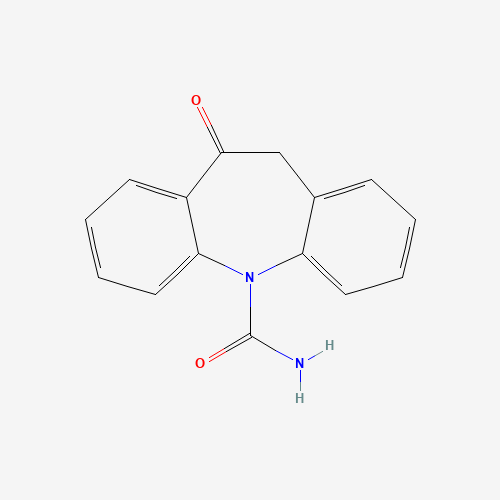
Oxcarbazepine is a dibenzoazepine derivative, having a carbamoyl group at the ring nitrogen, substituted with an oxo group at C-4 of the azepeine ring which is also hydrogenated at C-4 and C-5. It is a anticholinergic anticonvulsant and mood stabilizing drug, used primarily in the treatment of epilepsy. It has a role as an anticonvulsant and a drug allergen. It is a cyclic ketone and a dibenzoazepine. It contains a carbamoyl group.
科学粮草官-词典编辑部,修订于:2026-07-06
Toxicity
ToxicityFate Summary
ATMOSPHERIC FATE: According to a model of gas/particle partitioning of semivolatile organic compounds in the atmosphere(1), oxcarbazepine, which has an estimated vapor pressure of 7.6X10⁻⁹ mm Hg at 25 °C(SRC), determined from a fragment constant method(2), is expected to exist solely in the particulate phase in the ambient atmosphere. Particulate-phase oxcarbazepine may be removed from the air by wet or dry deposition(SRC). Oxcarbazepine contains chromophores that absorb at wavelengths >290 nm(3) and therefore may be susceptible to direct photolysis by sunlight(SRC).
Soil Adsorption / Mobility
Using a structure estimation method based on molecular connectivity indices(1), the Koc of oxcarbazepine can be estimated to be 360(SRC). According to a classification scheme(2), this estimated Koc value suggests that oxcarbazepine is expected to have moderate mobility in soil.
Environmental Bioconcentration
An estimated BCF of <1 was calculated in fish for oxcarbazepine(SRC), using an estimated log Kow of 1.11(1) and a regression-derived equation(2). According to a classification scheme(3), this BCF suggests the potential for bioconcentration in aquatic organisms is low(SRC).
Volatilization from Water / Soil
The Henry's Law constant for oxcarbazepine is estimated as 6.9X10⁻¹³ atm-cu m/mole(SRC) using a fragment constant estimation method(1). This Henry's Law constant indicates that oxcarbazepine is expected to be essentially nonvolatile from water surfaces(2). Oxcarbazepine's Henry's Law constant indicates that volatilization from moist soil surfaces will not occur(SRC). Oxcarbazepine is not expected to volatilize from dry soil surfaces(SRC) based upon an estimated vapor pressure of 7.6X10⁻⁹ mm Hg(SRC), determined from a fragment constant method(3).
Environmental Abiotic Degradation
Oxcarbazepine is not expected to undergo hydrolysis in the environment due to the lack of functional groups that hydrolyze under environmental conditions(1). Oxcarbazepine contains chromophores that absorb at wavelengths >290 nm(1) and therefore may be susceptible to direct photolysis by sunlight(SRC).
Environmental Water Concentrations
While data specific to oxcarbazepine were not located(SRC, 2007), the literature suggests that some pharmaceutically active compounds originating from human and veterinary therapy are not eliminated completely in municipal sewage treatment plants and are therefore discharged into receiving waters(1). Wastewater treatment processes often were not designed to remove them from the effluent(2). Selected organic waste compounds may be degrading to new and more persistent compounds that may be released instead of or in addition to the parent compound(2).
Artificial Pollution Sources
Oxcarbazepine's production and use as an anticonvulsive drug(1) may result in its release to the environment through various waste streams(SRC). It is on the list of the 300 most prescribed drugs in the US(2).
Probable Routes of Human Exposure
Occupational exposure to oxcarbazepine may occur through inhalation and dermal contact with this compound at workplaces where oxcarbazepine is produced or used. Exposure to oxcarbazepine among the general population may be limited to those administered the drug Trileptal, an anticonvulsive. (SRC)
Environmental Fate / Exposure Summary
Oxcarbazepine's production and use as an anticonvulsive drug may result in its release to the environment through various waste streams. If released to air, an estimated vapor pressure of 7.6X10⁻⁹ mm Hg at 25 °C indicates oxcarbazepine will exist solely in the particulate phase in the atmosphere. Particulate-phase oxcarbazepine will be removed from the atmosphere by wet or dry deposition. Oxcarbazepine contains chromophores that absorb at wavelengths >290 nm and therefore may be susceptible to direct photolysis by sunlight. If released to soil, oxcarbazepine is expected to have moderate mobility based upon an estimated Koc of 360. Volatilization from moist soil surfaces is not expected to be an important fate process based upon an estimated Henry's Law constant of 6.9X10⁻¹³ atm-cu m/mol...
Treatment
There is no specific antidote. Symptomatic and supportive treatment should be administered as appropriate. Removal of the drug by gastric lavage and/or inactivation by administering activated charcoal should be considered. (L1712)
Health Effects
May cause a potentially dangerous rash that may develop into Stevens Johnson syndrome, an extremely rare but potentially fatal skin disease.
Hepatotoxicity
Likelihood score: C (probable rare cause of clinically apparent liver injury).
Adverse Effects
Carbamazepine, oxcarbazepine, and eslicarbazepine can cause movement disorders. The types of movement disorders are myoclonus, dystonia, tics, dyskinesia, parkinsonism, and akathisia. Carbamazepine was noted to cause more movement disorders when compared to oxcarbazepine and eslicarbazepine.
Exposure Routes
Completely absorbed following oral administration. Food has no effect on the rate and extent of absorption of oxcarbazepine. After single-dose administration of Trileptal tablets to healthy male volunteers under fasted conditions, the median tmax was 4.5 (range 3 to 13) hours. After single-dose administration of Trileptal oral suspension to healthy male volunteers under fasted conditions, the median tmax was six hours. Steady-state plasma concentrations of MHD are reached within 2-3 days in patients when Trileptal is given twice a day.
Toxicity Summary
The exact mechanism by which oxcarbazepine exerts its anticonvulsant effect is unknown. It is known that the pharmacological activity of oxcarbazepine occurs primarily through its 10-monohydroxy metabolite (MHD). In vitro studies indicate an MHD-induced blockade of voltage-sensitive sodium channels, resulting in stabilization of hyperexcited neuronal membranes, inhibition of repetitive neuronal discharges, and diminution of propagation of synaptic impulses.
Carcinogen Classification
No indication of carcinogenicity to humans (not listed by IARC).
Drug Induced Liver Injury
References: DOI:10.1016/j.drudis.2019.09.022
Non-Human Toxicity Excerpts
/LABORATORY ANIMALS: Developmental or Reproductive Toxicity/ When pregnant rats were given oxcarbazepine (30, 300, or 1000 mg/kg) orally throughout the period of organogenesis, increased incidences of fetal malformations (craniofacial, cardiovascular, and skeletal) and variations were observed at the intermediate and high doses (approximately 1.2 and 4 times, respectively, the maximum recommended human dose [MRHD] on a mg/sq m basis). Increased embryofetal death and decreased fetal body weights were seen at the high dose. Doses > or = 300 mg/kg were also maternally toxic (decreased body weight gain, clinical signs), but there is no evidence to suggest that teratogenicity was secondary to the maternal effects.
Antidote and Emergency Treatment
/SRP:/ Advanced treatment: Consider orotracheal or nasotracheal intubation for airway control in the patient who is unconscious, has severe pulmonary edema, or is in severe respiratory distress. Positive-pressure ventilation techniques with a bag valve mask device may be beneficial. Consider drug therapy for pulmonary edema ... . Consider administering a beta agonist such as albuterol for severe bronchospasm ... . Monitor cardiac rhythm and treat arrhythmias as necessary ... . Start IV administration of D5W /SRP: "To keep open", minimal flow rate/. Use 0.9% saline (NS) or lactated Ringer's if signs of hypovolemia are present. For hypotension with signs of hypovolemia, administer fluid cautiously. Watch for signs of fluid overload ... . Treat seizures with diazepam or lorazepam ... . Use...
Effects During Pregnancy and Lactation
Having epilepsy can reduce sperm quality and sexual function and lead to reduced fertility. This makes it difficult for researchers studying seizure medications like oxcarbazepine to know if any adverse effects on male sexual function and fertility are related to the medications or to the underlying seizure disorders themselves. Among men with epilepsy, studies have found improved motility (forward movement) and survival of sperm, improved hormone levels, or improved sexual function reported by men treated with oxcarbazepine compared to those treated with some other seizure medications. It is unclear if these findings improved their fertility.In general, exposures that fathers or sperm donors have are unlikely to increase the risks to a pregnancy. For more information, please see the Mo...