


 一键配货
一键配货
化合物详情
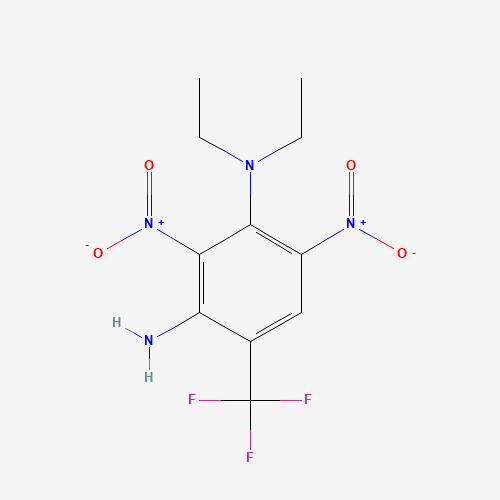
CAS29091-05-2
分子式C11H13F3N4O4
分子量322.24 g/mol
非危品
Dinitramine is a C-nitro compound.
科学粮草官-词典编辑部,修订于:2026-07-06
Toxicity
ToxicityEPA Ecotoxicity
Pesticide Ecotoxicity Data from EPA: 6
Fate Summary
ATMOSPHERIC FATE: According to a model of gas/particle partitioning of semivolatile organic compounds in the atmosphere(1), dinitramine, which has a measured vapor pressure of 3.60X10⁻⁶ mm Hg at 25 °C(2), will exist in both the vapor and particulate phases in the ambient atmosphere. Vapor-phase dinitramine is degraded in the atmosphere by reaction with photochemically-produced hydroxyl radicals(SRC); the half-life for this reaction in air is estimated to be about 22 hours(SRC), calculated from its rate constant of 1.77X10⁻¹¹ cu cm/molecule-sec at 25 °C(SRC) that was derived using a structure estimation method(3). Particulate-phase dinitramine may be removed from the air by wet or dry deposition(SRC). Dinitramine absorbs light in the environmental spectrum(4) and has been observed to deg...
Soil Adsorption / Mobility
Based upon a variety of measured Koc values in different soils (range of 115 to 34,400), dinitramine has a recommended Koc of 4000(1). According to a classification scheme(2), this Koc value suggests that dinitramine is expected to have slight mobility in soil. In adsorption studies using a Plano silt loam soil(3), dinitramine did not leach more than 4 mm over a 17-day observation period. No leaching was detected for dinitramine or six other dinitroaniline herbicides during a 1-year period in which 145 cm of rainfall and irrigation water entered sandy loam plots(4); these dinitroaniline herbicides were essentially immobile in soil(4). Dinitramine is reported to be strongly adsorbed on soil with no leaching(5).
Environmental Biodegradation
ANAEROBIC: Dinitramine has been observed to metabolize faster in anaerobic soil compared to aerobic soil(1,2). Anaerobic degradation of dinitroaniline herbicides proceeds through reduction followed by dealkylation(2).
Environmental Bioconcentration
An estimated BCF of 408 was calculated in fish for dinitramine(SRC), using an experimental log Kow of 4.30(1) and a regression-derived equation(2). An aquatic ecosystem study using Gambusia fish and a 3-day exposure period in the dark, determined a dinitramine BCF value of 235(3); the BCF value under sunlight conditions was 83; the lower BCF value in sunlight was thought to be the result of dinitramine photodegradation in sunlight. According to a classification scheme(4), BCF values of 235 and 408 suggest the potential for bioconcentration in aquatic organisms is high(SRC), provided the compound is not metabolized by the organism(SRC).
Volatilization from Water / Soil
The Henry's Law constant for dinitramine is estimated as 1.39X10⁻⁶ atm-cu m/mole(SRC) derived from its vapor pressure, 3.60X10⁻⁶ mm Hg(1), and water solubility, 1.1 mg/L(2). This Henry's Law constant indicates that dinitramine is expected to volatilize from water surfaces(3). Based on this Henry's Law constant, the volatilization half-life from a model river (1 m deep, flowing 1 m/sec, wind velocity of 3 m/sec)(3) is estimated as 47 days(SRC). The volatilization half-life from a model lake (1 m deep, flowing 0.05 m/sec, wind velocity of 0.5 m/sec)(3) is estimated as 350 days(SRC). However, volatilization from water surfaces is expected to be attenuated by adsorption to suspended solids and sediment in the water column. The estimated volatilization half-life from a model pond is greater...
Environmental Abiotic Degradation
During photodegradation, an N-alkyl group is cyclized with a less hindered nitrogen atom at the 4-position (from an amino group) to form benzimidazoles.
Ecotoxicity Excerpts
/PLANTS/ Prevents germination of seeds and inhibits root growth.
Artificial Pollution Sources
Dinitramine's former use as a herbicide(1) resulted in its direct release to the environment(SRC).
Probable Routes of Human Exposure
Occupational exposure and general population exposure should be low or non-existent since dinitramine is no longer produced or used in the US. In the past, dinitramine was applied directly to the field as a soil-incorporated concentrate and exposure to this compound was primarily by inhalation and dermal contact in the field where it was applied. (SRC)
Environmental Fate / Exposure Summary
Dinitramine's former use as a herbicide resulted in its direct release to the environment. If released to air, a measured vapor pressure of 3.60x10⁻⁶ mm Hg at 25 °C indicates dinitramine will exist in both the vapor and particulate phases in the atmosphere. Vapor-phase dinitramine will be degraded in the atmosphere by reaction with photochemically-produced hydroxyl radicals; the half-life for this reaction in air is estimated to be about 22 hours. Particulate-phase dinitramine will be removed from the atmosphere by wet or dry deposition. Dinitramine absorbs light in the environmental spectrum and has been observed to degrade readily when exposed to sunlight; therefore, direct photolysis may contribute to the removal of dinitramine from the atmosphere. If released to soil, dinitramine is...
Human Toxicity Excerpts
/SIGNS AND SYMPTOMS/ May be irritating. These herbicides do not uncouple oxidative phosphorylation or generate methemoglobin. /Fluorodinitrotoluidine cmpd/
Non-Human Toxicity Values
LD50 Rabbit dermal 2000 mg/kg
Non-Human Toxicity Excerpts
/LABORATORY ANIMALS: Chronic Exposure or Carcinogenicity/ In two year trials no carcinogenic response was observed in rats receiving 100 or 300 mg/kg diet.









