


 一键配货
一键配货
化合物详情
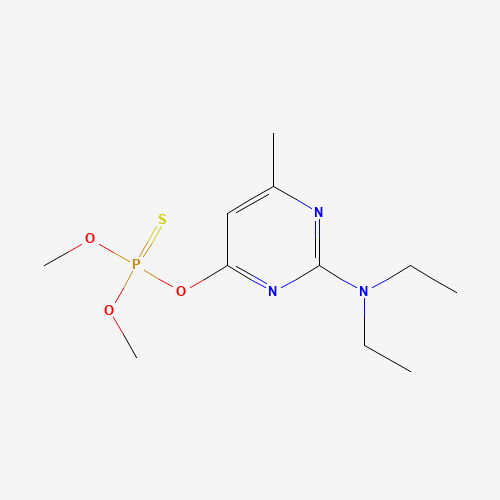
CAS29232-93-7
分子式C11H20N3O3PS
分子量305.33 g/mol g/mol
危化品
Physical Description | Pirimiphos-methyl is a yellow liquid. Corrosive to tin and mild steel. Used as an insecticide.
科学粮草官-词典编辑部,修订于:2026-07-06
Toxicity
ToxicityEPA Ecotoxicity
Pesticide Ecotoxicity Data from EPA: 14
Fate Summary
ATMOSPHERIC FATE: According to a model of gas/particle partitioning of semivolatile organic compounds in the atmosphere(1), pirimiphos-methyl, which has a vapor pressure of 1.5X10⁻⁵ mm Hg at 20 °C(2), is expected to exist in both the vapor and particulate phases in the ambient atmosphere. Vapor-phase pirimiphos-methyl is degraded in the atmosphere by reaction with photochemically-produced hydroxyl radicals(SRC); the half-life for this reaction in air is estimated to be 2.4 hours(SRC), calculated from its rate constant of 1.6X10⁻¹⁰ cu cm/molecule-sec at 25 °C(SRC) that was derived using a structure estimation method(3). Particulate-phase pirimiphos-methyl may be removed from the air by wet or dry deposition(SRC). Pirimiphos-methyl contains chromophores that absorb at wavelengths >290 nm(...
Soil Adsorption / Mobility
Koc values of 950 to 8500 were reported for pirimiphos-methyl(1). According to a classification scheme(2), this estimated Koc value range suggests that pirimiphos-methyl is expected to have low to no mobility in soil(SRC).
Environmental Bioconcentration
An estimated BCF of 270 was calculated in fish for pirimiphos-methyl(SRC), using a log Kow of 4.12(1) and a regression-derived equation(2). According to a classification scheme(3), this BCF suggests the potential for bioconcentration in aquatic organisms is high(SRC), provided the compound is not metabolized by the organism(SRC).
Volatilization from Water / Soil
The Henry's Law constant for pirimiphos-methyl is estimated as 6.0X10⁻⁷ atm-cu m/mole(SRC) derived from its vapor pressure, 1.5X10⁻⁵ mm Hg(1), and water solubility, 10 mg/L(1). This Henry's Law constant indicates that pirimiphos-methyl is expected to be essentially nonvolatile from moist soil and water surfaces(2). Pirimiphos-methyl is not expected to volatilize from dry soil surfaces(SRC) based upon its vapor pressure(1).
Environmental Abiotic Degradation
The rate constant for the vapor-phase reaction of pirimiphos-methyl with photochemically-produced hydroxyl radicals has been estimated as 1.6X10⁻¹⁰ cu cm/molecule-sec at 25 °C(SRC) using a structure estimation method(1). This corresponds to an atmospheric half-life of about 2.4 hours at an atmospheric concentration of 5X10+5 hydroxyl radicals per cu cm(1). Pirimiphos-methyl hydrolyzes rapidly at acidic pHs and is relatively stable at neutral and alkaline pH(2). Calculated hydrolysis half-lives or pirimiphos-methyl are 7.3 days at pH 5, 79.0 days at pH 7, and 54.0-62.0 days at pH 9(2). The main hydrolysis degradate recovered from all three pH's was 2-(diethylamino)-4-hydroxy-6-methyl pyrimidine, a second degradate, O-2-diethylamino-6-methylpyrimidin-4-yl o-methyl-phosphorothioate, was re...
Environmental Water Concentrations
RAIN/SNOW: The mean concentration of pirimiphos-methyl in rain from the Axios River Basin, Greece was 0.007 ug/L(1); the percentage of rain events with positive detections was 0.5%(1). Pirimiphos-methyl was detected in three of eight rainwater samples taken May to July 1997 in South Holland, Netherlands, reported concentrations were 0.02, 0.07 and 0.09 ug/L, however the quantification limit is 0.03 ug/L(2). The average annual concentration of pirimiphos-methyl in rainwater was 0.2 and 0.04 ng/L for 1998 and 2000 at five locations in Flanders, Belgium(3). Pirimiphos-methyl was not detected at the same locations in 1997, 1999 and 2001(3). Pirimiphos-methyl was detected in snow collected near a paper mill in Siberia, Russia at 0.26 ug/kg, but was not detected at 9 other locations in Russia...
Food Survey Values
In a 1995 monitoring program in Egypt pirimiphos-methyl was not detected in cabbage, cauliflower, carrot, courgette, cucumber, eggplant, green beans, green peas, lettuce, onion, pepper, apple, cantaloupe, grape, guava, mango, peach or strawberry samples(1). Pirimiphos-methyl was detected in 1 of 62 tomato samples at 0.06 mg/kg in the same 1995 monitoring program(1). In a 1996 monitoring program in Egypt pirimiphos-methyl was not detected in cabbage, lettuce, melokhia, spinach, watercress, artichoke, broad bean, cauliflower, cantaloupe, eggplant, green peas, okra, onion, squash, tomato, sweet potato, taro, apple, aqricot, banana, dates, fig, grape, quava, lemon lime, mango, peach, pear, plum or strawberry(2). Pirimiphos-methyl was detected in 1 of 24 grape leaf, 2 of 94 cucumber, 1 of 16...
Milk Concentrations
/EXPERIMENTAL/ In cows ... during the first 3 days 0.35% of the label was excreted in milk. The milk contained 0.04 ppm of pirimiphos-methyl equivalents, of which <2% was unchanged compound & phosphorus metabolites.
Ecotoxicity Excerpts
/AQUATIC SPECIES/ ... Evaluations were conducted in southeastern Queensland, Australia, to determine the toxicities of two organophosphate compounds (temephos and pirimiphos-methyl), an insect growth regulator (s-methoprene), and an entomopathogenic bacterium (Bacillus thuringiensis variety israelensis de Barjac ...) to Culex annulirostris ..., an Australian freshwater mosquito vector of arboviruses, and to Caradina indistincta, ... a co-habiting nontarget shrimp species. S-methoprene and B.thuringiensis were safest for C. annulirostris control with lethal dose ratios (LC95 nontarget/LC95 target) of 3,300 and 846,000, respectively. In contrast, lethal dose ratios for temephos and pirimiphos-methyl were 0.05 and 0.00005, respectively, suggesting that they are environmentally unsuitable....
Animal Concentrations
Pirimiphos-methyl was detected in 44% of honeybee samples at concentrations of 0.001 to 0.062 mg/kg, dead bee samples were collected in bags suspended under beehives (only worker bees were analyzed) in the district of Bologna, Italy(1).
Fish/Seafood Concentrations
Pirimiphos-methyl was detected in fish samples (types, locations and dates of fish samples not reported) from locations in Egypt at 50.5 ppb(1).
Artificial Pollution Sources
Pirimiphos-methyl's production may result in its release to the environment through various waste streams; its use as an insecticide(1) will result in its direct release to the environment(SRC).
Sediment/Soil Concentrations
SOIL: In the Bangkok area of Thailand, pirimiphos-methyl was not detected in the soil of soybean, onion, Chinese kale fields or citrus plantations(1).
Probable Routes of Human Exposure
Occupational exposure to pirimiphos-methyl may occur through inhalation and dermal contact with this compound at workplaces where pirimiphos-methyl is produced or used. Monitoring data indicate that the general population may be exposed to pirimiphos-methyl via ingestion of fruits and vegetables containing pirimiphos-methyl residues. (SRC)
Other Environmental Concentrations
Pirimiphos-methyl was not detected in 292 samples of 30 types of herbal drug materials from China and Korea(1).
Environmental Fate / Exposure Summary
Pirimiphos-methyl's production may result in its release to the environment through various waste streams; its use as an insecticide will result in its direct release to the environment. If released to air, a vapor pressure of 1.5X10⁻⁵ mm Hg at 20 °C indicates pirimiphos-methyl will exist in both the vapor and particulate phases in the atmosphere. Vapor-phase pirimiphos-methyl will be degraded in the atmosphere by reaction with photochemically-produced hydroxyl radicals; the half-life for this reaction in air is estimated to be 2.4 hours. Particulate-phase pirimphos-methyl will be removed from the atmosphere by wet or dry deposition. Pirimiphos-methyl contains chromophores that absorb at wavelengths >290 nm and, therefore, may be susceptible to direct photolysis by sunlight. If released...
Symptoms
Symptoms of low dose exposure include excessive salivation and eye-watering. Acute dose symptoms include severe nausea/vomiting, salivation, sweating, bradycardia, hypotension, collapse, and convulsions. Increasing muscle weakness is a possibility and may result in death if respiratory muscles are involved. Hypertension, hypoglycemia, anxiety, headache, tremor and ataxia may also result.
Treatment
If the compound has been ingested, rapid gastric lavage should be performed using 5% sodium bicarbonate. For skin contact, the skin should be washed with soap and water. If the compound has entered the eyes, they should be washed with large quantities of isotonic saline or water. In serious cases, atropine and/or pralidoxime should be administered. Anti-cholinergic drugs work to counteract the effects of excess acetylcholine and reactivate AChE. Atropine can be used as an antidote in conjunction with pralidoxime or other pyridinium oximes (such as trimedoxime or obidoxime), though the use of '-oximes' has been found to be of no benefit, or possibly harmful, in at least two meta-analyses. Atropine is a muscarinic antagonist, and thus blocks the action of acetylcholine peripherally.
Interactions
The pesticides benomyl, a benzimidazole fungicide, and pirimiphos-methyl, an organophosphorus insecticide, were tested separately and in combination at a ratio of 6:1, a mixture frequently found in foodstuffs by residual analysis, to determine their possible genotoxic action. The effect was measured by the micronucleus test carried out on cultured rat hepatocytes stimulated to proliferate by epidermal growth factor (EGF). Adult rat hepatocytes were exposed in vitro for 48 hr to the substances at increasing non-cytotoxic doses, chosen on the basis of cytotoxicity tests such as LDH and Neutral red assays. Benomyl induced a significant dose-related increase in micronucleus frequency; in contrast, pirimiphos-methyl was not genotoxic at any dose tested. When the hepatocytes were exposed to t...
Target Organs
Nervous
Toxicity Data
LC (rat) > 5040 mg/m3/4h
Health Effects
Acute exposure to cholinesterase inhibitors can cause a cholinergic crisis characterized by severe nausea/vomiting, salivation, sweating, bradycardia, hypotension, collapse, and convulsions. Increasing muscle weakness is a possibility and may result in death if respiratory muscles are involved. Accumulation of ACh at motor nerves causes overstimulation of nicotinic expression at the neuromuscular junction. When this occurs symptoms such as muscle weakness, fatigue, muscle cramps, fasciculation, and paralysis can be seen. When there is an accumulation of ACh at autonomic ganglia this causes overstimulation of nicotinic expression in the sympathetic system. Symptoms associated with this are hypertension, and hypoglycemia. Overstimulation of nicotinic acetylcholine receptors in the central...
Adverse Effects
Other Poison - Organophosphate
Toxicity Summary
Pirimiphos-methyl is a cholinesterase or acetylcholinesterase (AChE) inhibitor. A cholinesterase inhibitor (or 'anticholinesterase') suppresses the action of acetylcholinesterase. Because of its essential function, chemicals that interfere with the action of acetylcholinesterase are potent neurotoxins, causing excessive salivation and eye-watering in low doses, followed by muscle spasms and ultimately death. Nerve gases and many substances used in insecticides have been shown to act by binding a serine in the active site of acetylcholine esterase, inhibiting the enzyme completely. Acetylcholine esterase breaks down the neurotransmitter acetylcholine, which is released at nerve and muscle junctions, in order to allow the muscle or organ to relax. The result of acetylcholine esterase inhi...
Average Daily Intake
As part of FDA Total Diet Study between 1984-1986, between the years 1984-1986, the mean daily intake per unit body weight (ug/kg body wt/day) of pirimiphos-methyl was measured for the following age groups: 6-11 mo (0.0014), 2 yr (0.0041), 14-16 yr female (0.0015), 14-16 yr male (0.0018), 25-30 yr female (0.0016), 25-30 yr male (0.0014), 60-65 yr female (0.0006), and 60-65 yr male (0.0007)(1). In Belgium, the average daily intake of pirimiphos-methyl was 0.03 mg/kg/day(2).
RAIS Toxicity Values
Oral Chronic Reference Dose Reference: OPP
Carcinogen Classification
Spraying and application of nonarsenical insecticides entail exposures that are probably carcinogenic to humans (Group 2A). (L135)
1 or Cancer Risk Level 1E-06
Fraction of Contaminant Absorbed Dermally from Soil: 0.1
Evidence for Carcinogenicity
Cancer Classification: Not Yet Determined
Hazard Quotient Level 3 or Cancer Risk Level 1E-04
Fraction of Contaminant Absorbed Dermally from Soil: 0.1









