


 一键配货
一键配货
化合物详情
CAS33419-42-0
分子式C29H32O13
分子量588.6 g/mol
危化品
Etoposide can cause cancer according to California Labor Code. It can cause developmental toxicity according to state or federal government labeling requirements.
科学粮草官-词典编辑部,修订于:2026-07-06
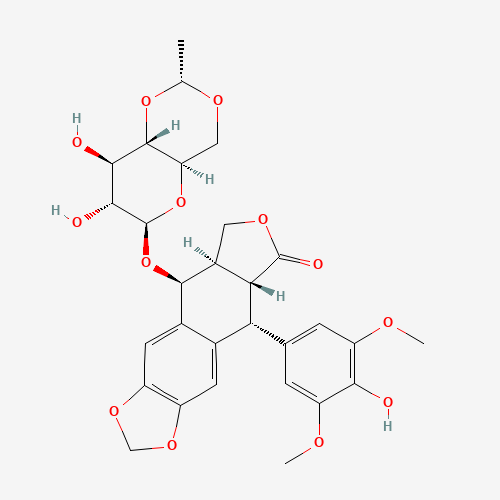
Toxicity
ToxicityFate Summary
ATMOSPHERIC FATE: According to a model of gas/particle partitioning of semivolatile organic compounds in the atmosphere(1), etoposide, which has an estimated vapor pressure of 5.4X10⁻²⁴ mm Hg at 25 °C(SRC), determined from a fragment constant method(2), is expected to exist solely in the particulate phase in the ambient atmosphere. Particulate-phase etoposide may be removed from the air by wet and dry deposition(SRC). Etoposide has a UV absorption band that extends beyond 290 nm(3) making it potentially susceptible to direct photolysis; however, photolysis of particulate phase compounds is generally much slower than for vapor phase compounds(SRC).
Soil Adsorption / Mobility
The Koc of etoposide is estimated as 51(SRC), using a log Kow of 0.60(1) and a regression-derived equation(2). According to a classification scheme(3), this estimated Koc value suggests that etoposide is expected to have high mobility in soil(SRC).
Environmental Biodegradation
No biodegradation was located for etoposide(SRC). The antineoplastic agents vindesine, vincristine, and vinblastine were all shown to fail the closed bottle test and Zahn-Wellens tests for ready and inherent biodegradability(1). These data suggest that etoposide may also be slow to biodegrade in the environment.
Environmental Bioconcentration
An estimated BCF of 3 was calculated for etoposide(SRC), using a log Kow of 0.60(1) and a regression-derived equation(2). According to a classification scheme(3), this BCF suggests the potential for bioconcentration in aquatic organisms is low(SRC).
Volatilization from Water / Soil
The Henry's Law constant for etoposide is estimated as 1.7X10⁻³⁰ atm-cu m/mole(SRC) using a fragment constant estimation method(1). This Henry's Law constant indicates that etoposide is expected to be essentially nonvolatile from water surfaces(2). Etoposide's Henry's Law constant indicates that volatilization from moist soil surfaces is not expected(SRC). Etoposide is not expected to volatilize from dry soil surfaces(SRC) based upon an estimated vapor pressure of 5.4X10⁻²⁴ mm Hg(SRC), determined from a fragment constant method(3).
Environmental Abiotic Degradation
Etoposide has a UV absorption band that extends beyond 290 nm(1) and contains a cyclic ester functional group that may potentially be susceptible to hydrolysis(2); however, the rates of photolysis and hydrolysis are not known.
Milk Concentrations
Excretion of etoposide in breast milk was demonstrated in a woman with acute promyelocytic leukemia receiving daily doses of 80 mg/sq m (route not stated). Peak concentrations of 0.6-0.8 ug/mL were measured immediately after dosing but had decreased to undetectable levels by 24 hr.
Effluent Concentrations
The mean concentration of etoposide from hospital sewage in Switzerland was estimated to be 0.49 ug/L(1).
Artificial Pollution Sources
Etoposide's production and use as an antineoplastic chemotherapy agent(1) may result in its release to the environment through various waste streams(SRC). Etoposide is expected to be released primarily to wastewater from the urinary excretion of patients using this medication(2).
Probable Routes of Human Exposure
Occupational exposure to etoposide may occur dermally or through accidental pathways for hospital workers such as doctors or nurses that administer etoposide to patients receiving treatment with this antineoplastic agent. The general population is not expected to be exposed to etoposide directly unless they are receiving chemotherapy treatments using this compound. (SRC)
Environmental Fate / Exposure Summary
Etoposide's production and use as an antineoplastic chemotherapy agent may result in its release to the environment through various waste streams. It is primarily released to wastewater from the urinary excretions of patients using this medication. If released to air, an estimated vapor pressure of 5.4X10⁻²³ mm Hg at 25 °C indicates etoposide will exist solely in the particulate phase in the ambient atmosphere. Particulate-phase etoposide will be removed from the atmosphere by wet and dry deposition. If released to soil, etoposide is expected to have high mobility based upon an estimated Koc of 51. Volatilization from moist soil surfaces is not expected to be an important fate process based upon an estimated Henry's Law constant of 1.7X10⁻³⁰ atm-cu m/mole. Volatilization from dry soil s...
Symptoms
Side effects include alopecia, constipation, diarrhea, nausea and vomiting and secondary malignancies (leukemia).
Adverse Effects
Different mechanisms have noted resistance to etoposide. Those cells with low levels of topoisomerase II are resistant to etoposide. The multiple drug resistance efflux pump also removes etoposide from cells. Some malignant cells have even deactivated etoposide.
Exposure Routes
Absorbed well, time to peak plasma concentration is 1-1.5 hrs. Mean bioavailability is 50% (range of 25% - 75%). Cmax and AUC values for orally administered etoposide capsules display intra- and inter-subject variability. There is no evidence of first-pass effect for etoposide.
Toxicity Summary
Etoposide inhibits DNA topoisomerase II, thereby inhibiting DNA re-ligation. This causes critical errors in DNA synthesis at the premitotic stage of cell division and can lead to apoptosis of the cancer cell. Etoposide is cell cycle dependent and phase specific, affecting mainly the S and G2 phases of cell division. Inhibition of the topoisomerase II alpha isoform results in the anti-tumour activity of etoposide. The drug is also capable of inhibiting the beta isoform but inhibition of this target is not associated with the anti-tumour activity. It is instead associated with the carcinogenic effect.
Carcinogen Classification
1, carcinogenic to humans. (L135)
Drug Induced Liver Injury
References: DOI:10.1016/j.drudis.2019.09.022
Non-Human Toxicity Values
LD50 Mouse ip 108 mg/kg bw
Evidence for Carcinogenicity
Evaluation: There is limited evidence in humans for the carcinogenicity of etoposide. There is sufficient evidence in humans for the carcinogenicity of etoposide given in combination with cisplatin and bleomycin. There is inadequate evidence in experimental animals for the carcinogenicity of etoposide. Overall evaluation: Etoposide is probably carcinogenic to humans (Group 2A). In reaching this evaluation, the Working Group noted that etoposide causes distinctive cytogenetic lesions in leukemic cells that can be readily distinguished from those induced by alkylating agents. The short latency of these leukemias contrasts with that of leukemia induced by alkylating agents. Potent protein masked DNA breakage and clastogenic effects occur in human cells in vitro and animal cells in vivo. Et...
Effects During Pregnancy and Lactation
A telephone follow-up study was conducted on 74 women who received cancer chemotherapy at one center during the second or third trimester of pregnancy to determine if they were successful at breastfeeding postpartum. Only 34% of the women were able to exclusively breastfeed their infants, and 66% of the women reported experiencing breastfeeding difficulties. This was in comparison to a 91% breastfeeding success rate in 22 other mothers diagnosed during pregnancy, but not treated with chemotherapy. Other statistically significant correlations included: 1. mothers with breastfeeding difficulties had an average of 5.5 cycles of chemotherapy compared with 3.8 cycles among mothers who had no difficulties; and 2. mothers with breastfeeding difficulties received their first cycle of chemothera...









