

 一键配货
一键配货
化合物详情
CAS33665-90-6
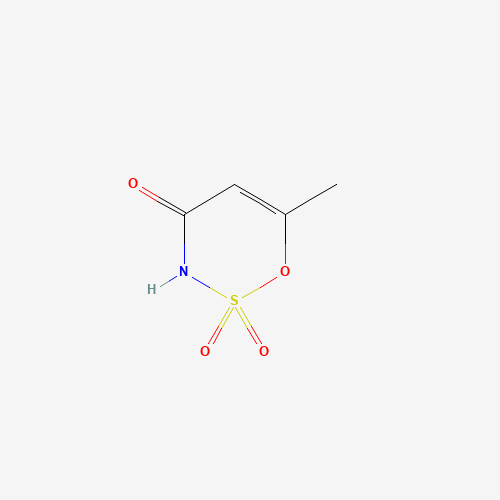
分子式C4H5NO4S
分子量163.15 g/mol
非危品
Acesulfame is a sulfamate ester that is 1,2,3-oxathiazin-4(3H)-one 2,2-dioxide substituted by a methyl group at position 6. It has a role as a xenobiotic, a sweetening agent and an environmental contaminant. It is an organic heteromonocyclic compound, an organonitrogen heterocyclic compound, an oxacycle and a sulfamate ester.
科学粮草官-词典编辑部,修订于:2026-07-06
Toxicity
ToxicityEcotoxicity Values
LC50; Species: Leuciscus Idus (Golden Orfe); Concentration: >1000 mg/L /Conditions of bioassay not specified in source examined/ /Acesulfame K/
Fate Summary
ATMOSPHERIC FATE: According to a model of gas/particle partitioning of semivolatile organic compounds in the atmosphere(1), acesulfame, which has an estimated vapor pressure of 9.0X10⁻⁶ mm Hg at 25 °C(SRC), determined from a fragment constant method(2), will exist in both the vapor and particulate phases in the ambient atmosphere. Vapor-phase acesulfame is degraded in the atmosphere by reaction with photochemically-produced hydroxyl radicals(SRC); the half-life for this reaction in air is estimated to be 11 hours(SRC), calculated from its rate constant of 3.6X10⁻¹¹ cu cm/molecule-sec at 25 °C(SRC) that was derived using a structure estimation method(2). Vapor-phase acesulfame is also degraded in the atmosphere by reaction with ozone(SRC); the half-life for this reaction in air is estima...
Soil Adsorption / Mobility
Using a structure estimation method based on molecular connectivity indices(1), the Koc of acesulfame can be estimated to be 4(SRC). According to a classification scheme(2), this estimated Koc value suggests that acesulfame is expected to have very high mobility in soil. The pKa of acesulfame is 2.0(3), indicating that this compound will exist almost entirely in the anion form in the environment and anions generally do not adsorb more strongly to soils containing organic carbon and clay than their neutral counterparts(4). Batch sorption tests in several soils found low adsorption of acesulfame with estimated Kd values of <0.1 L/kg(5).
Environmental Biodegradation
AEROBIC: Acesulfame is not eliminated in wastewater treatment plants located in the Canton of Zurich, Switzerland and was shown to be very persistent in surface waters(1). Incubation using activated sludge resulted in no degradation within 7 hours at 15 °C(1). In laboratory experiments simulating a fixed-bed reactor, no biodegradation of acesulfame (at 9 ug/L) was observed over a 56-day incubation period using aqueous compost and soil extract inocula(2); only in diluted effluent of a wastewater treatment plant, biodegradation started after 17 days of operation and acesulfame completely faded within 28 days(2). Flow-through column experiments and long-term observations at different concentration levels yielded no biodegradation of acesulfame(2). A long-term sampling campaign over a perio...
Environmental Bioconcentration
An estimated BCF of 3 was calculated in fish for acesulfame(SRC), using an estimated log Kow of -1.33(1) and a regression-derived equation(1). According to a classification scheme(2), this BCF suggests the potential for bioconcentration in aquatic organisms is low(SRC).
Volatilization from Water / Soil
A pKa of 2.0(1) indicates acesulfame will exist almost entirely in the anion form at pH values of 5 to 9 and, therefore, volatilization from water surfaces or moist soil is not expected to be an important fate process(SRC). Acesulfame is not expected to volatilize from dry soil surfaces(SRC) based upon an estimated vapor pressure of 9.0X10⁻⁶ mm Hg(SRC), determined from a fragment constant method(2).
Environmental Abiotic Degradation
Artificial sweeteners have been recognized as emerging contaminants due to their wide application, environmental persistence and ubiquitous occurrence. Among them, acesulfame has attracted much attention. After being discharged into the environment, acesulfame undergoes photolysis naturally. However, acesulfame photodegradation behavior and identity of its transformation products, critical to understanding acesulfame's environmental impact, have not been thoroughly investigated. The present study aimed to fill this knowledge gap by a laboratory simulation study in examining acesulfame transformation products and pathways under UV-C photolysis in the presence of TiO2. Photodegradation products of acesulfame were isolated and analyzed using the LC-IM-QTOF-MS coupled with LC Ion Trap MS in...
Environmental Water Concentrations
DRINKING WATER: Tap water samples collected at five sites in Tianjin China in 2011 detected acesulfame concentrations of approximately 600-675 ng/L(1).
Food Survey Values
Most diet drinks dispensed from a beverage dispenser, ie, soda fountain, contain a blend of aspartame and saccharin or aspartame, acesulfame-K and saccharin, instead of 100% aspartame(1).
Ecotoxicity Excerpts
/AQUATIC SPECIES/ Acesulfame (ACE) is listed as an emerging contaminant due to its environmental persistence and wide occurrence in the environment. ACE can be degraded partially in the regular UV disinfection process but the eco-toxicity of its irradiation products remains unclear. This study focused on the possible oxidative status change in the liver of Carassius auratus exposed to ACE and its irradiation products. The UV degradation of ACE follows pseudo-first-order kinetics, and eight irradiation products were identified. Fish were exposed 7 days to 0.1 and 10 mg/L ACE (ACE group) and ACE after UV irradiance (ACE-UV group). The oxidative stress in fish liver exposed to ACE group had no distinct change. However, in the ACE-UV group, the quantity of OH was induced by 17.96-55% and th...
Atmospheric Concentrations
URBAN/SUBURBAN: Ambient air monitoring conducted in Tianjin China in 2011 detected acesulfame in both the gas and particulate phases at concentrations of 1.60-5.80 and 2.50-18.0 pg/cu m respectively(1). Acesulfame was also detected in precipitation samples at levels of approximately 20-150 ng/L(1).
Artificial Pollution Sources
Acesulfame's production and use as an artificial sweetener(1) may result in its release to the environment through various waste streams(SRC). Acesulfame is discharged into surface waters by domestic wastewater treatment effluents due to incomplete degradation and retention during wastewater treatment causing ubiquitous occurrence in the aquatic environment(2).
Probable Routes of Human Exposure
Occupational exposure to acesulfame may occur through inhalation and dermal contact with this compound at workplaces where acesulfame is produced or used. Monitoring and use data indicate that the general population may be exposed to acesulfame via ingestion of consumer products and ingestion of contaminated drinking water containing acesulfame. (SRC)
Environmental Fate / Exposure Summary
Acesulfame's production and use as an artificial sweetener may result in its release to the environment through various waste streams. Acesulfame is discharged into surface waters by domestic wastewater treatment effluents due to incomplete degradation and retention during wastewater treatment causing ubiquitous occurrence in the aquatic environment. If released to air, an estimated vapor pressure of 9.0X10⁻⁶ mm Hg at 25 °C indicates acesulfame will exist in both the vapor and particulate phases in the atmosphere. Vapor-phase acesulfame will be degraded in the atmosphere by reaction with photochemically-produced hydroxyl radicals and by reaction with ozone; the half-lives for these reactions in air are estimated to be 11 hours and 1 day respectively. Particulate-phase acesulfame will be...
Interactions
Human bitter taste is mediated by the hTAS2R family of G protein-coupled receptors. ... /This study/ employed a high-throughput screening approach to discover a novel bitter receptor antagonist (GIV3727) that inhibits activation of hTAS2R31 (formerly hTAS2R44) by saccharin and acesulfame K, two common artificial sweeteners. Pharmacological analyses revealed that GIV3727 likely act/ed/ as an orthosteric, insurmountable antagonist of hTAS2R31. Surprisingly, ... /it was/ also found that this compound could inhibit five additional hTAS2Rs, including the closely related receptor hTAS2R43. Molecular modeling and site-directed mutagenesis studies suggest/ed/ that two residues in helix 7 are important for antagonist activity in hTAS2R31 and hTAS2R43. In human sensory trials, GIV3727 significant...
Toxicity Summary
IDENTIFICATION AND USE: Acesulfame (AS) is a solid. It is used as artificial sweetener for food, also used in cosmetics. HUMAN STUDIES: A case study is reported whereby an individual with known sulfite and sulfonamide allergies develops hypersensitivity to taurine above a threshold level as well as to the non-nutritive sweetener acesulfame potassium, compounds that are not normally associated with allergic reactions. In vitro studies suggested that long-term consumption of AS might accelerate atherosclerosis and senescence via impairment of function and structure of apoA-I and HDL. ANIMAL STUDIES: Acesulfame K was non-irritant in a primary dermal irritation test in the rabbit. Acesulfame K showed no antigenic effect and only the guinea pigs sensitized with BSA showed anaphylactic reacti...
Average Daily Intake
FDA and JECFA (Joint Expert Committee on Food Additives) have established an acceptable daily intake (ADI) of 15 mg per kg of body weight for acesulfame (potassium salt). This is approximately equivalent to 6 cans of diet soft drink. The European Food Safety Authority has set the ADI at 9 mg per kg of body weight(1).
Acceptable Daily Intakes
0-15 mg/kg bw
Non-Human Toxicity Values
LD50 Rat ip 2243 mg/kg /Acesulfame K/
Antidote and Emergency Treatment
/SRP:/ Advanced treatment: Consider orotracheal or nasotracheal intubation for airway control in the patient who is unconscious, has severe pulmonary edema, or is in severe respiratory distress. Positive-pressure ventilation techniques with a bag valve mask device may be beneficial. Consider drug therapy for pulmonary edema ... . Consider administering a beta agonist such as albuterol for severe bronchospasm ... . Monitor cardiac rhythm and treat arrhythmias as necessary ... . Start IV administration of D5W TKO /SRP: "To keep open", minimal flow rate/. Use 0.9% saline (NS) or lactated Ringer's (LR) if signs of hypovolemia are present. For hypotension with signs of hypovolemia, administer fluid cautiously. Watch for signs of fluid overload ... . Treat seizures with diazepam or lorazepam...
Effects During Pregnancy and Lactation
Relevant published information was not found as of the revision date.