


 一键配货
一键配货
化合物详情
CAS34123-59-6
分子式C12H18N2O
分子量206.28 g/mol
非危品
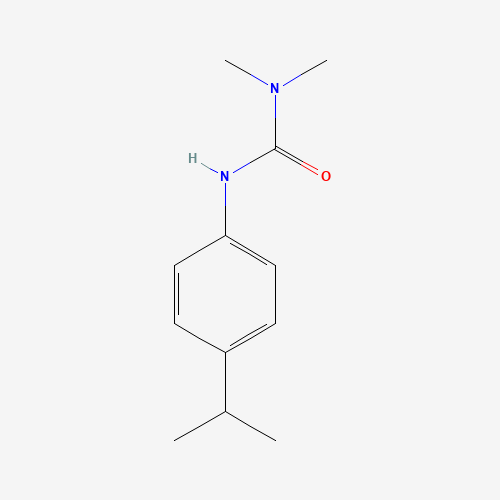
Isoproturon is a member of the class of phenylureas that is 1,1-dimethylurea substituted by a p-cumenyl group at position 3. A selective, systemic herbicide used to control annual grasses and broadleaf weeds in cereals, its use within the EU has been banned after September 2017 on the grounds of potential groundwater contamination and risks to aquatic life; there have also been concerns about its endocrine-disrupting properties. It has a role as a herbicide, an agrochemical, a xenobiotic and an environmental contaminant.
科学粮草官-词典编辑部,修订于:2026-07-06
Toxicity
ToxicityFate Summary
ATMOSPHERIC FATE: According to a model of gas/particle partitioning of semivolatile organic compounds in the atmosphere(1), isoproturon, which has a vapor pressure of 2.47X10⁻⁸ mm Hg at 25 °C(2), will exist in both the vapor and particulate phases in the ambient atmosphere. Vapor-phase isoproturon is degraded in the atmosphere by reaction with photochemically-produced hydroxyl radicals(SRC); the half-life for this reaction in air is estimated to be 1.3 days(SRC), calculated from its rate constant of 1.20X10⁻¹¹ cu cm/molecule-sec at 25 °C(3). Particulate-phase isoproturon may be removed from the air by wet and dry deposition(SRC). Isoproturon absorbs UV light at 245 nm(4) and, therefore, is not expected to be susceptible to direct photolysis by sunlight since sunlight consists of wavelen...
Environmental Biodegradation
PURE CULTURE: Isoproturon (IPU) degradation in an agricultural soil inoculated with an isolated IPU-degrader strain (Sphingomonas sp. strain AK1, IS) or a microbial consortium (MC) harboring this strain, with or without carrier material, were investigated in soil microcosm experiments during 46 days. Effect of the carrier material and inoculation size on IPU-degradation efficacy of the inoculants were studied. Mineralization, extractable residues and non-extractable residues of 14C-labeled IPU were analyzed. The low IPU mineralization in untreated soil (7.0%) was enhanced to different extents by inoculation of IS (17.4%-46.0%) or MC (58.9%-67.5%). Concentrations of IPU residues in soils amended with MC (0.002-0.095 ug/g dry soil) were significantly lower than in soils amended with IS (0...
Environmental Bioconcentration
An estimated BCF of 40 was calculated in fish for isoproturon(SRC), using a log Kow of 2.87(1) and a regression-derived equation(2). According to a classification scheme(2), this BCF suggests the potential for bioconcentration in aquatic organisms is moderate(SRC).
Volatilization from Water / Soil
The Henry's Law constant for isoproturon is estimated as 1.9X10⁻⁹ atm-cu m/mole(SRC) derived from its vapor pressure, 2.47X10⁻⁸ mm Hg(1), and water solubility, 65 mg/L(1). This Henry's Law constant indicates that isoproturon is expected to be essentially nonvolatile from water and moist soil surfaces(2). Isoproturon is not expected to volatilize from dry soil surfaces(SRC) based upon its vapor pressure(1).
Environmental Abiotic Degradation
The photocatalytic degradation of isoproturon, a persistent toxic herbicide, was investigated in the presence of natural iron oxide and oxalic acid and under UV irradiation. The influence of the relevant parameters such as the pH and the iron oxide and oxalic acid concentrations has been studied. The presence of natural iron oxide and oxalic acid in the system effectively allow the degradation of isoproturon, whereas the presence of t-butyl alcohol adversely affects the phototransformation of the target pollutant, thus indicating that an OH radical initiated the degradation mechanism. The degradation mechanism of isoproturon was investigated by means of GC-MS analysis. Oxidation of both the terminal N-(CH3)2 and isopropyl groups is the initial process leading to N-monodemethylated (NHCH...
Effluent Concentrations
Pesticide residues are frequently found in water bodies and may threaten freshwater ecosystems and biodiversity. In addition to runoff or leaching from treated agricultural fields, pesticides may enter streams via effluents from wastewater treatment plants (WWTPs). We compared the pesticide toxicity in terms of log maximum Toxic Unit (log mTU) of sampling sites in small agricultural streams of Germany with and without WWTPs in the upstream catchments. We found an approximately half log unit higher pesticide toxicity for sampling sites with WWTPs (p < 0.001). Compared to fungicides and insecticides, herbicides contributed most to the total pesticide toxicity in streams with WWTPs. A few compounds (diuron, terbuthylazin, isoproturon, terbutryn and Metazachlor) dominated the herbicide toxi...
Artificial Pollution Sources
Isoproturon's production may result in its release to the environment through various waste streams; it's use as a pre- and post-emergence herbicide(1) will result in its direct release to the environment(SRC). It is not marketed in the US(2).
Probable Routes of Human Exposure
Occupational exposure to isoproturon may occur through inhalation and dermal contact with this compound at workplaces where isoproturon is produced or used. Monitoring data indicate that the general population may be exposed to isoproturon via contact with contaminated water. In the US, exposure should be low or non-existent since isoproturon is no longer used in the US. (SRC)
Environmental Fate / Exposure Summary
Isoproturon's production may result in its release to the environment through various waste streams; its use as an herbicide will result in its direct release to the environment. It is not marketed in the US. If released to air, a vapor pressure of 2.47X10⁻⁸ mm Hg at 25 °C indicates isoproturon will exist in both the vapor and particulate phases in the atmosphere. Vapor-phase isoproturon will be degraded in the atmosphere by reaction with photochemically-produced hydroxyl radicals; the half-life for this reaction in air is estimated to be 1.3 days. Particulate-phase isoproturon will be removed from the atmosphere by wet and dry deposition. Isoproturon absorbs UV light at 245 nm and, therefore, is not expected to be susceptible to direct photolysis by sunlight since sunlight consists of...
Toxicity Summary
IDENTIFICATION AND USE: Isoproturon is a solid. It was formerly used in the United States as pre- and post-emergence herbicide for control of annual grasses and broad-leaved weeds. HUMAN STUDIES: Micronucleus induction was observed in human lymphocytes exposed to 100 uM isoproturon. ANIMAL STUDIES: Repeated applications of isoproturon technical (IPT) and its wettable powder formulation (IPF) to the skin of male and female rats for 21 days caused mild to moderate toxic effects. IPT was more toxic to male rats as evidenced by animal mortality and enzymatic and hematological changes. The toxicity of IPF was less to both sexes. In adult male rats exposed to isoproturon, testis showed degeneration and desquamation of cells of germinal layers. Tubular lumens of testis and epididymis exhibited...
Human Toxicity Excerpts
/ALTERNATIVE and IN VITRO TESTS/ To evaluate possible deleterious effects of commonly used herbicides on leukocytes, cytokine production was selected as a sensitive indicator. After in vitro exposure of human peripheral blood mononuclear cells from normal donors, the production of all 3 cytokines tested--interferon-gamma (a type 1 cytokine), interleukin-5 (a type 2 cytokine) and tumor necrosis factor-alpha (an inflammatory cytokine)--was impaired by up to 70, 50 and 70% respectively in a concentration-dependent manner in cultures exposed to atrazine (0.03-3 uM in 1% dimethylsulfoxide, DMSO). The effect paralleled that seen with dexamethasone, a known immunosuppressive agent. Other pesticides also dissolved in DMSO - mecoprop, simazine or MCPA (each up to 1 uM) - or dissolved in phosphat...









