


 一键配货
一键配货
化合物详情
CAS35367-38-5
分子式C14H9ClF2N2O2
分子量310.68 g/mol
非危品
Physical Description | Diflubenzuron appears as colorless to yellow crystals. Used as a selective insecticide.
科学粮草官-词典编辑部,修订于:2026-07-06
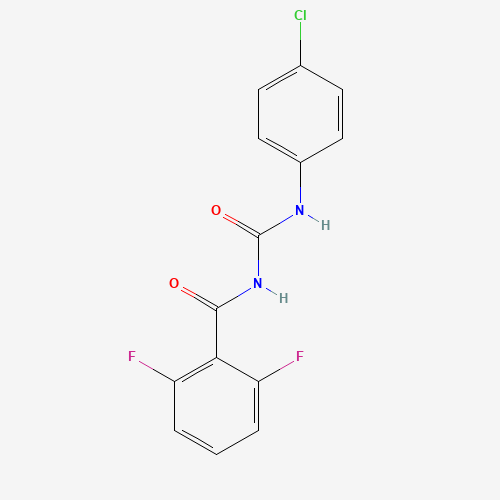
Toxicity
ToxicityBody Burden
Based on a pesticide residue study in oranges and an estimated annual intake of oranges of 22.26 kg/person, the estimated average daily intake of diflubenzuron is 0.042 ug/kg body wt/day(1).
EPA Ecotoxicity
Pesticide Ecotoxicity Data from EPA: 99
Fate Summary
ATMOSPHERIC FATE: According to a model of gas/particle partitioning of semivolatile organic compounds in the atmosphere(1), diflubenzuron, which has a vapor pressure of 9X10⁻¹⁰ mm Hg at 25 °C(2) is expected to exist solely in the particulate phase in the ambient atmosphere. Particulate-phase diflubenzuron may be removed from the air by wet and dry deposition(SRC). Diflubenzuron has been shown to degrade through direct photolysis in sunlight(3,4) suggesting that photolysis may occur in the atmosphere(SRC).
Soil Adsorption / Mobility
Diflubenzuron has reported Koc values of 6,790 and 10,600(1). According to a classification scheme(2), these Koc values suggest that diflubenzuron is expected to be immobile in soil. Binding to soil is an important transport process for diflubenzuron based on soil Kd values for sand clay, silty clay loam, silt loam, sand loam, sandy clay loam, clay, clay hydrosoil, and peat hydrosoil of 40, 40, 20, 25, 130, 110, 150, and 3500, respectively(3). Diflubenzuron is classified as relatively immobile in soil based on Rf values were 0.01, 0.07, 0.14, and 0.34 for silty clay loam, clay loam, and two sand loam soils, respectively(3). In field tests, diflubenzuron was not detectable below the 0-15 cm soil depth segment over a 60-day period(3). In water tank studies, diflubenzuron adsorbed to sedim...
Environmental Biodegradation
PURE CULTURE: Diflubenzuron was reported to be moderately stable to degradation by the soil microorganism, Pseudomonas putida(1).
Environmental Bioconcentration
Reported bioconcentration factors for diflubenzuron in bluegill sunfish (Lepomis macrochirus) ranged from 34 to 200 for fillet and 78 to 360 for whole fish(1). According to a classification scheme(2), these BCF ranges suggest the potential for bioconcentration in aquatic organisms is moderate to high. Diflubenzuron depurates rapidly in fish tissue(1); the depuration rate indicates a rapid decrease (99%) of accumulated residues in tissue during a 14-day depuration period.
Volatilization from Water / Soil
The Henry's Law constant for diflubenzuron is estimated as 4.6X10⁻⁹ atm-cu m/mole(SRC) derived from its vapor pressure, 9X10⁻¹⁰ mm Hg(1), and water solubility, 0.08 mg/L(1). This Henry's Law constant indicates that diflubenzuron is expected to be essentially nonvolatile from water surfaces(2). Diflubenzuron's Henry's Law constant indicates that volatilization from moist soil surfaces is not expect to occur(SRC). Diflubenzuron is not expected to volatilize from dry soil surfaces(SRC) based upon its vapor pressure(1).
Environmental Abiotic Degradation
The hydrolysis half-life of diflubenzuron at pH 5 and pH 7 was determined to be >180 days at 25 °C(1); at pHs 5 and 7, 90% remained unchanged after 4 weeks(2); at pH 9, the hydrolysis half-life was 32.5 days(1). Diflubenzuron (0.1 ppm) exhibited a 3-5% loss after 8 hr in tap water at 10 °C and pH 7.7-10; at 38 °C, a 4% loss was observed at pH 7.7 and a 22% loss was observed at pH 10 after 8 hr(3). At 24 °C, an average 10% loss was observed after 9 days for diflubenzuron in tap water at pH 7.7 and an average 27% loss was observed after 9 days at pH 10(3). The hydrolysis half-life of diflubenzuron in aqueous solution at 36 °C and pH 6 was reported as 7 days and at pH 10 was less than 3 days(4). The following 7 hydrolysis products were identified:(4-chlorophenyl)urea, 2,6-difluorobenzoic a...
Food Survey Values
Dislodgeable residues of diflubenzuron were identified 1 and 29 days post-application (March-April, 1978) at respective concentrations of 0.40 and 0.32 ppm on the fruit in an orange grove in Florida(1). Dislodgeable residues of diflubenzuron were identified 1 and 29 days post-application (July-August, 1978) at respective concentrations of 0.18 and 0.07 ppm on the fruit in an orange grove in Florida(1). In a monitoring study in Valencia Spain where 150 orange fruit samples were collected between Sept 1998 and June 1999, diflubenzuron was detected in 20 samples and concentrations ranging from 0.003-1.8 mg/kg(2).
Milk Concentrations
Following oral administration, diflubenzuron is absorbed, extensively metabolized, and almost totally excreted by cattle and sheep ... Trace amounts of the larvicide are excreted in milk following high dosages.
Plant Concentrations
During the use of diflubenzuron in the suppression of insect defoliators, residues were detected 21 days after application at a concentration of 0.18 ppm on foliage at Sleepy Creek Public Hunting and Fishing Area, Morgan County, WV(1). Dislodgeable residues of diflubenzuron were identified 1 and 29 days postapplication (March-April, 1978) at respective concentrations of 0.17 and 0.13 ppm on the leaves in an orange grove in Florida(2). Dislodgeable residues of diflubenzuron were identified 1 and 29 days postapplication (July-August, 1978) at respective concentrations of 0.10 and 0.05 ppm on the leaves in an orange grove in Florida(2). Diflubenzuron was detected on leaves in a Pennsylvania forest that was recently sprayed at concentrations of 7.2-235.22 ng/sq cm on the upper canopy and 5....
Animal Concentrations
During the use of diflubenzuron in the suppression of insect defoliators, residues were detected at a concentration of 0.09 ppm in canopy birds 21 days post application at Sleepy Creek Public Hunting and Fishing Area, Morgan County, WV; however, no diflubenzuron residues were found in understory birds 21 days after application(1).
Effluent Concentrations
Wastewater influent, effluent and sludge from 25 facilities in 18 US States were analyzed for various biocides, pesticides and degradates including diflubenzuron(1); concentrations of diflubenzuron were below the limit of detection in all matrices(1).
Artificial Pollution Sources
Diflubenzuron's production may result in its release to the environment through various waste streams; its use as an insecticide(1) will result in its direct release to the environment(SRC).
Sediment/Soil Concentrations
SOIL: Dislodgeable residues of diflubenzuron were identified 1 and 29 days post-application (March-April, 1978) at respective concentrations of 0.35 and 0.14 ppm on soil samples taken midway between trees in an orange grove in Florida. In the same study, residues were identified 1 and 29 days post-application at respective concentrations of 2.68 and 1.07 ppm on soil samples taken at the drip line(1).
Probable Routes of Human Exposure
Occupational exposure to diflubenzuron may occur through inhalation of dust particles and dermal contact with this compound at workplaces where diflubenzuron is produced or used. The general population may be exposed to diflubenzuron via ingestion of food products containing diflubenzuron. Since diflubenzuron is sprayed aerially on forests, swamps or vegetation in order to inhibit mosquito or fly growth, the general population may also be exposed to this compound through inhalation and dermal contact with leaves or vegetation. (SRC)
Environmental Fate / Exposure Summary
Diflubenzuron's production may result in its release to the environment through various waste streams; its use as an insecticide will result in its direct release to the environment. If released to air, a vapor pressure of 9X10⁻¹⁰ mm Hg at 25 °C indicates diflubenzuron will exist solely in the particulate phase in the ambient atmosphere. Particulate-phase diflubenzuron will be removed from the atmosphere by wet and dry deposition. Diflubenzuron is susceptible to direct photolysis in sunlight. If released to soil, diflubenzuron is expected to have no mobility based upon a Koc values of 6790 and 10600. Volatilization from moist soil surfaces is not expected to be an important fate process based upon an estimated Henry's Law constant of 4.6X10⁻⁹ atm-cu m/mole. Diflubenzuron is not expected...
Interactions
Aedes aegypti mosquito is one of the most notorious vectors of dangerous diseases like dengue hemorrhagic fever and chikangunya. One method of control of the vectors is by the use of semiochemicals or pheromones. The pheromone n-heneicosane (C21) has been proved to be effective in attracting the female Aedes aegypti to lay eggs in the treated water and the growth of the larva is controlled by insect growth regulator diflubenzuron (DB). This study was planned to assess the safety of C21 alone and the combination with DB. Acute toxicity tests were carried out using two doses, viz., 1600 and 3200 mg/kg and two routes of exposure oral and intra-peritoneal. Dermal toxicity test was carried out in both male and female rats at the dose of 3200 mg/kg. Primary skin irritation test was carried ou...
Target Organs
Hematologic
Toxicity Data
LC50 (rat) > 2,490 mg/m3
Health Effects
One of the metabolites of diflubenzuron, PCA, has severe health effects. It is associated with cancer of the spleen and liver and osteosarcomas in male rats. Another metabolite of diflubenzuron also has carcinogenic potential and the same carcinogenic potency as PCA.
Adverse Effects
Methemoglobinemia - The presence of increased methemoglobin in the blood; the compound is classified as secondary toxic effect
Toxicity Summary
One of the metabolites of diflubenzuron, PCA, is a proximate carcinogen. It is conjugated to form the carcinogen that can ionize and reat with DNA to form adducts which result in splenic tumor formation.
RAIS Toxicity Values
Oral Chronic Reference Dose Reference: IRIS Current
Human Toxicity Excerpts
/OTHER TOXICITY INFORMATION/ The acute oral toxicity of diflubenzuron for humans is low.
Acceptable Daily Intakes
OPP RfD= 0.02 mg/kg; EPA RfD= 0.02 mg/kg; WHO RfD= 0.02 mg/kg
Carcinogen Classification
para-Chloroaniline is possibly carcinogenic to humans (Group 2B). (L135)
Populations at Special Risk
The diflubenzuron metabolite, 4-chloroaniline, has been reported to cause methemoglobinemia in exposed workers and in neonates inadvertently exposed. Some individuals who are deficient in NADH-methemoglobin reductase may be particularly sensitive to 4-chloroaniline and, hence, to diflubenzuron exposure.
1 or Cancer Risk Level 1E-06
Fraction of Contaminant Absorbed Dermally from Soil: 0.1
Evidence for Carcinogenicity
Cancer Classification: Group E Evidence of Non-carcinogenicity for humans
Hazard Quotient Level 3 or Cancer Risk Level 1E-04
Fraction of Contaminant Absorbed Dermally from Soil: 0.1
USGS Health-Based Screening Levels for Evaluating Water-Quality
Reference: Smith, C.D. and Nowell, L.H., 2024. Health-Based Screening Levels for evaluating water-quality data (3rd ed.). DOI:10.5066/F71C1TWP









