

 一键配货
一键配货
化合物详情
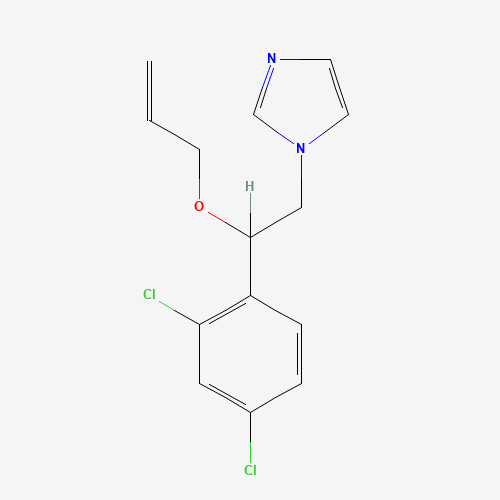
CAS35554-44-0
分子式C14H14Cl2N2O
分子量297.18 g/mol g/mol
危化品
Imazalil can cause cancer according to The Environmental Protection Agency (EPA).
科学粮草官-词典编辑部,修订于:2026-07-06
Toxicity
ToxicityEPA Ecotoxicity
Pesticide Ecotoxicity Data from EPA: 28
Fate Summary
ATMOSPHERIC FATE: According to a model of gas/particle partitioning of semivolatile organic compounds in the atmosphere(1), imazalil, which has a vapor pressure of 1.2X10⁻⁶ mm Hg at 20 °C(2), is expected to exist in both the vapor and particulate phases in the ambient atmosphere. Vapor-phase imazalil is degraded in the atmosphere by reaction with photochemically-produced hydroxyl radicals(SRC); the half-life for this reaction in air is estimated to be 4 hours(SRC), calculated from its rate constant of 8.5X10⁻¹¹ cu cm/molecule-sec at 25 °C(SRC), that was derived using a structure estimation method(3) Particulate-phase imazalil may be physically removed from the air by wet and dry deposition(SRC). Imazalil may undergo direct photolysis in the atmosphere since it was shown to photodegrade...
Soil Adsorption / Mobility
Soil adsorption coefficient Kd values of 182, 209, and 68 were reported in clay loam, sandy loam, and sandy soil, respectively(1). The Koc of imazalil was shown to range from 2,081 to 6,918 in 8 soils (average Koc 4,324)(2). The mobility of C-14 labeled (at 2-ethyl carbon) imazalil was also evaluated in a soil column leaching study(2). Imazalil was found to be immobile in loam and sandy soils. The majority of imazalil remained in the top soil zone (95.7% of the applied was detected in the 0-2.5 cm zone for the loam soil column whereas 84.5% was detected in the same zone for the sand soil column). According to a classification scheme(3), these Koc values suggests that imazalil is expected to have slight to no mobility in soil(SRC).
Environmental Biodegradation
AEROBIC: The biodegradation half-life of imazalil in loam soil under aerobic conditions was 166 days with 2-(2,4-dichlorophenyl)-2-hydroxyethyl-1H-imidazole identified as a degradation product(1).
Environmental Bioconcentration
An estimated BCF of 170 was calculated for imazalil(SRC), using a measured log Kow of 3.82(1) and a regression-derived equation(2). According to a classification scheme(3), this BCF suggests the potential for bioconcentration in aquatic organisms is high(SRC).
Volatilization from Water / Soil
Imazalil is a weak base with pKa of 6.53(1), indicating it will exist partially in the protonated form under environmental conditions(SRC). Volatilization of imazalil is not expected to be an important environmental fate process since cations do not volatilize and the Henry's Law constant for imazalil is estimated as 2.6X10⁻⁹ atm-cu m/mole(SRC) from its experimental values for vapor pressure, 1.2X10⁻⁶ mm Hg(1), and water solubility, 180 mg/L(1). Imazalil is not expected to volatilize from dry soil surfaces(SRC) based on its vapor pressure(1).
Environmental Abiotic Degradation
The rate constant for the vapor phase reaction of imazalil with photochemically produced hydroxyl radicals has been estimated to be 8.5X10⁻¹¹ cu cm/molecule-sec at 25 °C(SRC) using a structure estimation method(1). This corresponds to an atmospheric half-life of about 4 hours at an atmospheric concn of 5X10+5 hydroxyl radicals per cu cm(1). Imazalil was stable to hydrolysis (half-life > 30 days) at pH 5, 7, and 9(2). Imazalil had a photodegradation half-life of 36 hours in aqueous solution(2).
Environmental Water Concentrations
SURFACE WATER: Imazalil was detected in 64 out of 97 surface water samples obtained from streams in a banana growing region of Costa Rica at levels of 1-90 ug/L(1).
Food Survey Values
Imazalil was detected in 28.6% of the bananas sampled in Belgium between 1991 and 1993 at a maximum concentration of 0.89 ppm, and a mean concentration of 0.084 ppm(1). Imazalil was detected in the U.S. food supply during the 1989, 1990, and 1994 Fiscal Years(2,3,4). Imazalil was detected in 56 out of 6391 surveillance samples of U.S. domestic agricultural commodities during the period Oct 1981 to Sept 1986 at concentrations ranging from 0.05 to >2.0 ppm; it was detected in 20 out of 45 oranges, 20 out of 81 grapefruits, 11 out of 26 lemons, 2 out of 16 mandarin oranges, in 1 out of 1 tangellos, 1 out of 13 tangerines, and 1 sample of orange peel feed(5). Imazalil was detected in regulatory monitoring samples of domestic and imported foods which may be eaten by infants/children during 1...
Ecotoxicity Excerpts
/BIRDS and MAMMALS/ The Svalbard population of pink-footed geese Anser brachyrhynchus is concentrated in western Jutland, Denmark, from early March to early May. During spring, the geese shift feeding habitat from grasslands and stubble fields to new-sown fields. To avoid crop damage, grain bait is provided at five sites. The aim of this study was to quantify the exposure of geese to, and the ingestion rates of, pesticide-treated seeds, and to evaluate the potential effects at the individual and the population level. During spring 1994, approximately 7% and 1% of the total number of goose-days were spent on new-sown cereal fields and new-sown pea fields, respectively. After the commencement of sowing, about 25% of all goose-days were spent in new-sown fields. Late-departing individually...
Effluent Concentrations
Imazalil was detected at levels of 1-900 ug/L in 20 out of 31 effluent samples from banana packing plants in Costa Rica(1).
ICSC Environmental Data
The substance is very toxic to aquatic organisms. Avoid release to the environment in circumstances different to normal use.
Artificial Pollution Sources
Imazalil's production and use as a fungicide for the post harvest treatment of bananas and citrus fruits, as a fungicide for the treatment of barley and wheat seeds prior to planting, and as a fungicide to treat equipment and egg storage areas in chicken hatcheries(1) has resulted in its direct release to the environment(SRC).
Sediment/Soil Concentrations
SEDIMENT: Imazalil was detected in 13 out of 25 sediment samples of the Suerte River Basin, Costa Rica (1993-1997 sampling) at levels of 175-960 ug/kg (mean 446 ug/kg)(1).
Probable Routes of Human Exposure
Occupational exposure to imazalil may occur through inhalation of dust particles or aerosols and dermal contact with this fungicide during and after its application or at workplaces where imazalil is produced(SRC). Workers can be exposed to a pesticide through mixing, loading, and/or applying a pesticide, or re-entering treated sites. Occupational handlers of imazalil include: individual farmers or growers who mix, load, and/or apply pesticides, and professional or custom agricultural applicators(1). EPA has also determined that there is potential exposure to workers handling citrus fruits after waxing or foaming, to persons working in chicken hatchery facilities, and to persons handling treated seeds(1). The general population will be exposed to imazalil via ingestion of contaminated f...
Environmental Fate / Exposure Summary
Imazalil's production and use as a fungicide for the post harvest treatment of bananas and citrus fruits, as a fungicide for the treatment of barley and wheat seeds prior to planting, and as a fungicide to treat equipment and egg storage areas in chicken hatcheries has resulted in its direct release to the environment. If released to air, a vapor pressure of 1.2X10⁻⁶ mm Hg at 20 °C indicates imazalil is expected to exist in both the vapor and particulate phases in the ambient atmosphere. Vapor-phase imazalil is degraded in the atmosphere by reaction with photochemically-produced hydroxyl radicals; the half-life for this reaction in air is estimated to be 4 hours. Particulate-phase imazalil may be physically removed from the atmosphere by wet and dry deposition. Imazalil may undergo dire...
Symptoms
Ingestion Exposure: Nausea.
Toxicity Data
LC50 (rat) = 16,000 mg/m3/4h
Adverse Effects
Occupational hepatotoxin - Secondary hepatotoxins: the potential for toxic effect in the occupational setting is based on cases of poisoning by human ingestion or animal experimentation.
Exposure Routes
The substance can be absorbed into the body by inhalation and by ingestion.
RAIS Toxicity Values
Oral Slope Factor Reference: OPP
Human Toxicity Excerpts
/OTHER TOXICITY INFORMATION/ Although the Buehler assay was negative on a 13.5% formulation, cases of sensitivity to the compound have been previously described in Europe and in Central America. The technical material is labeled as a potential sensitizer.
Carcinogen Classification
No indication of carcinogenicity to humans (not listed by IARC).
Non-Human Toxicity Values
LD50 Rat ip 155 mg/kg
1 or Cancer Risk Level 1E-06
Fraction of Contaminant Absorbed Dermally from Soil: 0.1
Antidote and Emergency Treatment
/SRP:/ Advanced treatment: Consider orotracheal or nasotracheal intubation for airway control in the patient who is unconscious, has severe pulmonary edema, or is in severe respiratory distress. Positive-pressure ventilation techniques with a bag valve mask device may be beneficial. Consider drug therapy for pulmonary edema ... . Consider administering a beta agonist such as albuterol for severe bronchospasm ... . Monitor cardiac rhythm and treat arrhythmias as necessary ... . Start IV administration of D5W /SRP: "To keep open", minimal flow rate/. Use 0.9% saline (NS) or lactated Ringer's if signs of hypovolemia are present. For hypotension with signs of hypovolemia, administer fluid cautiously. Watch for signs of fluid overload ... . Treat seizures with diazepam or lorazepam ... . Use...
Hazard Quotient Level 3 or Cancer Risk Level 1E-04
Fraction of Contaminant Absorbed Dermally from Soil: 0.1