


 一键配货
一键配货
化合物详情
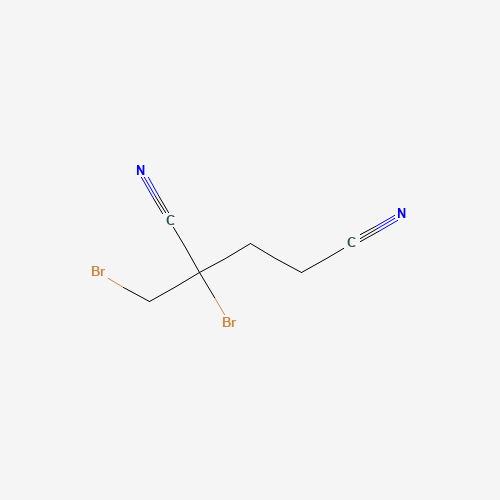
CAS35691-65-7
分子式C6H6Br2N2
分子量265.93 g/mol g/mol
危化品
Physical Description | Crystals with a pungent odor. Insoluble in water. Used as a preservative in latex paint, adhesives, etc.
科学粮草官-词典编辑部,修订于:2026-07-06
Toxicity
ToxicityEPA Ecotoxicity
Pesticide Ecotoxicity Data from EPA: 17
Ecotoxicity Values
LC50; Species: Americamysis bahia (Opossum shrimp); Conditions: flow through; Concentration: 2.7 ppm for 96 hr (95% confidence interval: 2.5-3.2 ppm) /formulated product/
Fate Summary
ATMOSPHERIC FATE: According to a model of gas/particle partitioning of semivolatile organic compounds in the atmosphere(1), 1,2-dibromo-2,4-dicyanobutane, which has a vapor pressure of 5.025X10⁻⁵ mm Hg at 25 °C(2), is expected to exist solely as a vapor in the ambient atmosphere. Vapor-phase 1,2-dibromo-2,4-dicyanobutane is degraded in the atmosphere by reaction with photochemically-produced hydroxyl radicals(SRC); the half-life for this reaction in air is estimated to be 18 days(SRC), calculated from its rate constant of 5.9X10⁻¹³ cu cm/molecule-sec at 25 °C(SRC) that was derived using a structure estimation method(3). 1,2-Dibromo-2,4-dicyanobutane does no contain chromophores that absorb at wavelengths >290 nm(4), and therefore is not expected to be susceptible to direct photolysis by...
Soil Adsorption / Mobility
At concentrations of 0.1 to 1.0 ug/mL, 1,2-dibromo-2,4-dicyanobutane exhibited Koc values of 528 in sand, 87.8 in sandy loam soil, 72.9 in clay loam, and 33.4 in silt loam soil, corresponding to Freundlich coefficients of 0.264, 0.351, 0.474, and 0.701, respectively(1). According to a classification scheme(2), this Koc range suggests that 1,2-dibromo-2,4-dicyanobutane is expected to have moderate to very high mobility in soil.
Environmental Bioconcentration
An estimated BCF of five was calculated in fish for 1,2-dibromo-2,4-dicyanobutane(SRC), using an estimated log Kow of 1.63(1) and a regression-derived equation(2). According to a classification scheme(3), this BCF suggests the potential for bioconcentration in aquatic organisms is low(SRC).
Volatilization from Water / Soil
The Henry's Law constant for 1,2-dibromo-2,4-dicyanobutane is estimated as 8.3X10⁻⁹ atm-cu m/mole(SRC)derived from its vapor pressure, 5.025X10⁻⁵ mm Hg(1), and water solubility, 2.12X10+3 mg/L(1). This Henry's Law constant indicates that 1,2-dibromo-2,4-dicyanobutane is expected to be essentially nonvolatile from water and moist soil surfaces(3). 1,2-Dibromo-2,4-dicyanobutane is not expected to volatilize from dry soil surfaces(SRC) based upon its vapor pressure(1).
Environmental Abiotic Degradation
The rate constant for the vapor-phase reaction of 1,2-dibromo-2,4-dicyanobutane with photochemically-produced hydroxyl radicals has been estimated as 5.9X10⁻¹³ cu cm/molecule-sec at 25 °C(SRC) using a structure estimation method(1). This corresponds to an atmospheric half-life of about 18 days at an atmospheric concentration of 5X10+5 hydroxyl radicals per cu cm(1). 1,2-Dibromo-2,4-dicyanobutane, at starting concentrations of 10 and 40 ug/mL in buffer solutions at 25 °C, exhibited half-lives of 190-198 days at pH 5, 24 to 72.8 days at pH 7, and 12.6 to 14.0 days at pH 9. The major hydrolysis degradate is trans-1-bromo-2,4-dicyanobutene; minor degradates are the cis-isomer and methylene glutaronitrile(2). 1,2-Dibromo-2,4-dicyanobutane does not contain chromophores that absorb at waveleng...
ICSC Environmental Data
Environmental effects from the substance have not been investigated adequately.
Artificial Pollution Sources
1,2-Dibromo-2,4-dicyanobutane's production may result in its release to the environment through various waste streams; its use as a microbiocide/microbiostat against slime-forming bacteria and fungi(1) for latex paints, adhesives, latex emulsions, dispersed pigments, joint cements, and metal working fluids(2) will result in its direct release to the environment(SRC).
Probable Routes of Human Exposure
NIOSH (NOES Survey 1981-1983) has statistically estimated that 17,713 workers (3,345 of these were female) were potentially exposed to 1,2-dibromo-2,4-dicyanobutane in the US(1). Occupational exposure to 1,2-dibromo-2,4-dicyanobutane may occur through inhalation and dermal contact with this compound at workplaces where 1,2-dibromo-2,4-dicyanobutane is produced or used. Use data indicate that the general population may be exposed to 1,2-dibromo-2,4-dicyanobutane via dermal contact consumer products containing 1,2-dibromo-2,4-dicyanobutane(SRC).
Environmental Fate / Exposure Summary
1,2-Dibromo-2,4-dicyanobutane's production may result in its release to the environment through various waste streams; its use as a microbiocide/microbiostat will result in its direct release to the environment. If released to air, a vapor pressure of 5.025X10⁻⁵ mm Hg at 25 °C indicates 1,2-dibromo-2,4-dicyanobutane will exist solely as a vapor in the atmosphere. Vapor-phase 1,2-dibromo-2,4-dicyanobutane will be degraded in the atmosphere by reaction with photochemically-produced hydroxyl radicals; the half-life for this reaction in air is estimated to be 18 days. 1,2-Dibromo-2,4-dicyanobutane does not contain chromophores that absorb at wavelengths >290 nm, and therefore is not expected to be susceptible to direct photolysis by sunlight. If released to soil, 1,2-dibromo-2,4-dicyanobuta...
Symptoms
Ingestion Exposure: Abdominal pain.
Interactions
The present study was undertaken to evaluate the combined effect of the preservative methyldibromo glutaronitrile (MDBGN) and sodium lauryl sulfate (SLS) on the elicitation response of allergic contact dermatitis. 20 volunteers with contact allergy to MDBGN were patch tested with 5 concentrations (10, 50, 100, 500 and 1000 p.p.m.) of MDBGN alone and in combination with 0.25% SLS on the upper arms for 24 hr. Skin reactions were evaluated by clinical scoring, and data were evaluated by logistic dose-response models. Additionally, evaluation of skin reactions was performed by measurement of transepidermal water loss (TEWL) and skin colour. Measurements were obtained at baseline and at D3 and D7. As evaluated by clinical assessment, allergic reactions to MDBGN were elicited at lower concent...
Toxicity Data
LC50 (rat) > 13,000 mg/m3/4h
Adverse Effects
Skin Sensitizer - An agent that can induce an allergic reaction in the skin.
Exposure Routes
The substance can be absorbed into the body by ingestion.
Toxicity Summary
Cosmetic Ingredient Review Finding(s): Safe for use in cosmetics, with qualifications
Human Toxicity Excerpts
/HUMAN EXPOSURE STUDIES/ ... A study group of 1,307 patients (Group 1) suspected of having allergic contact dermatitis was given patch tests using a standard series. Patch tests with Euxyl-K-400, its components methyldibromoglutaronitrile and phenoxyethanol (122996), and imidazolidinyl were performed on 1,109 patients (Group 2). Allergic reactions to Euxyl-K-400 were seen in 24 subjects (2.4%), all of whom also exhibited positive reactions to methyldibromoglutaronitrile. ... Of the chemicals in the supplementary series, allergic reactions were produced in 2.4% of the subjects by Euxyl-K-400 and methyldibromoglutaronitrile.
Carcinogen Classification
Summary: 1,2-dibromo-2,4-dicyanobutane administration induced nonneoplastic lesions at the site of application in male and female rats and mice.
Non-Human Toxicity Values
LD50 Rabbit dermal >5 g/kg /Technical 98%/ /from table/
Non-Human Toxicity Excerpts
/LABORATORY ANIMALS: Acute Exposure/ A ... maximization study was conducted using a commercial formulation containing Methyldibromo Glutaronitrile (20% Methyldibromo Glutaronitrile in 2-phenoxyethanol) on groups of 20 Pirbright guinea pigs (220 g) using intradermal and repeated topical application. Induction consisted of two 0.05 mL injections of each of the following: a 10% dilution in water of the commercial formulation; 10% dilution of the commercial solution in Freund's Complete Adjuvant(FCA) (1:1); and FCA in water (1:1). One week later, a 0.5 mL dermal application of the commercially supplied 20% Methyldibromo Glutaronitrile solution was applied to the injection site (occlusive) and maintained for 24 hr. Three weeks after the first injection, challenge was accomplished via a secon...
Antidote and Emergency Treatment
/SRP:/ Advanced treatment: Consider orotracheal or nasotracheal intubation for airway control in the patient who is unconscious, has severe pulmonary edema, or is in severe respiratory distress. Positive-pressure ventilation techniques with a bag valve mask device may be beneficial. Consider drug therapy for pulmonary edema ... . Consider administering a beta agonist such as albuterol for severe bronchospasm ... . Monitor cardiac rhythm and treat arrhythmias as necessary ... . Start IV administration of D5W /SRP: "To keep open", minimal flow rate/. Use 0.9% saline (NS) or lactated Ringer's if signs of hypovolemia are present. For hypotension with signs of hypovolemia, administer fluid cautiously. Watch for signs of fluid overload ... . Treat seizures with diazepam or lorazepam ... . Use...









