


 一键配货
一键配货
化合物详情
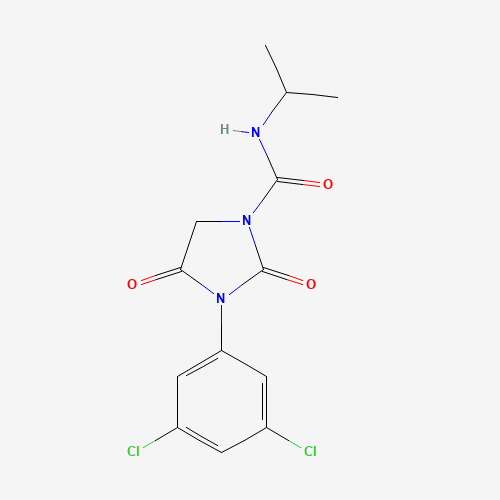
CAS36734-19-7
分子式Cl2C13H13N3O3
分子量330.17 g/mol g/mol
危化品
Iprodione can cause cancer according to The Environmental Protection Agency (EPA).
科学粮草官-词典编辑部,修订于:2026-07-06
Toxicity
ToxicityEPA Ecotoxicity
Pesticide Ecotoxicity Data from EPA: 49
Ecotoxicity Values
LC50 Bluegill sunfish 3.7 mg/l/96 hr /Conditions of bioassay not specified/
Fate Summary
ATMOSPHERIC FATE: According to a model of gas/particle partitioning of semivolatile organic compounds in the atmosphere(1), iprodione, which has a vapor pressure of the 3.75X10⁻⁹ mm Hg at 25 °C(2), is expected to exist solely in the particulate phase in the ambient atmosphere. Particulate-phase iprodione may be removed from the air by wet and dry deposition(SRC).
Soil Adsorption / Mobility
The Koc for iprodione is 700(1). According to a classification scheme(2), this Koc value suggests that iprodione is expected to have low mobility in soil. In one study, an investigation of the leachability of pesticides applied to a golf course was conducted using lysimeters at actual golf courses(3). At a fairway consisting of Korean lawn grass grown over volcanic ash soil, iprodione was applied at 1.5 g/l/sq m. Leachate was collected 40 cm below the surface and analyzed over a 37 day period. At the end of 37 days, a total of 0.2% of the applied iprodione had leached through the fairway soil profile(3).
Environmental Biodegradation
ANAEROBIC: Iprodione degraded with an observed half-life of 7-14 days in anaerobic silt loam sediment(1). As discussed in the abiotic section, iprodione undergoes chemical hydrolysis. As such, it could be expected that degradation in sediments with pH's at or above 7 would be more rapid than in acidic environments due to this additional route of degradation. In the anaerobic study, the sediment was at pH 6.4 and the water at 7.4 suggesting that hydrolysis could have played a major role in the decomposition of iprodione(1).
Environmental Bioconcentration
An estimated BCF of 41 was calculated for iprodione(SRC), using a log Kow of 3.00(1) and a regression-derived equation(2). According to a classification scheme(3), this BCF suggests the potential for bioconcentration is moderate. Under basic conditions, the high rate of hydrolysis(4) for iprodione will decrease the potential for bioconcentration.
Volatilization from Water / Soil
The Henry's Law constant for iprodione is 3.12X10⁻⁹ atm-cu m/mole(1). This Henry's Law constant indicates that iprodione is expected to be essentially nonvolatile from water surfaces(2). Iprodione is also not expected to volatilize substantially from soil due to aerobic soil metabolism, hydrolysis, and its low vapor pressure of 3.75X10⁻⁹ mm Hg(3,4). In addition, an aerobic soil metabolism study indicated that only 5.27% of the applied iprodione had volatilized after 276 days in a sandy loam soil. Of this, 5.23% was radio-labeled carbon dioxide(3).
Environmental Abiotic Degradation
Based upon a vapor pressure of 3.75X10⁻⁹ mm Hg(1), iprodione is expected to exist in the particulate phase in the atmosphere and therefore will not react with atmospheric hydroxyl radicals. Based upon experimental measurements at 60 °C and conversion to pseudo first-order rate constants at 25 °C, the aqueous hydrolysis half-lives of iprodione at respective pHs of 3, 5, 7, and 9 are 545.2, 37.4, 1.1, and 0.015 days(2). On irradiated soils, iprodione degraded with an observed degradation half-life of 7 to 14 days in sandy loam soil that was radiated with a xenon-arc lamp for 8.8 hours/day for 30 days(2). However, in the dark controls, radio labeled iprodione degraded with an observed half-life of 14 to 21 days. Therefore, degradation processes other than photolysis must have been responsi...
Environmental Water Concentrations
SURFACE WATER: Water samples were collected using solid-phase extraction at the mouth of the Shinano River in Niigata Prefecture, Japan from May to September 1996 and analyzed for iprodione (1). Iprodione was not detected (limit of detection = 0.02 ug/ml) in any of the samples.
Food Survey Values
During the 27 month period between January 1st 1992, and March 31st 1994, Agriculture and Agri-Food Canada analyzed 21,982 samples of fruit and vegetable commodities for pesticide residues. Iprodione was detected in cherries (0.5 ppm), grapes (0.1 ppm), nectarines (< 0.05 ppm), peaches (< 0.05 ppm), and raspberries (< 0.05 ppm)(1). Eight adult foods consumed in relatively large quantities by infants/children were selected from the domestic and import monitoring for 1985-1991 in the United States(2). These foods included apple juice, apples, bananas, grape juice, milk, orange juice, oranges, and pears. Of the 10,000 samples analyzed, only two imported foods, these being pears, had detectable quantities of iprodione at a maximum concentration of 0.22 ppm(2). From 1992-1993, the U.S. Food...
Atmospheric Concentrations
Thirty-nine kinds of pesticides were monitored in Kitakyushu city, Japan using a high-volume air sampler(1). After sampling about 700 cu m of air during summer and spring months, iprodione was not detected at a detection limit of 0.2 ng/cu m.
Artificial Pollution Sources
Iprodione's production and use as a fungicide(1,2) is expected to result in its direct release to the environment(SRC).
Probable Routes of Human Exposure
Several incidences of iprodione exposure have been reported to the EPA dating back as early as 1984. These incidences include: in 1994, when a UPS driver was exposed to iprodione after a bag spilled in his truck and he experienced dizziness; in 1995 when a male was sprayed with an aqueous use dilution mixture of iprodione after the rupture of a gauge; in 1994, when individuals alleged they developed skin rashes while working in their garden three days after iprodione and other pesticides were sprayed on crop fields; in 1996, when two workers prepared nonflowering ornamentals for shipment less than one day after foliar application of iprodione and another pesticide. The products were applied at 1 pound and 3 pounds/100 gallons of water. The workers wore rubber gloves to wrap loose vines...
Other Environmental Concentrations
The concentration of iprodione was studied in five different commercial compost samples(1). Iprodione was detected in two of the five samples; one at a concentration of 40.3 ug/kg and the other at 95.5 ug/kg.
Environmental Fate / Exposure Summary
Iprodione's production and use as a fungicide is expected to result in its direct release to the environment through various waste streams. If released to air, a vapor pressure of 3.75X10⁻⁹ mm Hg at 25 °C indicates iprodione will exist solely in the particulate phase in the ambient atmosphere. Particulate-phase iprodione will be removed from the atmosphere by wet and dry deposition. If released to soil, iprodione is expected to have moderate mobility based upon a Koc of 700. Volatilization from moist soil surfaces is not expected to be an important fate process based upon a Henry's Law constant of 3.12X10⁻⁹ atm-cu m/mole. Iprodione is not expected to volatilize from dry soil surfaces based upon its vapor pressure. The US Dept of Agric's Pesticide Properties Database lists a soil half-li...
Target Organs
Reproductive
Toxicity Data
LC50 (rat) > 3,300 mg/m3
Average Daily Intake
Based upon results of the FDA's pesticide residue monitoring program for fiscal year 1988, the avg daily intake of iprodione for various age groups were as follows(1): 6-11 month old: 0.0017 ug/kg body wt/day; 14-16 yr-old males: 0.0013ug/kg body wt/day; 60-65 yr old females: 0.0014 ug/kg body wt/day(1). In September of 1998, the EPA estimated that the exposure of iprodione through the consumption of red meat was 0.002668 ug/kg/day, for poultry was 0.001999 ug/kg/day, and for total dairy was 0.004552 ug/kg/day(2). The estimated exposure for the consumption of grapes, wine and sherry, was 0.0000114 ug/kg/day(2). From June 1984 to April 1986, a U.S. National Total Diet Study was performed that determined the average daily intake of iprodione for infants aged 6-11 months and 2 years was 0....
RAIS Toxicity Values
Oral Slope Factor Reference: OPP
Human Toxicity Excerpts
No human poisonings have been reported.
Carcinogen Classification
No indication of carcinogenicity to humans (not listed by IARC).
Non-Human Toxicity Excerpts
Iprodione exhibits low acute oral and dermal toxicity in laboratory animals.
1 or Cancer Risk Level 1E-06
Fraction of Contaminant Absorbed Dermally from Soil: 0.1
Hazard Quotient Level 3 or Cancer Risk Level 1E-04
Fraction of Contaminant Absorbed Dermally from Soil: 0.1
USGS Health-Based Screening Levels for Evaluating Water-Quality
Reference: Smith, C.D. and Nowell, L.H., 2024. Health-Based Screening Levels for evaluating water-quality data (3rd ed.). DOI:10.5066/F71C1TWP









