


 一键配货
一键配货
化合物详情
CAS37764-25-3
分子式C8H11Cl2NO
分子量208.09 g/mol
非危品
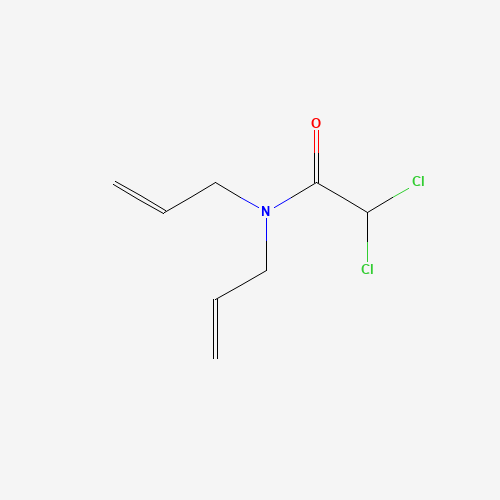
Dichlormid is a tertiary carboxamide.
科学粮草官-词典编辑部,修订于:2026-07-06
Toxicity
ToxicityEPA Ecotoxicity
Pesticide Ecotoxicity Data from EPA: 4
Ecotoxicity Values
LC50; Species: Oncorhynchus mykiss (Rainbow Trout) weight 0.66 g; Conditions: freshwater, static; Concentration: 141000 ug/L for 96 hr (95% confidence interval: 103000-194000 ug/L) /97% purity/
Fate Summary
ATMOSPHERIC FATE: According to a model of gas/particle partitioning of semivolatile organic compounds in the atmosphere(1), dichlormid, which has a vapor pressure of 6.0X10⁻³ mm Hg at 25 °C(SRC), determined from a fragment constant method(2), is expected to exist solely as a vapor in the ambient atmosphere. Vapor-phase dichlormid is degraded in the atmosphere by reaction with photochemically-produced hydroxyl radicals(SRC); the half-life for this reaction in air is estimated to be 5 hrs(SRC), calculated from its rate constant of 7.6X10⁻¹¹ cu cm/molecule-sec at 25 °C(SRC) that was derived using a structure estimation method(2). Vapor-phase dichlormid is degraded in the atmosphere by reaction with ozone(SRC); the half-life for this reaction in air is estimated to be 11 hrs(SRC), calculate...
Soil Adsorption / Mobility
Using a structure estimation method based on molecular connectivity indices(1), the Koc of dichlormid can be estimated to be 120(SRC). According to a classification scheme(2), this estimated Koc value suggests that dichlormid is expected to have high mobility in soil(SRC). Dichlormid leaching in soil is affected by percent organic matter and clay content of soil. Movement was greatest thourgh Galestown sand (90% sand, 7% silt, 3% clay, 0.8% organic matter) and least through a Manor gravelly loam (42% sand, 32% silt, 26% clay, 2.7% organic matter)(3).
Environmental Bioconcentration
An estimated BCF of 8 was calculated in fish for dichlormid(SRC), using a log Kow of 1.84(1) and a regression-derived equation(2). According to a classification scheme(2), this BCF suggests the potential for bioconcentration in aquatic organisms is low(SRC).
Volatilization from Water / Soil
The Henry's Law constant for dichlormid is estimated as 3.3X10⁻⁷ atm-cu m/mole(SRC) derived from its vapor pressure, 6.0X10⁻³ mm Hg(1), and water solubility, 5,000 mg/L(2). This Henry's Law constant indicates that dichlormid is expected to volatilize slowly from water surfaces(3). Based on this Henry's Law constant, the volatilization half-life from a model river (1 m deep, flowing 1 m/sec, wind velocity of 3 m/sec)(3) is estimated as 160 days(SRC). The volatilization half-life from a model lake (1 m deep, flowing 0.05 m/sec, wind velocity of 0.5 m/sec)(3) is estimated as 1,173 days(SRC). Dichlormid's estimated Henry's Law constant indicates that volatilization from moist soil surfaces may occur(SRC). Dichlormid is not expected to volatilize from dry soil surfaces(SRC) based upon its va...
Environmental Abiotic Degradation
The rate constant for the vapor-phase reaction of dichlormid with photochemically-produced hydroxyl radicals has been estimated as 7.6X10⁻¹¹ cu cm/molecule-sec at 25 °C(SRC) using a structure estimation method(1). This corresponds to an atmospheric half-life of about 5 hours at an atmospheric concentration of 5X10+5 hydroxyl radicals per cu cm(1). The rate constant for the vapor-phase reaction of dichlormid with ozone has been estimated as 2.4X10⁻¹⁷ cu cm/molecule-sec at 25 °C(SRC) that was derived using a structure estimation method(1). This corresponds to an atmospheric half-life of about 11 hrs at an atmospheric concentration of 7X10+11 ozone molecules per cu cm(2). Dichlormid is not expected to undergo hydrolysis in the environment due to the lack of functional groups that hydrolyze...
Environmental Water Concentrations
SURFACE WATER: Dichlormid was tested for but not detected in water, according to a German pesticide survey(1).
Ecotoxicity Excerpts
/PLANTS/ The glutathione transferases (GSTs) from maize (Zea mays L.) with activities toward the chloroacetanilide herbicide metolachlor and the diphenyl ether herbicide fluorodifen were fractionated into two pools based on binding to affinity columns. Pool 1 GSTs were retained on Orange A agarose and were identified as isoenzymes Zea mays (Zm) GST I-I, Zm GST I-II and Zm GST I-III, which have been described previously. Pool 2 GSTs selectively bound to S-hexyl-glutathione-Sepharose and were distinct from the pool 1 GSTs, being composed of a homodimer of 28.5 kDa subunits, termed Zm GST V-V, and a heterodimer of the 28.5 kDa polypeptide and a 27.5 kDa subunit, termed Zm GST V-VI. Using an antibody raised to Zm GST V-VI, a cDNA expression library was screened and a Zm GST V clone identifi...
Artificial Pollution Sources
Dichlormid's production may result in its release to the environment through various waste streams; its use as a herbicide safener to enhance herbicide selectivity(1) will result in its direct release to the environment(SRC).
Probable Routes of Human Exposure
Occupational exposure to dichlormid may occur through inhalation and dermal contact with this compound at workplaces where dichlormid is produced or used. Use data indicate that the general population is not likely to be exposed to dichlormid. (SRC)
Environmental Fate / Exposure Summary
Dichlormid's production may result in its release to the environment through various waste streams; its use as a herbicide safener to enhance herbicide selectivity will result in its direct release to the environment. If released to air, a vapor pressure of 6.0X10⁻³ mm Hg at 25 °C indicates dichlormid will exist solely as a vapor in the atmosphere. Vapor-phase dichlormid will be degraded in the atmosphere by reaction with photochemically-produced hydroxyl radicals; the half-life for this reaction in air is estimated to be 5 hrs. Vapor-phase dichlormid will be degraded in the atmosphere by reaction with ozone; the half-life for this reaction in air is estimated to be 11 hrs. Dichlormid contains chromophores that absorb at wavelengths >290 nm and, therefore, may be susceptible to direct p...
Interactions
The effects of individual or combined treatment of the cyclohexanedione herbicide sethoxydim and the safener dichlormid on total lipid synthesis, protein synthesis and acetyl-CoA carboxylase (ACCase, EC 6.4.1.12) activity of grain sorghum [Sorghum bicolor (L.) Moench, var. G623] were investigated. Sethoxydim and dichlormid were tested at concentrations of 0, 5, 50, and 100 uM each. Sethoxydim applied alone at 50 and 100 uM, inhibited the incorporation of (14)C-acetate into total lipids of sorghum leaf protoplasts by more than 50%, following a 4 hr incubation. Dichlormid antagonized partially the inhibitory effects of sethoxydim on the incorporation of acetate into total lipids of sorghum protoplasts only when it was used at 100 uM. Sethoxydim applied alone inhibited the incorporation of...
Toxicity Summary
IDENTIFICATION AND USE: Dichlormid is used to increase tolerance of corn to chloroacetanilide and thiocarbamate herbicides. It can also be effective in phytoremediation of water polluted with metals (or other toxic compounds). HUMAN STUDIES: Dichlormid alone did not produce any damage to human erythrocytes and did not elicit any changes in oxidative stress parameters. Combination of dichlormid with another herbicide did not attenuate hemolysis of erythrocytes compared to the herbicide alone. Dichlormid reduced lipid peroxidation induced by herbicides, which suggest the role of safeners as antioxidants. ANIMAL STUDIES: Dichlormid is mildly irritating to the skin of rabbits and severely irritating to the eyes of rabbits. Dichlormid is a mild dermal sensitizer. In a subchronic inhalation t...
RAIS Toxicity Values
Oral Chronic Reference Dose Reference: OPP
Human Toxicity Excerpts
/ALTERNATIVE and IN VITRO TESTS/ Chloroacetamides are used as pre-emergent substances for growth control of annual grasses and weeds. Since they can be harmful for crop plants, protective compounds (safeners) are used along with herbicides. So far, their effects on human blood cells have not been evaluated, and this study is the very first one devoted to this subject. We examined the harmful effects of chloroacetamides, their metabolites and safeners /dichlormid/, used alone or in combination with herbicides, on human erythrocytes measuring the extent of hemolysis, lipid peroxidation and catalase activity. Higher impact of herbicides than their metabolites on all of the investigated parameters was found. Safeners alone did not produce any damage to erythrocytes and did not elicit any ch...
Non-Human Toxicity Values
LD50 Rabbit dermal >2000 mg/kg
Antidote and Emergency Treatment
/SRP:/ Advanced treatment: Consider orotracheal or nasotracheal intubation for airway control in the patient who is unconscious, has severe pulmonary edema, or is in severe respiratory distress. Positive-pressure ventilation techniques with a bag valve mask device may be beneficial. Consider drug therapy for pulmonary edema ... . Consider administering a beta agonist such as albuterol for severe bronchospasm ... . Monitor cardiac rhythm and treat arrhythmias as necessary ... . Start IV administration of D5W TKO /SRP: "To keep open", minimal flow rate/. Use 0.9% saline (NS) or lactated Ringer's (LR) if signs of hypovolemia are present. For hypotension with signs of hypovolemia, administer fluid cautiously. Watch for signs of fluid overload ... . Treat seizures with diazepam (Valium) or l...









