


 一键配货
一键配货
化合物详情
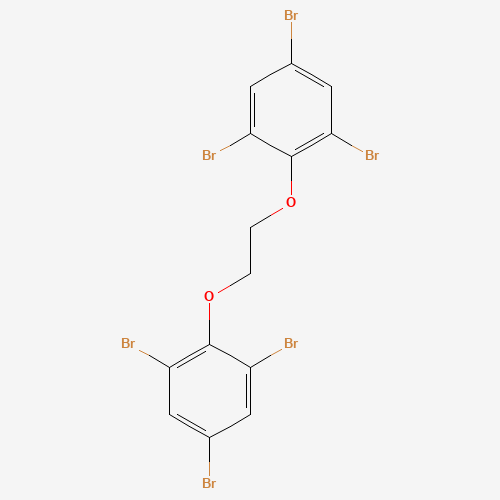
CAS37853-59-1
分子式C14H8Br6O2
分子量687.64 g/mol
非危品
Physical Description | 1,2-bis(2,4,6-tribromophenoxy)ethane is a white powder. (NTP, 1992)
科学粮草官-词典编辑部,修订于:2026-07-06
Toxicity
ToxicityBody Burden
Adults and toddlers were exposed to 1,2-bis(2,4,6-tribromophenoxy)ethane with high dust ingestion at 0.01 ng/kg bw/day and 0.05 ng/kg bw/day, respectively(1). 1,2-Bis(2,4,6-tribromophenoxy) ethane, in paired human maternal serum and breast milk samples was reported at not detected (detection limit 3.2 ng/g lipid) to 16 ng/g lipid and not detected (detection limit 0.86 ng/g lipid), respectively, samples collected from women in Sherbrooke, Canada in 2008 and 2009(2).
Fate Summary
ATMOSPHERIC FATE: According to a model of gas/particle partitioning of semivolatile organic compounds in the atmosphere(1), 1,2-bis(2,4,6-tribromophenoxy)ethane, which has an estimated vapor pressure of 1.9X10⁻¹⁰ mm Hg at 25 °C(SRC), determined from a fragment constant method(2), is expected to exist solely in the particulate phase in the ambient atmosphere. Particulate-phase 1,2-bis(2,4,6-tribromophenoxy)ethane may be removed from the air by wet and dry deposition(SRC). 1,2-Bis(2,4,6-tribromophenoxy)ethane contains chromophores that absorb at wavelengths >290 nm(4) and, therefore, may be susceptible to direct photolysis by sunlight(SRC).
Soil Adsorption / Mobility
The Koc of 1,2-bis(2,4,6-tribromophenoxy)ethane is estimated as 910,000(SRC), using a log Kow of 8.9(1) and a regression-derived equation(2). According to a classification scheme(2), this estimated Koc value suggests that 1,2-bis(2,4,6-tribromophenoxy)ethane is expected to be immobile in soil.
Environmental Biodegradation
AEROBIC: 1,2-Bis(2,4,6-tribromophenoxy)ethane, incubated at concentrations of 1%, 0.01% and 1 ppm, reached only 1.1, 0.53, and 1.41% mineralization, respectively, in a 26 to 30 week period using an acclimated sewage and garden soil inoculum(1).
Environmental Bioconcentration
Juvenile rainbow trout (Oncorhynchus mykiss) were exposed in the laboratory to an environmentally relevant dose of 1,2-bis(2,4,6-tribromophenoxy)ethane (BTBPE) via their diet for 49 days, followed by 154 days of untreated food to examine bioaccumulation parameters, potential biochemical effects, and metabolic products. There was a linear increase in the amount of BTBPE in fish during the uptake phase of the experiment, and an uptake rate constant of 0.0069 +/- 0.0012 (arithmetic mean +/- 1 x standard error) nmoles per day was calculated. The elimination of BTBPE from the fish obeyed first-order depuration kinetics (r2 = 0.6427, p < 0.001) with a calculated half-life of 54.1 +/- 8.5 days. The derived biomagnification factor of 2.3 +/- 0.9 suggests that this chemical has a high potential...
Volatilization from Water / Soil
The Henry's Law constant for 1,2-bis(2,4,6-tribromophenoxy)ethane is estimated as 4.3X10⁻⁷ atm-cu m/mole(SRC) using a fragment constant estimation method(1). This Henry's Law constant indicates that 1,2-bis(2,4,6-tribromophenoxy)ethane is expected to be essentially nonvolatile from water surfaces(2). 1,2-Bis(2,4,6-tribromophenoxy)ethane's Henry's Law constant indicates that volatilization from moist soil surfaces will not occur(SRC). 1,2-Bis(2,4,6-tribromophenoxy)ethane is not expected to volatilize from dry soil surfaces(SRC) based upon an estimated vapor pressure of 1.9X10⁻¹⁰ mm Hg(SRC), determined from a fragment constant method(3).
Environmental Abiotic Degradation
1,2-Bis(2,4,6-tribromophenoxy)ethane is not expected to undergo hydrolysis in the environment due to the lack of functional groups that hydrolyze under environmental conditions(1). 1,2-Bis(2,4,6-tribromophenoxy)ethane contains chromophores that absorb at wavelengths >290 nm(1) and, therefore, may be susceptible to direct photolysis by sunlight(SRC).
Milk Concentrations
ENVIRONMENTAL: 1,2-Bis(2,4,6-tribromophenoxy)ethane was not detected (detection limit 0.86 ng/g lipid) in 105 breast milk samples collected from women in Sherbrooke, Canada, samples were collected 2008-2009(1).
Ecotoxicity Excerpts
/AQUATIC SPECIES/ The phaseout of polybrominated diphenyl ethers (PBDEs) has prompted the search for appropriate substitutes. These substitutes, referred to as novel brominated flame retardants (NBFRs), are poorly characterized in terms of their persistence, bioaccumulation, and toxicity. The authors assessed the bioaccumulation potential of 3 non-PBDE brominated flame retardants: 1,2-bis(2,4,6-tribromophenoxy)ethane (BTBPE), tetrabromobisphenol A bis(2,3-dibromopropylether) (TBBPA-BDBPE), and BZ-54, a mixture of bis(2-ethylhexyl)tetrabromophthalate) (BEH-TEBP) and 2-ethylhexyl-2,3,4,5-tetrabromobenzoate (EH-TBB). Replicate outdoor aquatic mesocosms were treated individually at concentrations designed to give a maximum load of 500 ng/g of flame retardant in the upper 5 cm of the sedimen...
Plant Concentrations
1,2-Bis(2,4,6-tribromophenoxy)ethane was detected at concentrations ranging from 0.50 to 24 ng/g lipid in oak, elm, and pine bark from 29 North American locations, sampled between June 2000 and October 2001(1).
Animal Concentrations
1,2-Bis(2,4,6-tribromophenoxy)ethane was detected in Herring Gull (Larus argentatus) eggs collected from six colonies from Agawa Rock, Gull Island, Channel-Shelter Island, Fighting Island, Niagra River, and Toronto Harbour in the Laurentian Great Lakes at concentrations of 0.06, 0.16, 0.04, 0.26, 0.70, 0.04 ng/g ww, respectively(1). 1,2-Bis(2,4,6-tribromophenoxy)ethane was also detected in Herring Gull eggs in 2006 from seven colonies of the Laurentian Great Lakes (Agawa Rocks, Gull Island, Channel-Shelter Island, Chantry Island, Fighting Island, Niagara River, and Toronto Harbour) at 0.11, <0.06, 0.08, 0.10, 0.20, 0.11, and 0.09 ng/g ww, respectively(2).
Atmospheric Concentrations
Two brominated flame retardants, 1,2-bis(2,4,6-tribromophenoxy)ethane (TBE) and 2,3,4,5,6-pentabromoethylbenzene (PEB), were detected and identified in ambient air samples from various sites in the United States. The identifications were confirmed by comparing the gas chromatographic retention times and mass spectra of the compounds found in the environment with those of authentic materials. Generally, the TBE concentrations in air were comparable to those of tetra- through hexabrominated diphenyl ethers (PBDEs) and often higher than those of decabromodiphenyl ether (BDE-209). The atmospheric TBE concentrations at locations in the southern United States were higher than those in the northern United States. ... These occurrences of relatively high concentrations of TBE and PEB in environ...
Artificial Pollution Sources
1,2-Bis(2,4,6-tribromophenoxy)ethane's production and use as a brominated additive flame retardant(1) for many thermoplastic and thermoset systems(2) may result in its release to the environment through various waste streams(SRC).
Sediment/Soil Concentrations
SEDIMENT: ... 1,2-Bis(2,4,6-tribromophenoxy)ethane (TBE) was ... found in a sediment core from Lake Michigan; the concentrations of TBE increased with time, were lower than those of /decabromoduphenyl ether/ (BDE-209), but were approximately 10 times higher than the sum of BDE-47, -99, and -100. The maximum /2,3,4,5,6-Pentabromoethylbenzene/ (PEB) concentration in Chicago air was 550 pg/ cu m, which was 10 times higher than the concentration of total PBDEs in this sample. In general, the concentrations of PEB in air samples were low but detectable and were less than those of PBDEs. PEB was not found in the sediment core from Lake Michigan. These occurrences of relatively high concentrations of TBE and PEB in environmental samples may reflect the increasing usage of these compounds as fl...
Probable Routes of Human Exposure
1,2-Bis(2,4,6-tribromophenoxy)ethane was detected in the indoor air of a electronic recycling plant after the dismantling of computers, tv sets, etc. at 30 pmol/cu m and in offices with computers at 0.0084 pmol/cu m(1). 1,2-Bis(2,4,6-tribromophenoxy)ethane was detected in the indoor air from a plant that recycled electronic products at 5.6-67 ng/cu m, average 20 ng/cu m(2).
Other Environmental Concentrations
1,2-Bis(2,4,6-tribromophenoxy)ethane was detected in 20 of 30 hard plastic toys (race cars, weapons, hand-held video game consoles, action figures) and 2 of 15 rubber/soft plastic toys (Barbie dolls, teethers) at 2.42-236,515 and 713-3694 ng/g, respectively(1). It was not detected in 18 foam toys (mats, puzzles, swords) or textile/stuffed toys (animals, dolls). All toys were purchased in Guangzhou, China from Oct 2007 to Apr 2008(1).
Environmental Fate / Exposure Summary
1,2-Bis(2,4,6-tribromophenoxy)ethane's production and use as a brominated additive flame retardant for many thermoplastic and thermoset systems may result in its release to the environment through various waste streams. If released to air, an estimated vapor pressure of 1.9X10⁻¹⁰ mm Hg at 25 °C indicates 1,2-bis(2,4,6-tribromophenoxy)ethane will exist solely in the particulate phase in the atmosphere. Particulate-phase 1,2-bis(2,4,6-tribromophenoxy)ethane will be removed from the atmosphere by wet and dry deposition. 1,2-Bis(2,4,6-tribromophenoxy)ethane contains chromophores that absorb at wavelengths >290 nm and, therefore, may be susceptible to direct photolysis by sunlight. If released to soil, 1,2-bis(2,4,6-tribromophenoxy)ethane is expected to have no mobility based upon an estimat...
Toxicity Data
LC (rat) > 36,680 mg/m3/4h
Toxicity Summary
IDENTIFICATION AND USE: 1,2-Bis(2,4,6-tribromophenoxy)ethane (BTBPE) is a white, crystalline powder. It is used as a flame retardant for many thermoplastic and thermoset systems. HUMAN EXPOSURE AND TOXICITY: In occupational setting BTBPE was detected in less than 10% of the human serum samples. ANIMAL STUDIES: There was concordance between the BTBPE-induced transcriptional responses in vitro and in ovo for CYP1A4/5 (up-regulated) and type III iodothyronine 5'-deiodinase (DIO3; down-regulated) in chicken embryonic hepatocytes and chicken embryo. BTBPE was negative in four Salmonella typhimurium strains (TA98, TA100, TA1535, and TA1537) in the presence and absence of metabolic activation. ECOTOXICITY STUDIES: Juvenile rainbow trout (Oncorhynchus mykiss) treated with BTBPE did not show any...
Human Toxicity Excerpts
/OTHER TOXICITY INFORMATION/ Eleven novel brominated flame retardants (NBFRs) were analyzed in dust samples from California homes as a part of the Northern California Childhood Leukemia Study (NCCLS) and from the living quarters of California fire stations as a part of the Firefighter Occupational Exposure (FOX) study using high resolution gas chromatography/mass spectrometry. The eleven NBFRs were alpha- and beta-1,2-dibromo-4-(1,2-dibromoethyl)cyclohexane (alpha- and beta-DBE-DBCH), 2-bromoallyl 2,3,6-tribromophenylether (BATE), pentabromotoluene (PBT), pentabromoethylbenzene (PBEB), 2,3-dibromopropyl 2,4,6-tribromophenyl ether (TBP-DBPE), hexabromobenzene (HBB), 2-ethylhexyl-2,3,4,5-tetrabromobenzoate (EH-TBB), 1,2-bis(2,4,6-tribromophenoxy) ethane (BTBPE), bis(2-ethylhexyl) tetrabro...
Non-Human Toxicity Excerpts
/ALTERNATIVE and IN VITRO TESTS/ Some currently used brominated flame retardants (BFRs), such as hexachlorocyclopentadienyl-dibromocyclooctane (HCDBCO), bis(2-ethylhexyl)tetrabromophthalate (BEHTBP), 1,2-bis(2,4,6-tribromophenoxy)ethane (BTBPE) and decabromodiphenylethane (DBDPE), are persistent organic contaminants detected in various environmental matrices, including wild birds. Data on potential toxicological and molecular responses to exposure of these BFRs are lacking for avian species. A combined in vitro/in ovo approach was used to determine the concentration-dependent effects of these BFRs on overt toxicity and hepatic messenger RNA (mRNA) expression levels of 11 transcripts in primary cultures of chicken embryonic hepatocytes (CEH; all four BFRs) and chicken embryos (HCDBCO and...
Antidote and Emergency Treatment
/SRP:/ Advanced treatment: Consider orotracheal or nasotracheal intubation for airway control in the patient who is unconscious, has severe pulmonary edema, or is in severe respiratory distress. Positive-pressure ventilation techniques with a bag valve mask device may be beneficial. Consider drug therapy for pulmonary edema ... . Consider administering a beta agonist such as albuterol for severe bronchospasm ... . Monitor cardiac rhythm and treat arrhythmias as necessary ... . Start IV administration of D5W TKO /SRP: "To keep open", minimal flow rate/. Use 0.9% saline (NS) or lactated Ringer's (LR) if signs of hypovolemia are present. For hypotension with signs of hypovolemia, administer fluid cautiously. Watch for signs of fluid overload ... . Treat seizures with diazepam or lorazepam...









