

 一键配货
一键配货
化合物详情
CAS39515-40-7
分子式C24H25NO3
分子量375.47 g/mol
非危品
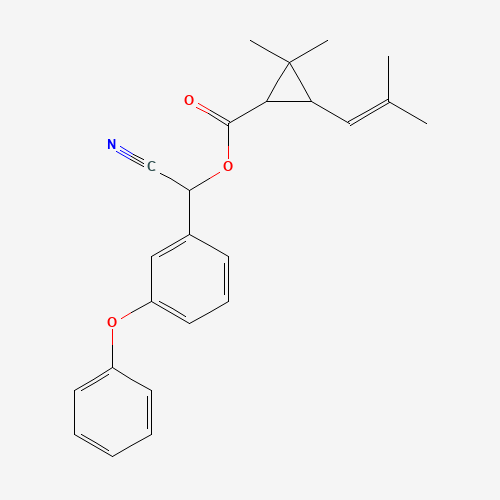
Cyphenothrin is a cyclopropanecarboxylate ester. It has a role as an agrochemical and a pyrethroid ester insecticide. It is functionally related to a chrysanthemic acid.
科学粮草官-词典编辑部,修订于:2026-07-06
Toxicity
ToxicityEPA Ecotoxicity
Pesticide Ecotoxicity Data from EPA: 5
Fate Summary
ATMOSPHERIC FATE: According to a model of gas/particle partitioning of semivolatile organic compounds in the atmosphere(1), cyphenothrin, which has a vapor pressure of 9.0X10⁻⁷ mm Hg at 25 °C(2), will exist in both the vapor and particulate phases in the ambient atmosphere. Vapor-phase cyphenothrin is degraded in the atmosphere by reaction with photochemically-produced hydroxyl radicals(SRC); the half-life for this reaction in air is estimated to be 4 hrs(SRC), calculated from its rate constant of 1.0X10⁻¹⁰ cu cm/molecule-sec at 25 °C(SRC) that was derived using a structure estimation method(3). Vapor-phase cyphenothrin is degraded in the atmosphere by reaction with ozone(SRC); the half-life for this reaction in air is estimated to be 38 minutes(SRC), calculated from its rate constant o...
Soil Adsorption / Mobility
Using a structure estimation method based on molecular connectivity indices(1), the Koc of cyphenothrin can be estimated to be 8.0X10+4(SRC). According to a classification scheme(2), this estimated Koc value suggests that cyphenothrin is expected to be immobile mobility in soil(SRC).
Environmental Bioconcentration
An estimated BCF of 360 was calculated in fish for cyphenothrin(SRC), using a log Kow of 6.29(1) and a regression-derived equation(2). According to a classification scheme(3), this BCF suggests the potential for bioconcentration in aquatic organisms is high(SRC).
Volatilization from Water / Soil
The Henry's Law constant for cyphenothrin is estimated as 4.5X10⁻⁵ atm-cu m/mole(SRC) derived from its vapor pressure, 9.0X10⁻⁷ mm Hg(1), and water solubility, 1.0X10⁻² mg/L(1). This Henry's Law constant indicates that cyphenothrin is expected to volatilize from water surfaces(3). Based on this Henry's Law constant, the volatilization half-life from a model river (1 m deep, flowing 1 m/sec, wind velocity of 3 m/sec)(3) is estimated as 2 days(SRC). The volatilization half-life from a model lake (1 m deep, flowing 0.05 m/sec, wind velocity of 0.5 m/sec)(3) is estimated as 19 days(SRC). However, volatilization from water surfaces is expected to be attenuated by adsorption to suspended solids and sediment in the water column. The estimated volatilization half-life from a model pond is 15 yr...
Environmental Abiotic Degradation
The rate constant for the vapor-phase reaction of cyphenothrin with photochemically-produced hydroxyl radicals has been estimated as 1.0X10⁻¹⁰ cu cm/molecule-sec at 25 °C(SRC) using a structure estimation method(1). This corresponds to an atmospheric half-life of about 4 hours at an atmospheric concentration of 5X10+5 hydroxyl radicals per cu cm(1). The rate constant for the vapor-phase reaction of cyphenothrin with ozone has been estimated as 4.3X10⁻¹⁶ cu cm/molecule-sec at 25 °C(SRC) that was derived using a structure estimation method(1). This corresponds to an atmospheric half-life of about 38 minutes at an atmospheric concentration of 7X10+11 ozone molecules per cu cm(2). In general, pyrethrins and pyrethroids undergo hydrolysis in the environment at varying rates depending on pH a...
Environmental Water Concentrations
No reports of surface water or ground water monitoring studies that included cyphenothrin were found in searches of the United States Geological Survey (USGS) online National Water Quality Assessment Data Warehouse (NAWQA) database, nor the EPA publication, EPA Pesticides in Ground Water, A Compilation of Monitoring Studies 1971-1991 National Summary(1).
Ecotoxicity Excerpts
/AQUATIC SPECIES/ ...The histopathological effects of several doses of cyphenothrin /were observed/. Adult guppies (Lebistes reticulatus) were placed in water containing 34.8, 46.5, 53.5 or 60 micrograms cyphenothrin/L for 96-hr and their gills examined. The most common changes at all cyphenothrin doses were the lifting of the epithelial layer from gill lamellae and some necrosis. Degeneration of secondary lamellae due to edema, the shortening of secondary lamellae, and club-shaped lamellae were also observed. The 96-hr LC50 for cyphenothrin to Lebistes reticulatus was 48.7 ug/L.
Artificial Pollution Sources
Cyphenothrin's production may result in its release to the environment through various waste streams; its use as an insecticide(1) will result in its direct release to the environment(SRC).
Probable Routes of Human Exposure
Occupational exposure to cyphenothrin may occur through inhalation and dermal contact with this compound at workplaces where cyphenothrin is produced or used. Monitoring data indicate that the general population may be exposed to cyphenothrin via inhalation of ambient air, ingestion of food and drinking water, and dermal contact with consumer products containing cyphenothrin. (SRC)
Environmental Fate / Exposure Summary
Cyphenothrin's production may result in its release to the environment through various waste streams; its use as an insecticide will result in its direct release to the environment. If released to air, a vapor pressure of 9.0X10⁻⁷ mm Hg at 20 °C indicates cyphenothrin will exist in both the vapor and particulate phases in the atmosphere. Vapor-phase cyphenothrin will be degraded in the atmosphere by reaction with photochemically-produced hydroxyl radicals and ozone; the half-lives for these reactions in air are estimated to be 4 hrs and 38 minutes, respectively. Particulate-phase cyphenothrin will be removed from the atmosphere by wet and dry deposition. Cyphenothrin contains chromophores that absorb at wavelengths >290 nm and, therefore, may be susceptible to direct photolysis by sunli...
Symptoms
Spilling on the head, face and eyes can result in pain, lacrimation, photophobia, congestion, and edema of the conjunctiva and eyelids. Ingestion cases epigastric pain, nausea, vomiting, headache, dizziness, anorexia, fatigue, tightness in chest, blurred vision, paresthesia, palpitations, coarse muscular fasciculations, and disturbances of conciousness. In servere poisonings, convulsive attacks with opisthotonos and loss of conciousness have occurred. (T10)
Treatment
Following oral exposure, the treatment is symptomatic and supportive and includes monitoring for the development of hypersensitivity reactions with respiratory distress. Provide adequate airway management when needed. Gastric decontamination is usually not required unless the pyrethrin product is combined with a hydrocarbon. Following inhalation exposure, move patient to fresh air. monitor for respiratory distress. If cough or difficulty breathing develops, evaluate for respiratory tract irritation, bronchitis, or pneumonitis. Administer oxygen and assist ventilation as required. Treat bronchospasm with inhaled beta2 agonist and oral or parenteral corticosteroids. In case of eye exposure, irrigate exposed eyes with copious amounts of room temperature water for at least 15 minutes. If ir...
Interactions
Despite the widespread use of pyrethroid insecticides that led to common exposure in the population, few studies have been conducted to quantitatively assess dose-additive effects of pyrethroids using a funcional measure involved in the common toxic mode of action. The aim of this study was to evaluate the potency and efficacy of 6 Type II pyretroids (alpha-cypermethrin, cyfluthrin, lambda-cyhalothrin, deltamethrin, cyphenothrin and esfenvalerate) to evoke induction of both nitric oxide and lipid peroxides levels measured as malondialdehyde in three in vitro models (SH-SY5Y, HepG2 and Caco-2 human cells) as well as to test the hypothesis of dose additivity for mixtures of these same 6 pyrethroids. Concentration-responses for 6 pyrethroids were determined as well as the response to mixtu...
Health Effects
Pyrethroid effects typically include rapid onset of aggressive behavior and increased sensitivity to external stimuli, followed by fine tremor, prostration with coarse whole body tremor, elevated body temperature, coma, and death. Paresthesia, severe corneal damage, hypotension and tachycardia, associated with anaphylaxis, can also occur following pyrethriod poisoning. (L857)
Toxicity Summary
Both type I and type II pyrethroids exert their effect by prolonging the open phase of the sodium channel gates when a nerve cell is excited. They appear to bind to the membrane lipid phase in the immediate vicinity of the sodium channel, thus modifying the channel kinetics. This blocks the closing of the sodium gates in the nerves, and thus prolongs the return of the membrane potential to its resting state. The repetitive (sensory, motor) neuronal discharge and a prolonged negative afterpotential produces effects quite similar to those produced by DDT, leading to hyperactivity of the nervous system which can result in paralysis and/or death. Other mechanisms of action of pyrethroids include antagonism of gamma-aminobutyric acid (GABA)-mediated inhibition, modulation of nicotinic cholin...
Human Toxicity Excerpts
/ALTERNATIVE and IN VITRO TESTS/ Despite the widespread use of pyrethroid insecticides that led to common exposure in the population, few studies have been conducted to quantitatively assess dose-additive effects of pyrethroids using a funcional measure involved in the common toxic mode of action. The aim of this study was to evaluate the potency and efficacy of 6 Type II pyretroids (alpha-cypermethrin, cyfluthrin, lambda-cyhalothrin, deltamethrin, cyphenothrin and esfenvalerate) to evoke induction of both nitric oxide and lipid peroxides levels measured as malondialdehyde in three in vitro models (SH-SY5Y, HepG2 and Caco-2 human cells) as well as to test the hypothesis of dose additivity for mixtures of these same 6 pyrethroids. Concentration-responses for 6 pyrethroids were determined...
Carcinogen Classification
No indication of carcinogenicity to humans (not listed by IARC).