


 一键配货
一键配货
化合物详情
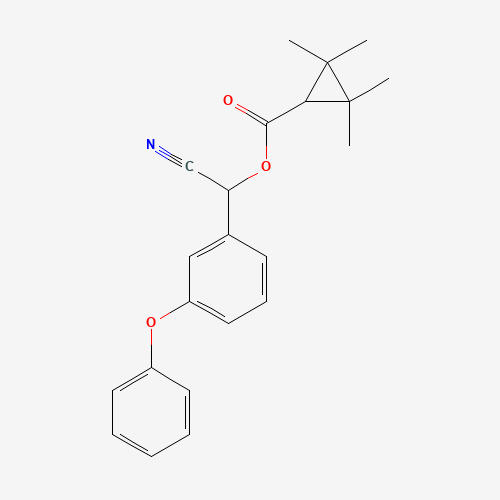
CAS39515-41-8
分子式C22H23NO3
分子量349.43 g/mol
非危品
Physical Description | Yellowish to brown liquid or solid, depending on purity and temperature. Used as an acaricide and insecticide.
科学粮草官-词典编辑部,修订于:2026-07-06
Toxicity
ToxicityEPA Ecotoxicity
Pesticide Ecotoxicity Data from EPA: 62
Ecotoxicity Values
LC50 Bluegill sunfish 1.95 ug/l/48 hr /Conditions of bioassay not specified/
Fate Summary
ATMOSPHERIC FATE: According to a model of gas/particle partitioning of semivolatile organic compounds in the atmosphere(1), fenpropathrin, which has a vapor pressure of 5.48X10⁻⁶ mm Hg at 20 °C (2), is expected to exist in both the vapor and particulate phases in the ambient atmosphere. Vapor-phase fenpropathrin is degraded in the atmosphere by reaction with photochemically-produced hydroxyl radicals(SRC); the half-life for this reaction in air is estimated to be 22 hours(SRC), calculated from its rate constant of 1.8X10⁻¹¹ cu cm/molecule-sec at 25 °C (SRC) determined using a structure estimation method(3). Particulate-phase fenpropathrin may be removed from the air by wet and dry deposition(SRC). Fenpropathrin also undergoes direct photolysis in the atmosphere(4). Fenpropathrin applied...
Soil Adsorption / Mobility
Koc values for fenpropathrin range from 5,000 to 340,000(1). According to a classification scheme(2), these Koc values suggest that fenpropathrin is expected to be immobile in soil(SRC).
Environmental Biodegradation
ANAEROBIC: Fenpropathrin degrades very slowly under anaerobic conditions(1). Eight weeks after its application to both a Kodaira and Azuchi soil (Japan), about 2% of the applied 14C-labeled fenpropathrin evolved as 14C-CO2(1).
Environmental Bioconcentration
An estimated BCF of 190 was calculated for fenpropathrin(SRC), using a log Kow of 6(1) and a regression-derived equation(2). According to a classification scheme(3), this BCF suggests the potential for bioconcentration in aquatic organisms is high(SRC). However, bioconcentration studies on compounds which are structurally similar suggest that bioconcentration may be lower than that indicated by the regression-derived equations due to the ability of aquatic organisms to readily metabolize this class of compounds(4).
Volatilization from Water / Soil
The Henry's Law constant for fenpropathrin is estimated as 1.8X10⁻⁴ atm-cu m/mole(SRC) based upon its vapor pressure, 5.48X10⁻⁶ mm Hg(1), and water solubility, 1.41X10⁻² mg/l(1). This Henry's Law constant indicates that fenpropathrin is expected to volatilize from water surfaces(2). Based on this Henry's Law constant, the volatilization half-life from a model river (1 m deep, flowing 1 m/sec, wind velocity of 3 m/sec)(2) is estimated as 8 days(SRC). The volatilization half-life from a model lake (1 m deep, flowing 0.05 m/sec, wind velocity of 0.5 m/sec)(2) is estimated as 98 days(SRC). However, volatilization from water surfaces is expected to be attenuated by adsorption to suspended solids and sediment in the water column(SRC). The estimated volatilization half-life from a model pond i...
Environmental Abiotic Degradation
The rate constant for the vapor-phase reaction of fenpropathrin with photochemically-produced hydroxyl radicals has been estimated as 1.8X10⁻¹¹ cu cm/molecule-sec at 25 °C(SRC) using a structure estimation method(1). This corresponds to an atmospheric half-life of about 22 hours at an atmospheric concentration of 5X10+5 hydroxyl radicals per cu cm(1). Fenpropathrin adsorbs light in the environmental UV spectrum and undergoes photolysis in the environment. Fenpropathrin applied to silica gel plates and irradiated at 360 nm was photodecomposed 72% after 18 hours(2). The photolysis half-lives of fenpropathrin in distilled water, distilled water with humic acid, river water, and seawater were 13.5, 6, 2.7, and 1.6 weeks, respectively when exposed to sunlight(3). The hydrolysis of fenpropath...
Environmental Water Concentrations
RAIN/FOG: Mean and max concn of dissolved fenpropathrin in rainwater collected at Colmar (eastern France) between 1991 and 1993 was 0.26 and 5 ng/ml, respectively(1); the mean and max concn of dissolved fenpropathrin in fogwater was 2.5 and 17 ng/ml, respectively(1); the mean and max concn of particle bound fenpropathrin in fogwater was 70 and 900 ng/ml, respectively(1).
Atmospheric Concentrations
RURAL/REMOTE: Mean and max concn of fenpropathrin in air (gas phase) collected at Colmar (eastern France) between 1991 and 1993 was 0.5 and 2.7 ng/ml, respectively(1); the mean and max concn of fenpropathrin in air (particulate phase) was 0.6 and 4 ng/ml, respectively(1).
Artificial Pollution Sources
Fenpropathrin's production and use as an insecticide(1) is expected to result in its direct release to the environment(SRC).
Probable Routes of Human Exposure
Occupational exposure to fenpropathrin may occur through inhalation and dermal contact with this compound at workplaces where fenpropathrin is produced or used. Monitoring data indicate that the general population may be exposed to fenpropathrin via inhalation of ambient air containing fenpropathrin. (SRC)
Environmental Fate / Exposure Summary
Fenpropathrin's production and use as an insecticide is expected to result in its direct release to the environment. If released to air, a vapor pressure of 5.48X10⁻⁶ mm Hg at 20 °C indicates fenpropathrin will exist in both the vapor and particulate phases in the ambient atmosphere. Vapor-phase fenpropathrin will be degraded in the atmosphere by reaction with photochemically-produced hydroxyl radicals; the half-life for this reaction in air is estimated to be 22 hours. Particulate-phase fenpropathrin will be removed from the atmosphere by wet and dry deposition. Fenpropathrin is also rapidly degraded by direct photolysis in the atmosphere and should not persist for more than a few days. If released to soil, fenpropathrin is expected to have no mobility based upon Koc values ranging fro...
Symptoms
Following dermal exposure to fenpropathrin, feelings of numbness, itching, burning, stinging, tingling, or warmth may occur, that could last for a few hours. Dizziness, headache, nausea, muscle twitching, reduced energy, and changes in awareness can result from inhalation or ingestion of large amounts of fenpropathrine. Paralysis can occur after exposure. (L857)
Treatment
Following oral exposure, the treatment is symptomatic and supportive and includes monitoring for the development of hypersensitivity reactions with respiratory distress. Provide adequate airway management when needed. Gastric decontamination is usually not required unless the pyrethrin product is combined with a hydrocarbon. Following inhalation exposure, move patient to fresh air. monitor for respiratory distress. If cough or difficulty breathing develops, evaluate for respiratory tract irritation, bronchitis, or pneumonitis. Administer oxygen and assist ventilation as required. Treat bronchospasm with inhaled beta2 agonist and oral or parenteral corticosteroids. In case of eye exposure, irrigate exposed eyes with copious amounts of room temperature water for at least 15 minutes. If ir...
Interactions
At dietary level of 1000 ppm pyrethrins & 10000 ppm piperonyl butoxide ... /enlargement, margination, & cytoplasmic inclusions in liver cells of rats/ were well developed in only 8 days, but ... were not maximal. Changes were proportional to dosage & similar to those produced by DDT. Effects of the 2 ... were additive. /Pyrethrins/
Target Organs
Nervous
Toxicity Data
LD50: 70.6 mg/kg (Oral, Rat) (T58)
Health Effects
At high doses, signs of poisoning attributable to fenpropathrin include profuse salivation and pulmonary edema, clonic seizures, opisthotonos (i.e., the spine is bent forward such that a supine body rests on its head and heels), coma, and death. At lower doses, commonly observed effects include paresthesia and erythema. (L863)
Adverse Effects
Occupational hepatotoxin - Secondary hepatotoxins: the potential for toxic effect in the occupational setting is based on cases of poisoning by human ingestion or animal experimentation.
Exposure Routes
Inhalation (L857); oral (L857); dermal (L857); eye contact (L857).
Toxicity Summary
Pyrethroids exert their effect by prolonging the open phase of the sodium channel gates when a nerve cell is excited. They appear to bind to the membrane lipid phase in the immediate vicinity of the sodium channel, thus modifying the channel kinetics. This blocks the closing of the sodium gates in the nerves, and thus prolongs the return of the membrane potential to its resting state. The repetitive (sensory, motor) neuronal discharge and a prolonged negative afterpotential produces effects quite similar to those produced by DDT, leading to hyperactivity of the nervous system which can result in paralysis and/or death. Other mechanisms of action of pyrethroids include antagonism of gamma-aminobutyric acid (GABA)-mediated inhibition, modulation of nicotinic cholinergic transmission, enha...
RAIS Toxicity Values
Oral Chronic Reference Dose Reference: IRIS Current
Human Toxicity Excerpts
The allergenic properties of pyrethroids /with early pyrethrum preparations/ are marked in comparison with other pesticides. Many cases of contact dermatitis and respiratory allergy have been reported. Persons sensitive to ragweed pollen are particularly prone to such reactions. Preparations containing synthetic pyrethroids are less likely to cause allergic reactions than are the preparations made from pyrethrum powder. /Pyrethroids/
Carcinogen Classification
No indication of carcinogenicity to humans (not listed by IARC).
Non-Human Toxicity Values
LD50 Rabbit percutaneous >2000 mg/kg
Non-Human Toxicity Excerpts
Synthetic pyrethroids are neuropoisons acting on the axons in the peripheral and central nervous systems by interacting with sodium channels in mammals and/or insects. A single dose produces toxic signs in mammals, such as tremors, hyperexcitability, salivation, choreoathetosis, and paralysis. ... At near-lethal dose levels, synthetic pyrethroids cause transient changes in the nervous system, such as axonal swelling and/or breaks and myelin degeneration in sciatic nerves. They are not considered to cause delayed neurotoxicity of the kind induced by some organophosphorus compounds. /Synthetic prethroids/
Populations at Special Risk
Chronic respiratory disease: In persons with chronic respiratory disease, especially asthma, the inhalation of /pyrethroids/ might cause exacerbation of symptoms due to its sensitizing properities. Skin disease: /Pyrethroids/ can cause dermatitis which may be allergic in nature. Persons with pre-existing skin disorders may be more susceptible to the effects of this agent. ... /Pyrethroids/
1 or Cancer Risk Level 1E-06
Fraction of Contaminant Absorbed Dermally from Soil: 0.1
Antidote and Emergency Treatment
Other treatments. Several drugs are effective in relieving the pyrethroid neurotoxic manifestations observed in deliberately poisoned laboratory animals, but none has been tested in human poisonings. Therefore, neither efficacy nor safety under these circumstances is known. Furthermore, moderate neurotoxic symptoms and signs are likely to resolve spontaneously if they do occur. /Pyrethroids/
Hazard Quotient Level 3 or Cancer Risk Level 1E-04
Fraction of Contaminant Absorbed Dermally from Soil: 0.1









