


 一键配货
一键配货
化合物详情
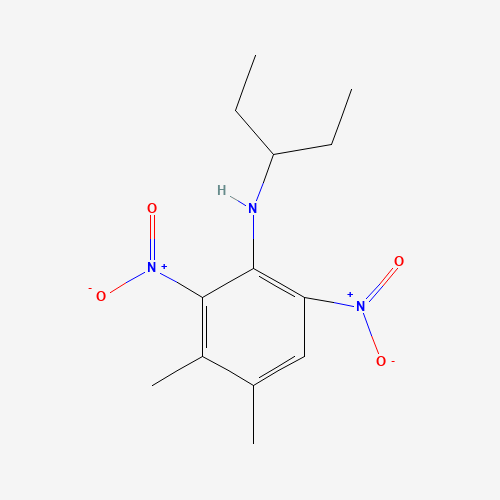
CAS40487-42-1
分子式C13H19N3O4
分子量281.31 g/mol g/mol
危化品
Physical Description | Pendimethalin appears as orange-yellow crystals. Non corrosive. Used as an herbicide.
科学粮草官-词典编辑部,修订于:2026-07-06
Toxicity
ToxicityEPA Ecotoxicity
Pesticide Ecotoxicity Data from EPA: 91
Soil Adsorption / Mobility
Pendimethalin dissipation was studied following annual 1.7 kg ai/ha applications to 3 yr old Kentucky bluegrass turf growing on a Sharpsburg silty clay loam soil and an 85/15 by vol sand/Sharpsburg soil mixt in 150 cm deep rhizotron containers. Plant tissue, thatch, and soil were sampled periodically between application and 168 days after treatment. Soil and leachate were collected to monitor pendimethalin movement. Most of the herbicide appeared to remain within the turfgrass system. Pendimethalin concn was highest in plant tissue and thatch. The 4-hydroxymethyl pendimethalin metabolite was detected in turfgrass tissue up to 42 days after treatment. No pendimethalin was detected at the 30, 60, or 120 cm depths in the rhizotron containers. Traces (<0.003 mg/kg) of pendimethalin detected...
Environmental Biodegradation
ANAEROBIC: A study involving the anaerobic degradation of 14C-pendimethalin in a soil suspension at a redox potential of -240 to -450 mv found that after 4 days, 85% of the recovered radioactivity was as the parent compound and 16% was a benzimidazole; a similar incubation of 13 days gave 88% and 9.5%, respectively(1). The radioactivity recoverable after 4 and 13 days was 45 and 22%, respectively.
Environmental Bioconcentration
A bioconcentration study using USEPA guideline 165-4 (OPPTS 850.1730), Bluegill fish (Lepomis macrochirus) and a 28-day exposure period determined a pendimethalin BCF value of 5,100(1). According to a classification scheme(2), this BCF suggests the potential for bioconcentration in aquatic organisms is very high(SRC). 14C-Pendimethalin-treated soil (1 and 10 ppm) was added to a model ecosystem containing 16 L of water 400 g of soil, snails, fish, algae, and daphnids and monitoring over 30 days(3); snails reached their peak 14C level between days 7 and 15; while 50% of the radioactivity was pendimethalin on day-1, <1% was so by day-15; fish reached their peak 14C level on day-1 and thereafter levels declined paralleling that of 14C in water; while 76% of the radioactivity was pendimethal...
Volatilization from Water / Soil
Volatilization loss of ring-labeled 14C-pendimethalin in 3 hours at 50 °C with an air flow of 50 mL/min was measured for various soils at different moisture levels(1). The results were (soil, loss): Lakeland sand (0.5% organic matter, 7.0% soil moisture), 4%; Lakeland sand (0.5% organic matter, 15.3% soil moisture), 3%; Hagerstown clay loam (1.9% organic matter, 25.8% moisture), 3%; Littleton silt loam (5.2% organic matter, 25.0% moisture), 2%(1). A laboratory study in which pendimethalin (0.5 ppm) volatilizing from dry, moist, and flooded Bosket sandy loam in a Petri dish was trapped on activated charcoal coated on the cover of the dish indicated that the amount of herbicide lost was very low at all moisture levels(2). A volatilization study using a soil of 2% organic matter and a 7-da...
Environmental Abiotic Degradation
Pendimethalin absorbs UV radiation >290 nm (1-3) and may therefore undergo direct photolysis in the aquatic environment. While pendimethalin readily decomposed when irradiated in methanol at wavelengths >250 nm to form a number of products, its decomposition in sunlight (>290 nm) is relatively slow, leading to N-dealkylation and arylmethyl oxidation(2). While acidity or alkalinity did not effect the rate of disappearance of pendimethalin, the pH of the media affected the products formed; at acid pH, N-dealkylation occurred, whereas at alkaline pH, a nitrate group was replaced by a hydroxyl group(2). On dry thin layer soil (Hagerstown clay loam) plates, pendimethalin underwent 9.9% photodecomposition following exposure to solar radiation for 7 days in July(1); dark controls showed some l...
Environmental Water Concentrations
RAIN/SNOW/FOG: Event-based precipitation samples were collected during the main agricultural season (April-Sept) over 4 years (2000-2003) at one site in the Choptank River Watershed on the Delmarva Peninsula(1); pendimethalin (minimum detection limit of 1.20 ng/L) were as follows for each year(1): 2000: 20-83 ng/L (4.8 ng/L avg); 2001: 12-96 ng/L (3.7 ng/L avg); 2002: 14-150 ng/L (4.5 ng/L); 2003: 2.8-76 ng/L (4.3 ng/L avg). During 1997-1998, samples from 205 rain events were collected at 8 sites in an agricultural river basin in Greece(2); pendimethalin (detection limit of 0.005 ug/L) was detected in 6 samples (max 0.07 ug/L, mean 0.02 ug/L)(2). The pendimethalin concentration in two samples of California fogwater in 1985 was 1370 ng/L (Parlier, near Fresno - a fruit and citrus-growing...
Food Survey Values
Pendamethalin was not found in samples during FDA's 1993 regulatory monitoring program (12,751 samples)(1).
Plant Concentrations
After application of pendimethalin 60DG on irrigated and nonirrigated turfgrass field plots, the dislodgeable (detergent- stripped) pendimethalin residues on grass clippings were (concn irrigated (nonirrigated) plot in ug/sq cm at time after application): 0.20 (0.40) at 2 hr; 0.07 (0.24) at 2 days; and 0.01 (0.03) at 7 days(1). In terms of percentages of nominal application rates, the dislodgeable residues for irrigated (nonirrigated) plots declined from 4.53% (9.21%), 2 hours after application, to 0.35% (0.75%) after 7 days(1). Pendimethalin completely volatilizes from leaf surfaces within 24 hr(2).
Atmospheric Concentrations
RURAL/REMOTE: Pendimethalin concentrations of 1-6 ng/cu m were detected in air samples collected at an agricultural site in Mississippi between April-June 1995(1). Pendimethalin was detected in air samples (concn range of 5-26 pg/cu m) collected at a field site in Costa Rica in 2005(2).
Artificial Pollution Sources
Pendimethalin's production may result in its release to the environment through various waste streams; its use as a herbicide to control annual grasses and broadleaf weeds on a variety of grains, cotton and other crops(1) will result in its direct release to the environment(SRC).
Sediment/Soil Concentrations
SOIL: A review with 46 references of the performance and persistence of chlorsulfuron, chlortoluron, isoproturon, methabenzthiazuron, pendimethalin, terbutryn, and tri-allate. The persistence of all these herbicides decreases at higher temp and increased soil moisture content. Increased clay and organic matter content of soils increases their adsorption and thereby decreases leaching of most of these herbicides, as well as losses due to volatilization.
Probable Routes of Human Exposure
The concentration of pendimethalin in the air of a warehouse was 0.0063 mg/cu m while that in the operations room was <0.001 mg/cu m(1). Breathing zone air of eight pendimethalin applicators that were monitored during a workshift of at least eight hours did not contain detectible levels of the herbicide(1). Rural residents can be exposed to pendimethalin through the proximity of their homes to crop fields as evidenced by the detection of pendimethalin in house dust monitoring(2).
Other Environmental Concentrations
Pendimethalin was detected in the mainstream and sidestream smoke of cigarettes at concentrations ranging from 0.4-17 ng/cigarette(1). Pendimethalin was detected in one of ten carpet dust samples (0.2 ug/sq m) collected in rural farmer homes in Cortland and Tompkins County, NY during 1999(2). Pendimethalin was detected in the carpet dust of 11.6% of 112 homes sampled between 1998-2000 in Iowa at a concentration range of 141-1650 ng/g (median 215 ng/g)(3).
Environmental Fate / Exposure Summary
Pendimethalin's production may result in its release to the environment through various waste streams; its use as an herbicide to control annual grasses and broadleaf weeds on a variety of grains, cotton and other crops will result in its direct release to the environment. If released to air, a vapor pressure of 9.4X10⁻⁶ mm Hg at 25 °C indicates pendimethalin will exist in both the vapor and particulate phases in the atmosphere. Vapor-phase pendimethalin will be degraded in the atmosphere by reaction with photochemically-produced hydroxyl radicals; the half-life for this reaction in air is estimated to be 13 hours. Particulate-phase pendimethalin will be removed from the atmosphere by wet or dry deposition. Pendimethalin absorbs UV radiation at wavelengths >290 nm and therefore may be s...
Symptoms
Symptoms include headache, dizziness, weakness, and nausea. Irritation of the eyes, skin, and respiratory tract, burns of the esophagus or gastrointestinal tract may follow, depending on the route of exposure (T36).
Treatment
In case of oral exposure, administer charcoal as a slurry. Consider gastric lavage after ingestion of a potentially life-threatening amount of poison if it can be performed soon after ingestion (generally within 1 hour). Protect airway by placement in Trendelenburg and left lateral decubitus position or by endotracheal intubation. Control any seizures first. In case of inhalation, move patient to fresh air, monitor for respiratory distress. If the exposure occurred via eye contact, irrigate exposed eyes with copious amounts of room temperature water for at least 15 minutes. Remove contaminated clothing and wash exposed area thoroughly with soap and water if the exposure occurred via dermal contact. (T36)
Target Organs
Hepatic
Toxicity Data
LD50: >5000 mg/kg (Oral, Rat) (L1133) LD50: >5000 mg/kg (Dermal, Rabbit) (L1133)
Health Effects
Poisoning can produce an allergic hypersensitivity dermatitis or asthma with bronchospasm and wheezing with chronic exposure. Moreover, abnormalities of the hematopoietic system, liver, and kidneys may follow (T36).
Adverse Effects
Skin Sensitizer - An agent that can induce an allergic reaction in the skin.
Exposure Routes
Inhalation (L741); oral (L741); dermal (L741).
Toxicity Summary
Inhibits cell division and cell elongation (L800).
RAIS Toxicity Values
Oral Subchronic Chronic Reference Dose Reference: HEAST Current
Acceptable Daily Intakes
EPA RfD= 0.04 mg/kg
Carcinogen Classification
No indication of carcinogenicity to humans (not listed by IARC).
1 or Cancer Risk Level 1E-06
Fraction of Contaminant Absorbed Dermally from Soil: 0.1
Evidence for Carcinogenicity
Cancer Classification: Group C Possible Human Carcinogen
Antidote and Emergency Treatment
/SRP:/ Advanced treatment: Consider orotracheal or nasotracheal intubation for airway control in the patient who is unconscious, has severe pulmonary edema, or is in severe respiratory distress. Positive-pressure ventilation techniques with a bag valve mask device may be beneficial. Consider drug therapy for pulmonary edema ... . Consider administering a beta agonist such as albuterol for severe bronchospasm ... . Monitor cardiac rhythm and treat arrhythmias as necessary ... . Start IV administration of D5W /SRP: "To keep open", minimal flow rate/. Use 0.9% saline (NS) or lactated Ringer's if signs of hypovolemia are present. For hypotension with signs of hypovolemia, administer fluid cautiously. Watch for signs of fluid overload ... . Treat seizures with diazepam or lorazepam ... . Use...
Hazard Quotient Level 3 or Cancer Risk Level 1E-04
Fraction of Contaminant Absorbed Dermally from Soil: 0.1
USGS Health-Based Screening Levels for Evaluating Water-Quality
Reference: Smith, C.D. and Nowell, L.H., 2024. Health-Based Screening Levels for evaluating water-quality data (3rd ed.). DOI:10.5066/F71C1TWP









