


 一键配货
一键配货
化合物详情
CAS41083-11-8
分子式C20H35N3Sn
分子量436.21 g/mol
危化品
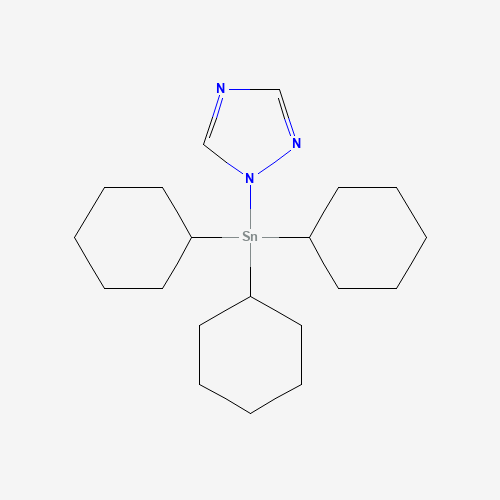
Azocyclotin is a member of the class of triazoles that is 1,2,4-triazole substituted at position 1 by a tricyclohexylstannyl group. It is a member of triazoles and an organotin acaricide.
科学粮草官-词典编辑部,修订于:2026-07-06
Toxicity
ToxicityEcotoxicity Values
USDA APHIS Chemical Effects: collection=usda_chemeffect&query_type=synonym&query='^41083-11-8$'
Fate Summary
ATMOSPHERIC FATE: According to a model of gas/particle partitioning of semivolatile organic compounds in the atmosphere(1), azocyclotin, which has a vapor pressure of 4.5X10⁻¹³ mm Hg at 25 °C(2), is expected to exist solely in the particulate phase in the ambient atmosphere. Particulate-phase azocyclotin may be removed from the air by wet and dry deposition(SRC).
Soil Adsorption / Mobility
The Koc of azocyclotin is estimated as 18,000(SRC), using a log Kow of 5.3(1)and a regression-derived equation(2). According to a classification scheme(3), this estimated Koc value suggests that azocyclotin is expected to be immobile in soil. The pKa of azocyclotin is 5.36(1), indicating that this compound will partially exist in the protonated form in the environment and cations generally adsorb to organic carbon and clay more strongly than their neutral counterparts(4).
Environmental Biodegradation
In a fresh water microcosm study, 14C-azocyclotin was observed to be rapidly hydrolyzed to cyhexatin, which in turn was mineralized to 14CO2(1).
Environmental Bioconcentration
An estimated BCF of 2,400 was calculated for azocyclotin(SRC), using a log Kow of 5.3(1) and a regression-derived equation(2). According to a classification scheme(3), this BCF suggests the potential for bioconcentration in aquatic organisms is very high(SRC).
Volatilization from Water / Soil
The Henry's Law constant for azocyclotin is estimated as 2.15X10⁻¹² atm-cu m/mole(SRC) derived from its vapor pressure, 4.5X10⁻¹³ mm Hg(1), and water solubility, 1.2X10⁻¹ mg/l(1). This Henry's Law constant indicates that azocyclotin is expected to be essentially nonvolatile from water surfaces(2). Azocyclotin is not expected to volatilize from dry soil surfaces(SRC) based upon its vapor pressure(1).
Environmental Abiotic Degradation
Azocyclotin, which has a vapor pressure of 4.5X10⁻¹³ mm Hg at 25 °C(1), is expected to exist solely in the particulate phase in the ambient atmosphere. Particulate-phase azocyclotin may be removed from the air by wet and dry deposition(SRC). Using a fresh water microcosm, 14C-azocyclotin was observed to be rapidly hydrolyzed to cyhexatin (tricyclohexyltinhydroxide) in a matter of days, which is then mineralized to 14CO2 and polar metabolites(2).
Artificial Pollution Sources
Azocyclotin's former(2) production and use as an acaricide(1) may result in its direct release to the environment(SRC).
Probable Routes of Human Exposure
Occupational exposure to azocyclotin may have occurred through inhalation of dust and dermal contact with this compound at workplaces where azocyclotin was produced or used. The general population may have been exposed through inhalation and dermal contact during its former use as an acaricide. (SRC)
Environmental Fate / Exposure Summary
Azocyclotin's former production and use as an acaricide may have resulted in its direct release to the environment. If released to air, a vapor pressure of 4.5X10⁻¹³ mm Hg at 25 °C indicates azocyclotin will exist solely in the particulate phase in the ambient atmosphere. Particulate-phase azocyclotin will be removed from the atmosphere by wet and dry deposition. If released to soil, azocyclotin is expected to have no mobility based upon an estimated Koc of 18,000. Volatilization from moist soil surfaces is not expected to be an important fate process based upon an estimated Henry's Law constant of 2.1X10⁻¹² atm-cu m/mole. The pKa of azocyclotin is 5.36, indicating that this compound will partially exist in the protonated form in the environment and cations generally adsorb to organic c...
Symptoms
Inorganic or organic tin compounds placed on the skin or in the eyes can produce skin and eye irritation. (L308)
Effect Level
collection=toxvaldb&kind=^EL$
Lethal Dose
collection=toxvaldb&kind=^LD$
Toxicity Data
LD50: 99 mg/kg (Oral, Rat) (T14) LD50: 1000 mg/kg (Dermal, Rat) (T14) LC50: 0.02 mg/L over 4 hours (Inhalation, Rat) (T58)
Health Effects
Breathing or swallowing, or skin contact with organotins, can interfere with the way the brain and nervous system work, causing death in severe cases. Organic tin compounds may also damage the immune and reproductive system. (L307, L308)
Adverse Effects
ACGIH Carcinogen - Not Classifiable.
Exposure Routes
Oral (L308); inhalation (L308); dermal (L308)
Toxicity Summary
Organotin compounds produce neurotoxic and immunotoxic effects. Organotins may directly activate glial cells contributing to neuronal cell degeneration by local release of pro-inflammatory cytokines, tumor necrosis factor-_, and/or interleukins. They may also induce apoptosis by direct action on neuronal cells. Organotin compounds stimulate the neuronal release of and/or decrease of neuronal cell uptake of neurotransmitters in brain tissue, including aspartate, GABA, glutamate, norepinephrine, and serotonin. This may be either a contributing factor to or result of the neuronal cell loss. The immunotoxic effects of organotins are characterized by thymic atrophy caused by the suppression of proliferation of immature thymocytes and apoptosis of mature thymocytes. Organotin compounds are be...
Lethal Concentration
collection=toxvaldb&kind=^LC$
Carcinogen Classification
No indication of carcinogenicity to humans (not listed by IARC).
Non-Human Toxicity Values
LD50 Mouse oral 870-980 mg/kg
Non-Human Toxicity Excerpts
Strong dermal irritant; strong & corrosive eye irritant (rabbits).









