


 一键配货
一键配货
化合物详情
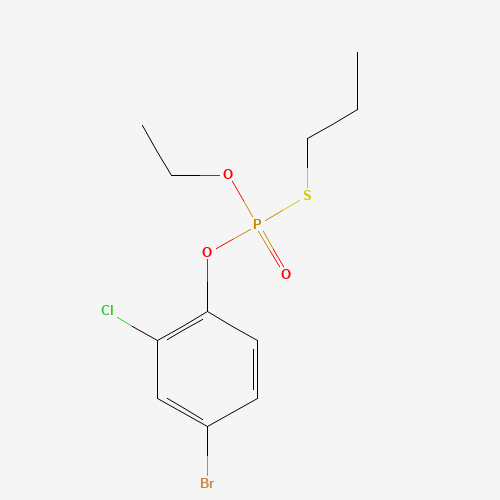
CAS41198-08-7
分子式C11H15BrClO3PS
分子量373.63 g/mol
非危品
Physical Description | Profenofos is a pale yellow liquid with garlic-like odor. Corrosive. Used as an insecticide.
科学粮草官-词典编辑部,修订于:2026-07-06
Toxicity
ToxicityBody Burden
... The levels of profenofos in whole blood, urine, and gastric contents were 1200 ng, 350 ng, and 3.35 mg/mL, respectively.
EPA Ecotoxicity
Pesticide Ecotoxicity Data from EPA: 72
Ecotoxicity Values
USDA APHIS Chemical Effects: collection=usda_chemeffect&query_type=synonym&query='^41198-08-7$'
Fate Summary
ATMOSPHERIC FATE: According to a model of gas/particle partitioning of semivolatile organic compounds in the atmosphere(1), profenofos, which has a vapor pressure of 9.00X10⁻⁷ mm Hg at 25 °C(2), will exist in both the vapor and particulate phases in the ambient atmosphere(SRC). Vapor-phase profenofos is degraded in the atmosphere by reaction with photochemically-produced hydroxyl radicals(SRC); the half-life for this reaction in air is estimated to be 8.6 hrs(SRC), calculated from its rate constant of 4.5X10⁻¹¹ cu cm/molecule-sec at 25 °C(SRC) that was derived using a structure estimation method(3). Particulate-phase profenofos may be removed from the air by wet and dry deposition(SRC). Profenofos is stable toward direct photolysis(4).
Soil Adsorption / Mobility
The Koc values for profenofos range from 869 to 3,162(1). According to a classification scheme(2), this estimated Koc value suggests that profenofos is expected to have low to slight mobility in soil(SRC). Profenofos has Freundlich values of 4.6 for sand, 7.5 for sandy loam, 17.0 for loam, and 89.3 for clay soil samples(1). Desorption values ranged from 6.2 (sand) to 128.1 (clay)(1). Adsorption generally increased with increasing soil organic matter content, clay content, and cation exchange capacity(1).
Environmental Biodegradation
ANAEROBIC: Profenofos metabolizes rapidly under alkaline anaerobic conditions(1). In alkaline (pH 7.8) soil, profenofos degraded with a half-life of 3 days under anaerobic conditions(1). The rate of metabolism was influenced by chemical hydrolysis. Thus, anaerobic metabolism in neutral and acid soils is likely to be slower(1). In anaerobic aquatic conditions, profenefos degraded with a half-life of 3 days in a pH 5.1 sediment flooded with pH 7.3 water(1). The major degradates are 4-bromo-2-chlorophenol and O-ethyl-S-propyl phosphorthioate(1). Additional metabolites, 4-bromo-2-chlorophenyl ethyl ether, cyclohexadienyl sulfate, and phenol complex increased in concentration after 180 days(1).
Environmental Bioconcentration
BCF values of 29 (body), 45 (head), and 682 (viscera) in fish(1) and 134 in zebrafish(2) were measured for profenofos. According to a classification scheme(3), BCF values of 29 and 45 are moderate and from 134 and 682 are high(SRC).
Volatilization from Water / Soil
The Henry's Law constant for profenofos is estimated as 2.2X10⁻⁸ atm-cu m/mole(SRC) derived from its vapor pressure, 9.00X10⁻⁷ mm Hg(1), and water solubility, 280 mg/l(1). This Henry's Law constant indicates that profenofos is expected to be essentially nonvolatile from water surfaces(2).
Environmental Abiotic Degradation
The rate constant for the vapor-phase reaction of profenofos with photochemically-produced hydroxyl radicals has been estimated as 4.5X10⁻¹¹ cu cm/molecule-sec at 25 °C(SRC) using a structure estimation method(1). This corresponds to an atmospheric half-life of about 8.6 hrs at an atmospheric concentration of 5X10+5 hydroxyl radicals per cu cm(1). Hydrolysis half-lives of profenofos are 104-108 days, 24-62 days, and 0.33 days for pHs 5, 7, and 9, respectively(2). O-Ethyl-S-propyl phosphorthioate is expected to form in equimolar proportions with 4-bromo-2-chlorophenol. Profenofos is stable to photolysis in water and on soil(2).
Environmental Water Concentrations
SURFACE WATERS: Profenofos was detected in 2 lake samples in Arkansas at an avg concn of 0.5 ug/l between the years 1989-1991(1). Between February 1992 and July 1992, the concn of profenofos in different natural waters from the Comunitat Valenciana, Spain ranged from 0.024 to 0.069 ug/ml(2).
Food Survey Values
Between the years 1987-1989, the concn level of profenofos residues in various vegetables from Thailand was 0.11 mg/kg(1). Between the years 1985-1991, the max concn of profenofos in one of 2,464 samples of apples from the USA was 0.08 ppm(2). In Denmark, profenofos was detected in 1 of 19 samples of spring onions between the years 1995-1996(3). In Egypt in the year 1995, profenofos was detected in 1 of 62 samples of tomatoes at a mean concn of 0.72 mg/kg (range, 0.04-2 mg/kg)(4).
Effluent Concentrations
Profenofos was measured in the water of several fish kill incidents(1); in most instances the concn was <1.5 ug/l(1); in one incident on Cane Creek, MS, concns up to 36 ug/l were reported(1).
Artificial Pollution Sources
Profenofos' production may result in its release to the environment through various waste streams; its use as an insecticide (1) will result in its direct release to the environment(SRC).
Probable Routes of Human Exposure
Occupational exposure to profenofos may occur through dermal contact with this compound at workplaces where profenofos is produced or used. The general population may be exposed to profenofos near agricultural areas where it is used as a pesticide. (SRC)
Environmental Fate / Exposure Summary
Profenofos' production may result in its release to the environment through various waste streams; its use as an insecticide will result in its direct release to the environment. If released to air, a vapor pressure of 9.00X10⁻⁷ mm Hg at 25 °C indicates profenofos will exist in both the vapor and particulate phases in the ambient atmosphere. Vapor-phase profenofos will be degraded in the atmosphere by reaction with photochemically-produced hydroxyl radicals; the half-life for this reaction in air is estimated to be 8.6 hrs. Particulate-phase profenofos will be removed from the atmosphere by wet and dry deposition. Profenofos is stable towards direct photolysis in water and on soil. If released to soil, profenofos is expected to have very low to slight mobility based upon a range of Koc...
Symptoms
Symptoms of low dose exposure include excessive salivation and eye-watering. Acute dose symptoms include severe nausea/vomiting, salivation, sweating, bradycardia, hypotension, collapse, and convulsions. Increasing muscle weakness is a possibility and may result in death if respiratory muscles are involved. Hypertension, hypoglycemia, anxiety, headache, tremor and ataxia may also result.
Treatment
If the compound has been ingested, rapid gastric lavage should be performed using 5% sodium bicarbonate. For skin contact, the skin should be washed with soap and water. If the compound has entered the eyes, they should be washed with large quantities of isotonic saline or water. In serious cases, atropine and/or pralidoxime should be administered. Anti-cholinergic drugs work to counteract the effects of excess acetylcholine and reactivate AChE. Atropine can be used as an antidote in conjunction with pralidoxime or other pyridinium oximes (such as trimedoxime or obidoxime), though the use of '-oximes' has been found to be of no benefit, or possibly harmful, in at least two meta-analyses. Atropine is a muscarinic antagonist, and thus blocks the action of acetylcholine peripherally.
Interactions
... Mixtures of atropine with eserine, pyridinium oximes, or the bispyridinium compound SAD-128 increased the LD50 of coadministered profenofos by up to sevenfold in chicks and fourfold in mice. Atropine and the oximes were less effective as profenofos antidotes, indicating that profenofos-inhibited AChE may undergo rapid aging. Brain AChE from chicks poisoned with profenofos was not reactivated by pralidoxime methanesulfonate, although it was from chicks poisoned with the phosphoramidothiolate, methamidophos. Similarly, eel AChE, inhibited in vitro by bioactivated (-)-profenofos, the most toxic isomer, did not reactivate in contrast to that inhibited by methamidophos, nonbioactivated (-)-profenofos, and (+)-profenofos, with or without bioactivation.
Toxicity Data
LC50 (rat) = 3,000 mg/m3/4h
Health Effects
Acute exposure to cholinesterase inhibitors can cause a cholinergic crisis characterized by severe nausea/vomiting, salivation, sweating, bradycardia, hypotension, collapse, and convulsions. Increasing muscle weakness is a possibility and may result in death if respiratory muscles are involved. Accumulation of ACh at motor nerves causes overstimulation of nicotinic expression at the neuromuscular junction. When this occurs symptoms such as muscle weakness, fatigue, muscle cramps, fasciculation, and paralysis can be seen. When there is an accumulation of ACh at autonomic ganglia this causes overstimulation of nicotinic expression in the sympathetic system. Symptoms associated with this are hypertension, and hypoglycemia. Overstimulation of nicotinic acetylcholine receptors in the central...
Adverse Effects
Other Poison - Organophosphate
Toxicity Summary
Profenofos is a cholinesterase or acetylcholinesterase (AChE) inhibitor. A cholinesterase inhibitor (or 'anticholinesterase') suppresses the action of acetylcholinesterase. Because of its essential function, chemicals that interfere with the action of acetylcholinesterase are potent neurotoxins, causing excessive salivation and eye-watering in low doses, followed by muscle spasms and ultimately death. Nerve gases and many substances used in insecticides have been shown to act by binding a serine in the active site of acetylcholine esterase, inhibiting the enzyme completely. Acetylcholine esterase breaks down the neurotransmitter acetylcholine, which is released at nerve and muscle junctions, in order to allow the muscle or organ to relax. The result of acetylcholine esterase inhibition...
Average Daily Intake
Between the years 1984-1986, the mean daily intake per unit body weight (ug/kg body wt/day) of profenofos was measured for the following age groups: 6-11 mo (<0.0001), 2 yr (0.0001), 14-16 yr female (<0.0001), 14-16 yr male (<0.0001), 25-30 yr female (<0.0001), 25-30 yr male (<0.0001), 60-65 yr female (<0.0001), and 60-65 yr male (<0.0001)(1).
RAIS Toxicity Values
Oral Chronic Reference Dose Reference: OPP
Human Toxicity Excerpts
An outbreak of food poisoning in which 105 persons from various parts of Singapore were affected was traced to one type of green leafy vegetable (Brassica alboglabra) that had been imported. The clinical symptoms were generally mild and the incubation period short (median 2.5 h). The etiology was confirmed when excessive levels of two organophosphorus pesticides--methamidophos (Tamaron/Monitor; 2.4 ppm-31.7 ppm) and profenofos (Selecron/Curacron; 1.1 ppm-5.4 ppm) were detected in the implicated food, and blood cholinesterase levels of the hospitalized patients were depressed by 26.1%-81.4% based on the lower limit of the reference range.
Carcinogen Classification
No indication of carcinogenicity to humans (not listed by IARC).
Non-Human Toxicity Excerpts
Male Baladi rabbits were acutely and sub-chronically intoxicated with cyanofenphos and profenophos. The levels of cholesterol, triglycerides, B-lipoproteins and total proteins were determined in the serum, brain, spinal cord and sciatic nerve of rabbits. Moreover, the activities of alkaline phosphatase, acid phosphatase and glutamic-pyruvic transaminase were determined in the liver of the animals. ... Liver function suffered from adverse effects of the tested insecticides.
Antidote and Emergency Treatment
Advanced treatment: Consider orotracheal or nasotracheal intubation for airway control in the patient who is unconscious or has severe pulmonary edema. Positive pressure ventilation techniques with a bag valve mask device may be beneficial. Monitor cardiac rhythm and treat arrhythmias if necessary ... . Start an IV with D5W /SRP: "To keep open", minimal flow rate/. Use lactated Ringer's if signs of hypovolemia are present. Administer atropine. Correct hypoxia before giving atropine ... . Administer pralidoxime chloride (2 PAM). USE UNDER DIRECT PHYSICIAN ORDERS ONLY ... . Treat seizures with adequate atropinization and correction of hypoxia. Rarely is diazepam necessary ... . For hypotension with signs of hypovolemia, administer fluid cautiously and consider vasopressors for hypotension...
USGS Health-Based Screening Levels for Evaluating Water-Quality
Reference: Smith, C.D. and Nowell, L.H., 2024. Health-Based Screening Levels for evaluating water-quality data (3rd ed.). DOI:10.5066/F71C1TWP









