

 一键配货
一键配货
化合物详情
CAS1478-61-1
分子式C15H10F6O2
分子量336.23 g/mol g/mol
危化品
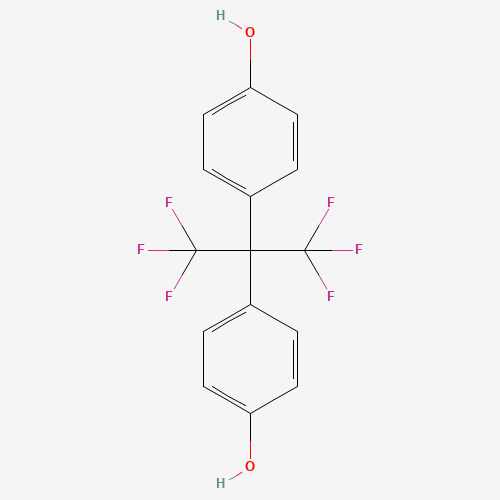
Bisphenol AF is an organofluorine compound that is bisphenol A with its methyl hydrogens replaced by fluorines. It has a role as a metabolite. It is a bisphenol and an organofluorine compound. It is functionally related to a bisphenol A.
科学粮草官-词典编辑部,修订于:2026-07-06
Toxicity
ToxicityFate Summary
ATMOSPHERIC FATE: According to a model of gas/particle partitioning of semivolatile organic compounds in the atmosphere(1), bisphenol AF, which has an estimated vapor pressure of 5.4X10⁻⁷ mm Hg at 25 °C(SRC), determined from a fragment constant method(2), will exist in both the vapor and particulate phases in the ambient atmosphere. Vapor-phase bisphenol AF is degraded in the atmosphere by reaction with photochemically-produced hydroxyl radicals(SRC); the half-life for this reaction in air is estimated to be 1.6 hours(SRC), calculated from its rate constant of 8.0X10⁻¹¹ cu cm/molecule-sec at 25 °C(SRC) that was derived using a structure estimation method(2). Particulate-phase bisphenol AF may be removed from the air by wet and dry deposition(SRC).
Soil Adsorption / Mobility
Using a structure estimation method based on molecular connectivity indices(1), the Koc of bisphenol AF can be estimated to be 7.6X10+5(SRC). According to a classification scheme(2), this estimated Koc value suggests that bisphenol AF is expected to be immobile in soil. The estimated pKa of bisphenol AF is 9.2(3), indicating that this compound will exist partially in anion form in the environment and anions generally do not adsorb more strongly to soils containing organic carbon and clay than their neutral counterparts(4).
Environmental Bioconcentration
An estimated BCF of 420 was calculated in fish for bisphenol AF(SRC), using an estimated log Kow of 4.47(1) and a regression-derived equation(1). According to a classification scheme(2), this BCF suggests the potential for bioconcentration in aquatic organisms is high(SRC).
Volatilization from Water / Soil
The Henry's Law constant for bisphenol AF is estimated as 5.7X10⁻¹⁰ atm-cu m/mole(SRC) using a fragment constant estimation method(1). This Henry's Law constant indicates that bisphenol AF is expected to be essentially nonvolatile from water surfaces(2). Bisphenol AF's Henry's Law constant indicates that volatilization from moist soil surfaces is not expected to occur(SRC). Bisphenol AF is not expected to volatilize from dry soil surfaces(SRC) based upon an estimated vapor pressure of 5.4X10⁻⁷ mm Hg(SRC), determined from a fragment constant method(1).
Environmental Abiotic Degradation
The rate constant for the vapor-phase reaction of bisphenol AF with photochemically-produced hydroxyl radicals has been estimated as 8.0X10⁻¹¹ cu cm/molecule-sec at 25 °C(SRC) using a structure estimation method(1). This corresponds to an atmospheric half-life of about 1.6 hours at an atmospheric concentration of 5X10+5 hydroxyl radicals per cu cm(1). Bisphenol AF is not expected to undergo hydrolysis in the environment due to the lack of functional groups that hydrolyze under environmental conditions(2). Phenols can undergo sensitized photo-oxidation in surface waters exposed to sunlight via reaction with hydroxyl and peroxy (RO2) radicals with half-lives on the order of days to weeks at the water surface(3); therefore, photo-oxidation may have some importance as a fate process for bis...
Artificial Pollution Sources
Bisphenol AF's production and use as a cross-linking agent in fluorocarbon elastomers and specialty polymers(1,2) may result in its release to the environment through various waste streams(SRC).
Probable Routes of Human Exposure
NIOSH (NOES Survey 1981-1983) has statistically estimated that 4388 workers (1460 of these were female) were potentially exposed to bisphenol AF in the US(1). Occupational exposure to bisphenol AF may occur through inhalation and dermal contact with this compound at workplaces where bisphenol AF is produced or used(2). The general population may be exposed to bisphenol AF via dermal contact with this compound from consumer products containing polymers made from bisphenol AF(2). Contact via food and cosmetics may be possible since the tubing and seals in the food and pharmaceutical industry are made from bisphenol AF polymers(2). Monitoring data indicate that the general population may be exposed to bisphenol AF via inhalation of indoor dust(3).[(1) NIOSH; NOES. National Occupational Exp...
Other Environmental Concentrations
The presence of bisphenol AF in dust samples from New York (Albany, n = 38), China (n = 55), Japan (n = 22), and Korea (n = 41) was monitored in 2006 and 2010. Bisphenol AF was not detected in dust samples from New York or China(1); bisphenol AF was detected in 76% of dust samples from Korea, with a maximum level of 0.091 ug/g, and 9% of dust samples from Japan, with a maximum level of 0.011 ug/g(1).
Environmental Fate / Exposure Summary
Bisphenol AF's production and use as a cross-linking agent in fluorocarbon elastomers and specialty polymers may result in its release to the environment through various waste streams. If released to air, an estimated vapor pressure of 5.4X10⁻⁷ mm Hg at 25 °C indicates bisphenol AF will exist in both the vapor and particulate phases in the atmosphere. Vapor-phase bisphenol AF will be degraded in the atmosphere by reaction with photochemically-produced hydroxyl radicals; the half-life for this reaction in air is estimated to be 1.6 hours. Particulate-phase bisphenol AF will be removed from the atmosphere by wet and dry deposition. If released to soil, bisphenol AF is expected to have no mobility based upon an estimated Koc of 7.6X10+5. The estimated pKa of bisphenol AF is 9.2, indicating...
Effect Level
collection=toxvaldb&kind=^EL$
Interactions
The estrogenic activities of BPA, BPAF, BPAP, BPF were tested based on recombinant gene yeast assay. Six mixtures were designed based on the result of the test,each of which had an equitoxic ratio ray (EC10 or EC50). The EC50 values are 6.81 x 10(-6) mol x L(-1), 7.44 x 10(-7) mol x L(-1), 1.43 x 10(-5) mol x L(-1), 7.52 x 10(-6) mol x L(-1) for BPA, BPAF, BPAP and BPF respectively,which reveals that the estrogenic activities order among the four bisphenols was BPAF> BPA> BPF> BPAP. The experiment shows that when BPA mixes with BPAF, BPAP and BPF in different ratios individually, different combination effects are produced. It reveals that the combined ratios of the components may affect the combined effect. The dose addition model and the independent action model are used to identify th...
Lethal Dose
collection=toxvaldb&kind=^LD$
Human Toxicity Excerpts
/ENDOCRINE MODULATION/ /The researchers/ aimed to determine the relative preference of bisphenol AF for the human nuclear estrogenic receptors ERalpha and ERbeta and the bisphenol A-specific estrogen-related receptor ERRgamma, and to clarify structural characteristics of receptors that influence bisphenol AF binding. /The researchers/ examined receptor-binding activities of bisphenol AF relative to [(3)H]17beta-estradiol (for ERalpha and ERbeta) and [(3)H]bisphenol A (for ERRgamma). Functional luciferase reporter gene assays were performed to assess receptor activation in HeLa cells. /The researchers/ found that bisphenol AF strongly and selectively binds to ERs over ERRgamma. Furthermore, bisphenol AF receptor-binding activity was three times stronger for ERbeta [IC50 (median inhibitor...
Non-Human Toxicity Values
LD50 Rat oral 3400 mg/kg
Reference and Risk Values
collection=toxvaldb&kind=^RRV$
Non-Human Toxicity Excerpts
/ENDOCRINE MODULATION/ The endocrine-disrupting activities of bisphenol A (BPA) and 19 related compounds were comparatively examined by means of different in vitro and in vivo reporter assays. BPA and some related compounds exhibited estrogenic activity in human breast cancer cell line MCF-7, but there were remarkable differences in activity. Tetrachlorobisphenol A (TCBPA) showed the highest activity, followed by bisphenol B, BPA, and tetramethylbisphenol A (TMBPA); 2,2-bis(4-hydroxyphenyl)-1-propanol, 1,1-bis(4-hydroxyphenyl)propionic acid and 2,2-diphenylpropane showed little or no activity. Anti-estrogenic activity against 17beta-estradiol was observed with TMBPA and tetrabromobisphenol A (TBBPA). TCBPA, TBBPA, and BPA gave positive responses in the in vivo uterotrophic assay using o...
Antidote and Emergency Treatment
/SRP:/ Advanced treatment: Consider orotracheal or nasotracheal intubation for airway control in the patient who is unconscious, has severe pulmonary edema, or is in severe respiratory distress. Positive-pressure ventilation techniques with a bag valve mask device may be beneficial. Consider drug therapy for pulmonary edema ... . Consider administering a beta agonist such as albuterol for severe bronchospasm ... . Monitor cardiac rhythm and treat arrhythmias as necessary ... . Start IV administration of D5W /SRP: "To keep open", minimal flow rate/. Use 0.9% saline (NS) or lactated Ringer's if signs of hypovolemia are present. For hypotension with signs of hypovolemia, administer fluid cautiously. Watch for signs of fluid overload ... . Treat seizures with diazepam or lorazepam ... . Use...