


 一键配货
一键配货
化合物详情
CAS42399-41-7
分子式C22H26N2O4S
分子量414.52 g/mol g/mol
危化品
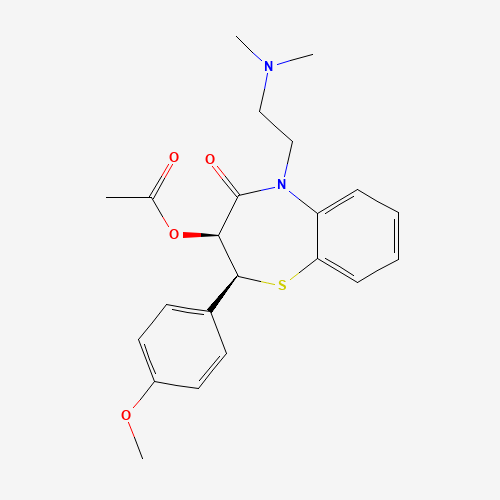
Diltiazem is a 5-[2-(dimethylamino)ethyl]-2-(4-methoxyphenyl)-4-oxo-2,3,4,5-tetrahydro-1,5-benzothiazepin-3-yl acetate in which both stereocentres have S configuration. A calcium-channel blocker and vasodilator, it is used as the hydrochloride in the management of angina pectoris and hypertension. It has a role as a vasodilator agent, an antihypertensive agent and a calcium channel blocker. It is a conjugate base of a diltiazem(1+). It is an enantiomer of an ent-diltiazem.
科学粮草官-词典编辑部,修订于:2026-07-06
Toxicity
ToxicityBody Burden
A 15-yr-old woman was admitted to the ICU after ... auto-intoxication with 10 tablets of 200 mg diltiazem sustained release. ... Max plasma lactate concn was 10 mmol/l and the highest measured plasma diltiazem level was 500 micrograms/l.
Environmental Water Concentrations
SURFACE WATER: In a survey conducted by the United States Geological Survey, diltiazem was detected at a max concn of 0.049 ug/l (0.021 ug/l median concn, 0.012 ug/l reporting level) at a 13.1% frequency in 84 submitted water samples from a network of 139 US stream sampling sites across 30 states during 1999-2000(1).
Milk Concentrations
Diltiazem is excreted into human milk.
Symptoms
LD<sub>50</sub>=740mg/kg (orally in mice)
Treatment
In the event of overdose or exaggerated response, appropriate supportive measures should be employed in addition to gastrointestinal decontamination. If bradycardia and/or high-degree AV block occurs, administer atropine (0.60 to 1.0 mg). If there is no response to vagal blockage, administer isoproterenol cautiously. Fixed high-degree AV block should be treated with cardiac pacing. In cases of cardiac failure, administer inotropic agents (isoproterenol, dopamine, or dobutamine) and diuretics. If hypotension occurs, use vasopressors (e.g. dopamine or levarterenol bitartrate). (L1712)
Toxicity Data
LD<sub>50</sub>=740mg/kg (orally in mice)
Health Effects
Because of its negative inotropic effect, diltiazem causes a modest decrease in heart muscle contractility and reduces myocardium oxygen consumption. Its negative chronotropic effect results in a modest lowering of heart rate, due to slowing of the sinoatrial node. It results in reduced myocardium oxygen consumption. Because of its negative dromotropic effect, conduction through the AV (atrioventricular) node is slowed, which increases the time needed for each beat. This results in reduced myocardium oxygen consumption. A reflex sympathetic response, caused by the peripheral dilation of vessels and the resulting drop in blood pressure, works to counteract the negative inotropic, chronotropic and dromotropic effects of diltiazem. Undesirable effects include hypotension, bradycardia, dizz...
Hepatotoxicity
Likelihood score: C (probable but rare cause of clinically apparent liver injury).
Adverse Effects
* Drug-Drug Interactions: Beta-blockers and diltiazem interaction may lead to bradyarrhythmias. A recent drug-drug interaction study has identified a fatality resulting from diltiazem-ibrutinib interaction. Diltiazem is a moderate inhibitor of CYP3A4, and ibrutinib is a substrate of this CYP3A4; concurrent administration for an extended time decreases ibrutinib clearance and results in cardiotoxicity. Diltiazem is also a P-glycoprotein inhibitor; hence there is an increased bleeding risk associated with direct oral anticoagulants (DOACs) like dabigatran or apixaban concomitantly with the P-glycoprotein inhibitor diltiazem.
Exposure Routes
Intravenous, Oral. Diltiazem is well absorbed from the gastrointestinal tract but undergoes substantial hepatic first-pass effect.
Toxicity Summary
Possibly by deforming the channel, inhibiting ion-control gating mechanisms, and/or interfering with the release of calcium from the sarcoplasmic reticulum, diltiazem, like verapamil, inhibits the influx of extracellular calcium across both the myocardial and vascular smooth muscle cell membranes. The resultant inhibition of the contractile processes of the myocardial smooth muscle cells leads to dilation of the coronary and systemic arteries and improved oxygen delivery to the myocardial tissue.
Carcinogen Classification
No indication of carcinogenicity to humans (not listed by IARC).
Drug Induced Liver Injury
References: DOI:10.1016/j.drudis.2019.09.022
Non-Human Toxicity Excerpts
/GENOTOXICITY/ There was no mutagenic response in vitro or in vivo in mammalian cell assays or in vitro in bacteria.[
Antidote and Emergency Treatment
...A patient who developed tetany with sudden respiratory arrest after the infusion of iv diltiazem /is described/. The admin of calcium chloride rapidly resolved the patient's tetany with prompt recovery of respiratory function, averting the need for more aggressive airway management & ventilatory support. The emergency physician should be aware that life-threatening tetany may accompany the admin of iv diltiazem & that calcium chloride may be a rapid & effective remedy.
Effects During Pregnancy and Lactation
◉ Effects on Lactation and Breastmilk
USGS Health-Based Screening Levels for Evaluating Water-Quality
Reference: Smith, C.D. and Nowell, L.H., 2024. Health-Based Screening Levels for evaluating water-quality data (3rd ed.). DOI:10.5066/F71C1TWP









