

 一键配货
一键配货
化合物详情
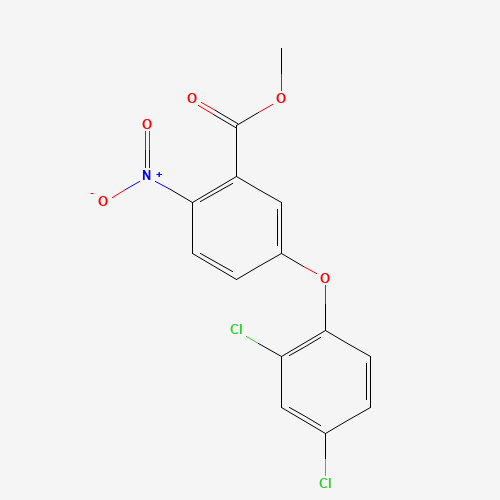
CAS42576-02-3
分子式C14H9Cl2NO5
分子量342.13 g/mol
非危品
MC-4379 is a nitrobenzoic acid.
科学粮草官-词典编辑部,修订于:2026-07-06
Toxicity
ToxicityBody Burden
Concentrations of bifenox in urine samples of tree nursery workers (applicators) involved in conifer seedling production ranged from 0.0066 to 0.0287 mg/kg(1).
EPA Ecotoxicity
Pesticide Ecotoxicity Data from EPA: 10
Fate Summary
ATMOSPHERIC FATE: According to a model of gas/particle partitioning of semivolatile organic compounds in the atmosphere(1), bifenox, which has a vapor pressure of 2.4X10⁻⁶ mm Hg at 25 °C(2), will exist in both the vapor and particulate phases in the ambient atmosphere. Vapor-phase bifenox is degraded in the atmosphere by reaction with photochemically-produced hydroxyl radicals(SRC); the half-life for this reaction in air is estimated to be 15 days(SRC), calculated from its rate constant of 1.1X10⁻¹² cu cm/molecule-sec at 25 °C(SRC) that was derived using a structure estimation method(3). Particulate-phase bifenox may be removed from the air by wet and dry deposition(SRC).
Soil Adsorption / Mobility
Kocs for bifenox have been reported ranging from 2,658 to 3,107(1). According to a classification scheme(2), these Koc values suggest that bifenox is expected to have slight to no mobility in soil. The sorption kinetics for bifenox were characterized by immediate rapid sorption with 30-70% of the added chemical adsorbed within the first 4 hrs, followed by a slow sorption over a longer time period(3). Slight desorption (10%) was noted after 24 hrs(3). In runoff experiments, it was shown that poorly soluble compounds like bifenox are only removed from fields as a result of heavy, erosive rainfalls on areas with a slope >10%; concn in soil before irrigation was 0.78 mg/kg in the 0-5 cm layer, after irrigation concns were in 0.77, 0.01, and 0.01 mg/kg at soil depths of 0-5, 5-10, and 10-15...
Environmental Biodegradation
ANAEROBIC: A rate constant of -0.26 hr-1 for bifenox, which has a redox potential of -1.20, was obtained in anaerobic reduction experiment using digestor sewage sludge(1). In a field study using rice paddy soils under flooded conditions, bifenox was degraded rapidly with a half-life of 4 days; metabolites included the free acid and the amino derivatives of the ester and free-acid forms, acetyl- and formyl-amino derivatives of the ester and free acid forms and the salicylic acid derivative(2).
Environmental Bioconcentration
An estimated BCF of 560 was calculated for bifenox(SRC), using a log Kow of 4.48(1) and a regression-derived equation(2). According to a classification scheme(3), this BCF suggests the potential for bioconcentration in aquatic organisms is high(SRC). However, hydrolysis may attenuate this process(4). Radiolabeled bifenox, introduced to a model 33-day rice paddy ecosystem sand at a 1.29 kg/ha dosage, exhibited a comparatively low ecological magnification value of 49 in mosquito fish (Gambusia) as compared with the other rice paddy herbicides examined in this study, for example 1,546 for nitrofen and 867 formethoxy-nitrofen(4).
Volatilization from Water / Soil
The Henry's Law constant for bifenox is estimated as 2.7X10⁻⁶ atm-cu m/mole(SRC) derived from its vapor pressure, 2.4X10⁻⁶ mm Hg(1), and water solubility, 0.398 mg/l(2). This Henry's Law constant indicates that bifenox is expected to volatilize from water surfaces(3). Based on this Henry's Law constant, the volatilization half-life from a model river (1 m deep, flowing 1 m/sec, wind velocity of 3 m/sec)(3) is estimated as 25 days(SRC). The volatilization half-life from a model lake (1 m deep, flowing 0.05 m/sec, wind velocity of 0.5 m/sec)(3) is estimated as 190 days(SRC). However, volatilization from water surfaces is expected to be attenuated by adsorption to suspended solids and sediment in the water column. The estimated volatilization half-life from a model pond is 3 years if adsor...
Environmental Abiotic Degradation
The rate constant for the vapor-phase reaction of bifenox with photochemically-produced hydroxyl radicals has been estimated as 1.1X10⁻¹² cu cm/molecule-sec at 25 °C(SRC) using a structure estimation method(1). This corresponds to an atmospheric half-life of about 15 days at an atmospheric concentration of 5X10+5 hydroxyl radicals per cu cm(1). A base-catalyzed second-order hydrolysis rate constant of 1.3X10⁻¹ L/mole-sec(SRC) was estimated using a structure estimation method(2); this corresponds to half-lives of 1.6 years and 60 days at pH values of 7 and 8, respectively(2). Radiolabeled bifenox, introduced to a 3-day model rice paddy at a concn of 0.3 ppm, readily hydrolyzed to the corresponding 2,4-dichlorophenyl 3'-carboxy-4'-nitrophenyl ether and was also reduced to 2,4-dichlorophen...
Environmental Water Concentrations
SURFACE WATER: Bifenox was detected in the Teufelsweiher pond in Scheyern, Upper Bavaria, Germany from 1992-1994 at concns ranging from 9.5 to 23 ng/l in pore water(1). A linear correlation was drawn between concentration and dissolved organic carbon(1). Bifenox was not detected (detection limit not specified) in water samples collected at the mouth of the Shinano River in Niigata Prefecture, Japan, where the total amounts of pesticides used annually were 19,000 tons in cultivated areas and 520 tons in noncultivated ares in fiscal year 1995(2).
Food Survey Values
Bifenox was not detected, detection limit = 0.25 ppm, in 6,970 produce samples (80% domestic, 20% foreign) surveyed in the US from 1989-1991(1).
Ecotoxicity Excerpts
/BIRDS and MAMMALS/ ...American kestrel (Falco sparverius) nestlings were orally dosed for 10 days with 5 ul/g of corn oil (controls) or one of the diphenyl ether herbicides (nitrofen, bifenox, or oxyfluorofen). At 500 mg/kg ...bifenox /resulted/ in high (66%) mortality... . .../For/ bifenox at 250 mg/kg ...crown-rump, humerus, radius-ulna and femur lengths were significantly less than controls. ...Bifenox ingestion (> or =50 mg/kg) resulted in increased hepatic GSH peroxidase activity. ...
Artificial Pollution Sources
Bifenox's production may have resulted in its release to the environment through various waste streams; it's former(2) use as a herbicide(1) resulted in its direct release to the environment(SRC).
Sediment/Soil Concentrations
SEDIMENT: Bifenox was detected in the Teufelsweiher pond sediments (pH, 7.8 to 8.1; DOC 41.5 to 50.2) in Scheyern, Upper Bavaria, Germany from 1992-1994 at concns ranging from 4.1 to 18.3 ug/kg in sediment(1).
Probable Routes of Human Exposure
Average concentrations of bifenox on work clothing of tree nursery workers involved in conifer seedling production from 2 different nurseries were 34 (4 of 311 samples pos, scouts whose job it was to examine treated beds daily), 55 (6 of 385 samples pos, weeders), ug/test patch(1). For applicators from both nurseries, results were 109 (9 or 340 samples pos) and 53 (4 of 523 samples pos) ug/test patch(1).
Environmental Fate / Exposure Summary
Bifenox's production may have resulted in its release to the environment through various waste streams; it's former use as a herbicide resulted in its direct release to the environment. If released to air, a vapor pressure of 2.4X10⁻⁶ mm Hg 25 °C indicates bifenox will exist in both the vapor and particulate phases in the ambient atmosphere. Vapor-phase bifenox will be degraded in the atmosphere by reaction with photochemically-produced hydroxyl radicals; the half-life for this reaction in air is estimated to be 15 days. Particulate-phase bifenox will be removed from the atmosphere by wet and dry deposition. Bifenox is susceptible to photolysis with 2,4-dichloro-3'-carboxy-4'-nitrodiphenyl ether, nitrofen, p-nitrophenol, p-aminophenol as identified photoproducts. If released to soil, bi...
Toxicity Data
LC50 (rat) > 910 mg/m3
Adverse Effects
Occupational hepatotoxin - Secondary hepatotoxins: the potential for toxic effect in the occupational setting is based on cases of poisoning by human ingestion or animal experimentation.
RAIS Toxicity Values
Oral Subchronic Chronic Reference Dose Reference: PPRTV Current
Non-Human Toxicity Values
LD50 Rat oral >6400 mg/kg
1 or Cancer Risk Level 1E-06
Fraction of Contaminant Absorbed Dermally from Soil: 0.1
Antidote and Emergency Treatment
Advanced treatment: Consider orotracheal or nasotracheal intubation for airway control in the patient who is unconscious, has severe pulmonary edema, or is in respiratory arrest. Positive pressure ventilation techniques with a bag valve mask device may be beneficial. Monitor cardiac rhythm and treat arrhythmias as necessary ... . Start an IV with D5W /SRP: "To keep open", minimal flow rate/. Use lactated Ringer's if signs of hypovolemia are present. Watch for signs of fluid overload. Consider drug therapy for pulmonary edema ... . For hypotension with signs of hypovolemia, administer fluid cautiously. Watch for signs of fluid overload ... . Treat seizures with diazepam (Valium) ... . Use proparacaine hydrochloride to assist eye irrigation ... . /Poison A and B/
Hazard Quotient Level 3 or Cancer Risk Level 1E-04
Fraction of Contaminant Absorbed Dermally from Soil: 0.1