


 一键配货
一键配货
化合物详情
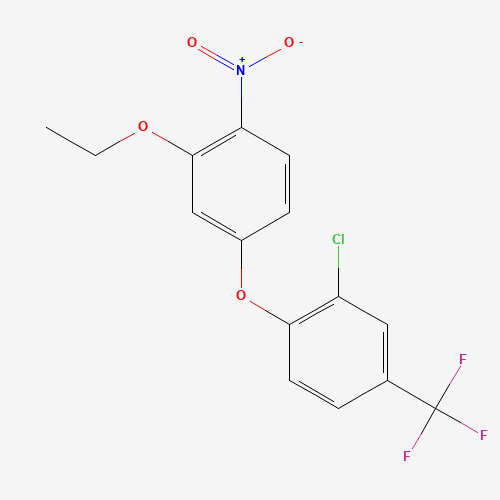
CAS42874-03-3
分子式C15H11ClF3NO4
分子量361.7 g/mol
非危品
Physical Description | Oxyfluorfen is an orange crystalline solid. Non corrosive. Used as an herbicide.
科学粮草官-词典编辑部,修订于:2026-07-06
Toxicity
ToxicityEPA Ecotoxicity
Pesticide Ecotoxicity Data from EPA: 93
Fate Summary
ATMOSPHERIC FATE: According to a model of gas/particle partitioning of semivolatile organic compounds in the atmosphere(1), oxyfluorfen, which has a vapor pressure of 2.0X10⁻⁷ mm Hg at 25 °C(2), will exist in both the vapor and particulate phases in the ambient atmosphere. Vapor-phase oxyfluorfen is degraded in the atmosphere by reaction with photochemically-produced hydroxyl radicals(SRC); the half-life for this reaction in air is estimated to be 33 hours(SRC), calculated from its rate constant of 1.2X10⁻¹¹ cu cm/molecule-sec at 25 °C(SRC) that was derived using a structure estimation method(3). Particulate-phase oxyfluorfen may be removed from the air by wet or dry deposition(SRC).
Soil Adsorption / Mobility
The Koc of oxyfluorfen is estimated as 8900(SRC), using a log Kow of 4.73(1) and a regression-derived equation(2). According to a classification scheme(3), this estimated Koc value suggests that oxyfluorfen is expected to be immobile in soil(SRC). Oxyfluorfen is strongly absorbed to organic soils and only minimally leached(10). Oxyfluorfen had reported Kd values of 52-755 and 111-829 at 25 and 37 °C, respectively in 6 different soils with moisture contents of 30-90%(4). Oxyfluorfen stayed in the top 0-10 cm of soil 28 days after application(5). Oxyfluorfen remained in the top 0-5 cm in a 1992 and 1993 study with an application rate of 1.2 kg ai/ha(6). Oxyfluorfen penetrated to 5.41-8.89 cm with 3.2-12.8 cm of rain and had a half-life in the soil of 35 days(7). Soil half-lives of 30-103...
Environmental Biodegradation
AEROBIC: Oxyfluorfen was >60% biodegraded in 7 days when incubated at 28 °C using Azotobacter chroococcum, a soil borne bacteria(1).
Environmental Bioconcentration
An estimated BCF of 880 was calculated in fish for oxyfluorfen(SRC), using a log Kow of 4.73(1) and a regression-derived equation(2). According to a classification scheme(3), this BCF suggests the potential for bioconcentration in aquatic organisms is high, provided the compound is not metabolized by the organism(SRC).
Volatilization from Water / Soil
The Henry's Law constant for oxyfluorfen is estimated as 8.2X10⁻⁷ atm-cu m/mole(SRC) derived from its vapor pressure, 2.0X10⁻⁷ mm Hg(1), and water solubility, 0.116 mg/L(2). This Henry's Law constant indicates that oxyfluorfen is expected to be essentially nonvolatile from water surfaces(3). Oxyfluorfen is not expected to volatilize from dry soil surfaces(SRC) based upon its vapor pressure(1).
Environmental Abiotic Degradation
The rate constant for the vapor-phase reaction of oxyfluorfen with photochemically-produced hydroxyl radicals has been estimated as 1.2X10⁻¹¹ cu cm/molecule-sec at 25 °C(SRC) using a structure estimation method(1). This corresponds to an atmospheric half-life of about 33 hours at an atmospheric concentration of 5X10+5 hydroxyl radicals per cu cm(1). Oxyfluorfen was shown to have photochemical half-lives of 3.3 and 6.9 hours in Preveza (45% sand, 22% silt 33% clay, 0.9% organic matter, 7.0 pH) and Nea Malgara soil (31% sand, 50% silt 19% clay, 2.3% organic matter, 7.1 pH), respectively(2). Oxyfluorfen decomposed rapidly by UV irradiation; DT50 3 days at room temperature and was stable up to 50 °C(3). Oxyfluorfen is stable to hydrolysis(4); the chemical showed no significant hydrolysis in...
Environmental Water Concentrations
SURFACE WATERS: Oxyfluorfen was detected at the highest concentration of 0.04 ug/mL in retention basins at container nurseries in South Carolina(1). Oxyfluorfen was not detected in 36, 48, and 32 samples from the Arno River, Italy in 1992, 1993, and 1994, respectively(2). Oxyfluorfen was detected in 2 of 51 samples from the Arno River, Italy in 1995(2). Oxyfluorfen concentration maximum of 0.147 mg/L occurred 1 day after treatment in run off from a container nursery in South Carolina with an application rate of 2.2 kg ai/ha(3).
Food Survey Values
Oxyfluorfen was not detected in apples, broccoli, cabbage, carrots, celery, cucumbers, grapefruit, grapes, greens, lemons, lettuce, limes, melons, mushrooms, nectarines, onions, oranges, peppers, plums, potatoes, radishes, squash, turnips(1). Oxyfluorfen was not detected in green beans or sweet potatoes(2). Oxyfluorfen was not detected in peaches, spinach, or strawberries(1-2). Oxyfluorfen was not detected in pears or tomatoes(1-3). Oxyfluorfen was not detected on grapes 4 days after application(4). Oxyfluorfen concentrations of onions were <0.05 mg/kg 4-11 days after applications of 60-240 g/h in test conducted 1985-88(5).
Ecotoxicity Excerpts
/ACCIDENTAL POISONINGS/ On August 22, 2000, Fifteen Mile Creek near the Dalles Dam in Oregon was the site of an oxyfluorfen spill. A truck carrying formulated oxyfluorfen (Goal 2XL) crashed on a bridge spilling approximately 20,000 gallons of herbicide into the creek yards from where the creek enters the Columbia River. Two weeks after the spill, samples of filtered and unfiltered water near the spill site contained an average of 32:g/L and 340:g/L, respectively. This spill was estimated to cause a 35% decrease in the numbers of adult chinook salmon and a 26% decrease in the numbers of steelhead passing over the Dalles Dam the day immediately following the spill, relative to the day prior to the spill. The spill was also reported to kill thousands of young lampreys.
Artificial Pollution Sources
Oxyfluorfen's production may result in its release to the environment through various waste streams; its use as an herbicide(1) will result in its direct release to the environment(SRC).
Sediment/Soil Concentrations
SEDIMENT: Oxyfluorfen sediment concentrations reached a maximum 3 days after treatment at 0.35 mg/kg in a runoff water containment pond(1).
Probable Routes of Human Exposure
Occupational exposure to oxyfluorfen may occur through inhalation and dermal contact with this compound at workplaces where oxyfluorfen is produced or used(SRC). Oxyfluorfen was detected on greenhouse herbicide applicators, weeders and scouts(1). There is application concern due to spray-drift of oxyfluorfen(2). The general population may be exposed to oxyfluorfen via dermal contact with spray drift in immediate areas following application(SRC).
Environmental Fate / Exposure Summary
Oxyfluorfen's production may result in its release to the environment through various waste streams; its use as an herbicide will result in its direct release to the environment. If released to air, a vapor pressure of 2.0X10⁻⁷ mm Hg at 25 °C indicates oxyfluorfen will exist in both the vapor and particulate phases in the atmosphere. Vapor-phase oxyfluorfen will be degraded in the atmosphere by reaction with photochemically-produced hydroxyl radicals; the half-life for this reaction in air is estimated to be 33 hours. Particulate-phase oxyfluorfen will be removed from the atmosphere by wet or dry deposition. If released to soil, oxyfluorfen is expected to have no mobility based upon an estimated Koc of 8900. Volatilization from moist soil surfaces is not expected to be an important fate...
Target Organs
Hepatic
Toxicity Data
LC50 (rat) >3,710 mg/m3/4H
Adverse Effects
Occupational hepatotoxin - Secondary hepatotoxins: the potential for toxic effect in the occupational setting is based on cases of poisoning by human ingestion or animal experimentation.
RAIS Toxicity Values
Oral Slope Factor Reference: OPP
Human Toxicity Excerpts
/ALTERNATIVE and IN VITRO TESTS/ ... Human erythroblastic progenitors (BFU-E/CFU-E: Burst Forming Unit-Erythroid and Colony Forming Unit-Erythroid) were exposed to oxyfluorfen, a diphenyl-ether herbicide in the presence of erythropoietin, and the hematoxicity evaluated in vitro by scoring the development of BFU-E/CFU-E colonies after 7 and 14 days of culture. The toxic effect on differentiation has been evaluated using four criteria: morphology, total protein, total porphyrin, and hemoglobin content. The study of BFU-E/CFU-E proliferation and differentiation showed a cytotoxic effect of oxyfluorfen only at very high concentrations. In contrast, hemoglobin synthesis can be inhibited by concentration of oxyfluorfen (10-4 M) that have no adverse effect on cellular proliferation.[Rio B et a...
Carcinogen Classification
No indication of carcinogenicity to humans (not listed by IARC).
1 or Cancer Risk Level 1E-06
Fraction of Contaminant Absorbed Dermally from Soil: 0.1
Hazard Quotient Level 3 or Cancer Risk Level 1E-04
Fraction of Contaminant Absorbed Dermally from Soil: 0.1
USGS Health-Based Screening Levels for Evaluating Water-Quality
Reference: Smith, C.D. and Nowell, L.H., 2024. Health-Based Screening Levels for evaluating water-quality data (3rd ed.). DOI:10.5066/F71C1TWP









