


 一键配货
一键配货
化合物详情
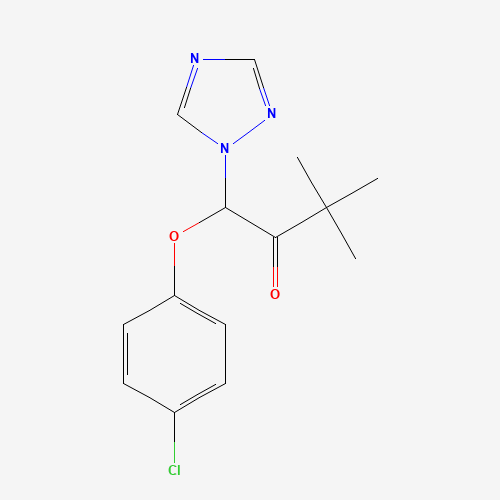
CAS43121-43-3
分子式C14H16ClN3O2
分子量293.75 g/mol g/mol
危化品
Triadimefon can cause developmental toxicity, female reproductive toxicity and male reproductive toxicity according to The Environmental Protection Agency (EPA).
科学粮草官-词典编辑部,修订于:2026-07-06
Toxicity
ToxicityBody Burden
It has been reported that low levels of triadimefon metabolites have been detected in the urine of workers using triadimefon(1).
EPA Ecotoxicity
Pesticide Ecotoxicity Data from EPA: 65
Fate Summary
ATMOSPHERIC FATE: According to a model of gas/particle partitioning of semivolatile organic compounds in the atmosphere(1), triadimefon, which has a vapor pressure of 1.50X10⁻⁸ mm Hg at 25 °C(2), is expected to exist solely in the particulate phase in the ambient atmosphere. Particulate-phase triadimefon may be removed from the air by wet and dry deposition(SRC). Triadimefon absorbs light in the environmental spectrum. When triadimefon in aqueous media was irradiated with UV light (> 290 nm), 87% was degraded after four hours(3). Triadimefon undergoes photodegradation resulting in products that represent transformations at the carbonyl group as well as decarbonylation via alpha cleavage.
Soil Adsorption / Mobility
Triadimefon had a Koc value of 150 in turfgrass soil, 300 in loam soil(1) and between 133-315 in 5 different Indian soil types(2). In another study, a measured soil Kd (partition coefficient) of 8.33 in a silty clay loam soil of 2.8% organic matter(3) can be used to determine a Koc value of 510(SRC). According to a classification scheme(4), these Koc values suggest that triadimefon is expected to have moderate to low mobility depending upon the soil.
Environmental Biodegradation
AEROBIC: To study the fate of pesticides in golf compost heaps, researchers applied triadimefon to soil at 1.4 ug/g and to thatch and grass clippings at 2.7 ug/g and monitored for degradation(1). They found that triadimefon had a half-life in soil, thatch, and grass of 3.9, 7.9, and 1.8 days, respectively. The U.S. Department of Agriculture's Pesticide Properties Database lists a soil half-life of 26 days for triadimefon(2). Laboratory persistence studies using a silty clay loam soil with no prior exposure to triadimefon found a soil half-life of 15 days(3). West German field tests in various soils and conditions found half-lives ranging from 10 days to 7 months(4). Various fungi have been found to metabolize triadimefon to triadimenol(5).
Environmental Bioconcentration
An estimated BCF of 31 was calculated for triadimefon(SRC), using a log Kow of 2.77(1) and a regression-derived equation(2). According to a classification scheme(3), this BCF suggests the potential for bioconcentration in aquatic organisms is low(SRC).
Volatilization from Water / Soil
The Henry's Law constant for triadimefon is estimated as 8.10X10⁻¹¹ atm-cu m/mole(SRC) derived from its vapor pressure, 1.50X10⁻⁸ mm Hg at 25 °C(1), and water solubility, 7.15 mg/L(1). This Henry's Law constant indicates that triadimefon is expected to be essentially nonvolatile from water surfaces(2). The Henry's Law constant for triadimefon indicates that volatilization from moist soil surfaces is not expected(SRC). Triadimefon is not expected to volatilize from dry soil surfaces(SRC) based upon its vapor pressure(3). One study suggests volatility of triadimefon to be a greater factor than suggested by the vapor pressure and water solubility based upon a proposed volatilization equation(4).
Environmental Abiotic Degradation
Based upon a vapor pressure of 1.50X10⁻⁸ mm Hg (1), triadimefon is expected to exist in the particulate phase in the atmosphere and therefore is not expected to react with atmospheric hydroxyl radicals. Hydrolysis in water can occur, albeit slowly, via catalytic action by water salts, mainly divalent cations(2); degradation in water at 70 degrees C has been reported to reach 90% in eight weeks. The photostability of triadimefon in aqueous media when irradiated with UV light (> 290 nm) in the presence of humic and fulvic acids (isolated from soil) and in their absence was studied(3). The results showed that after four hours of irradiation, 87% degraded whereas irradiation in the presence of humic and fulvic acids resulted in 91.7 and 93.6% degradation, respectively. Photodegradation prod...
Environmental Water Concentrations
SURFACE WATER: In 1989, water samples were collected from the Rhine River at several locations in the Netherlands Delta(1). Samples were taken near the German border at Lobith (17/03/89 and 15/09/89), downstream of Rotterdam Harbor at Maassluis (26/05/89 and 22/09/89), along the mainstream at Werkendam (29/09/89), in a semi-stagnant branch of Haringvliet (19/05/89) and in the out lead of the Ijssel at Kampen (21/04/89). Triadimefon was detected only at Lobith on 15/09/89 at 0.019 ug/L(1).
Food Survey Values
In 1994, 11,348 food samples were analyzed for pesticide residues; 5474 were domestic and 5874 were imported food items(1). Triadimefon was not detected in any of the samples (detection limit not indicated). Strawberries were bought from the supermarkets in Nara, Japan from January to March 1992 and again in 1993 and analyzed for pesticide concentrations(2). Fourteen of 91 imported pineapples collected from Hyogo Perfecture, Japan from 1995-1999 indicated the presence of triadimefon at concentrations between 0.01-0.5 ug/g(3). The concentration of triadimefon in strawberries collected in 1992 ranged from 0.02-0.04 ug/g and in 1993 ranged from 0.01-0.04 ug/g. From January 1995 to December 1996, 4182 food samples were collected in Denmark and analyzed by the Danish National Pesticide Monit...
Milk Concentrations
... A lactating goat was fed [phenyl- (14)C]triadimefon at 86 ppm for three consecutive days. The parent was detected at low levels in milk and fat (<5% TRR) but was not detected in kidney, liver, or muscle. The major residue identified was KWG 1342 glucuronide (6-47% TRR). Triadimenol and its conjugates comprised a major portion of the residue in tissues and milk (totals of 9-42% TRR). The remainder of the radioactivity was identified as KWG 1323 glucuronide (19-22% TRR in muscle and fat) and KWG 1342 (1-6% TRR) and its sulfate (1-15% TRR in tissues, 43% TRR in milk).
Ecotoxicity Excerpts
/PLANTS/ Ornamentals may be damaged if used at excessive rates.
Plant Concentrations
The rate of decay of triadimefon and its concentration after application was measured during cucumber cultivation in greenhouses under normal growing conditions(1). One day after high-volume spraying, the residue concentration on leaves was on average 0.009 ug/sq cm. One week after spraying, no changes in concentration on the surfaces were observed(1).
Effluent Concentrations
Triadimefon, having a moderate mobility in soil, is generally not found in water supplies. However, when applied at very high rates under irrigated conditions, triadimefon has been detected at concentrations up to 616 ug/L of agricultural leachate(1,2).
Fish/Seafood Concentrations
Concentrations of various organic micro contaminants were measured in zebra mussels and eel from the Rhine-Meuse Basin from 1993 to 1994. Triadimefon was not detected in either zebra mussels or eel at a detection limit of 5.0 ug/kg wet weight(1).
Artificial Pollution Sources
Triadimefon's production may result in its release to the environment through various waste streams; its use as a fungicide(1) will result in its direct release to the environment(SRC).
Probable Routes of Human Exposure
The rate of decay of triadimefon and its concentration after application was measured during cucumber cultivation in greenhouses under normal growing conditions(1). In preliminary experiments, the concentration of triadimefon in air was, at a sampling period of 0-2 hours after application, below the detection limit (3 ug/cu m). Hence, air exposure is likely of no concern with respect to human health. On the floor surfaces, the triadimefon concentrations were on average 0.010 ug/sq cm after low-volume spraying and 0.013 ug/sq cm after high-volume spraying. Six days after low-volume spraying, the concentration of triadimefon was below the detection limit (0.002 ug/sq cm), and after high-volume spraying, the concentration of triadimefon was estimated to be 0.004 ug/sq cm(1).
Environmental Fate / Exposure Summary
Triadimefon's production may result in its release to the environment through various waste streams; its use as a fungicide will result in its direct release to the environment. If released to air, a vapor pressure of 1.50X10⁻⁸ mm Hg at 25 °C indicates triadimefon will exist solely in the particulate phase in the ambient atmosphere. Particulate-phase triadimefon will be removed from the atmosphere by wet and dry deposition. If released to soil, triadimefon is expected to have moderate to low mobility based upon a Koc ranging from 150-510. Volatilization from moist soil surfaces is not expected to be an important fate process based upon a Henry's Law constant of 8.10X10⁻¹¹ atm-cu m/mole. Triadimefon is not expected to volatilize from dry soil surfaces based upon its vapor pressure. Soil...
Target Organs
Hematologic
Toxicity Data
LC50 (rat) = 2,450 mg/m3
Adverse Effects
Skin Sensitizer - An agent that can induce an allergic reaction in the skin.
RAIS Toxicity Values
Oral Chronic Reference Dose Reference: OPP
Acceptable Daily Intakes
FAO/WHO ADI: 0.03 mg/kg
Carcinogen Classification
No indication of carcinogenicity to humans (not listed by IARC).
1 or Cancer Risk Level 1E-06
Fraction of Contaminant Absorbed Dermally from Soil: 0.1
Antidote and Emergency Treatment
/SRP:/ Advanced treatment: Consider orotracheal or nasotracheal intubation for airway control in the patient who is unconscious, has severe pulmonary edema, or is in severe respiratory distress. Positive-pressure ventilation techniques with a bag valve mask device may be beneficial. Consider drug therapy for pulmonary edema ... . Consider administering a beta agonist such as albuterol for severe bronchospasm ... . Monitor cardiac rhythm and treat arrhythmias as necessary ... . Start IV administration of D5W /SRP: "To keep open", minimal flow rate/. Use 0.9% saline (NS) or lactated Ringer's if signs of hypovolemia are present. For hypotension with signs of hypovolemia, administer fluid cautiously. Watch for signs of fluid overload ... . Treat seizures with diazepam or lorazepam ... . Use...
Hazard Quotient Level 3 or Cancer Risk Level 1E-04
Fraction of Contaminant Absorbed Dermally from Soil: 0.1









