


 一键配货
一键配货
化合物详情
CAS51235-04-2
分子式C12H20N4O2
分子量252.31 g/mol g/mol
危化品
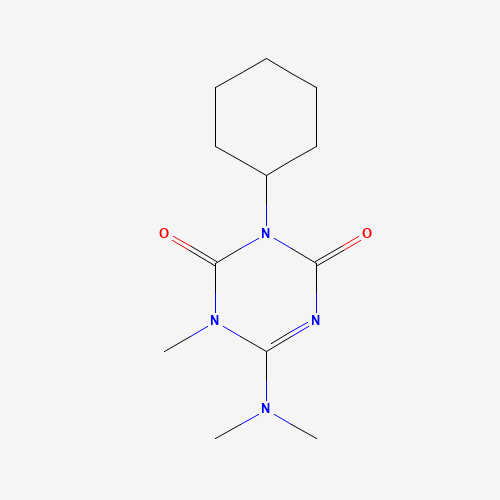
Physical Description | Hexazinone is a white crystalline solid. Corrosive eye irritant. Used as an herbicide.
科学粮草官-词典编辑部,修订于:2026-07-06
Toxicity
ToxicityEPA Ecotoxicity
Pesticide Ecotoxicity Data from EPA: 51
Soil Adsorption / Mobility
A spring 1983 field study of herbicide behavior in an orthic humo-ferric podzol was conducted in northeast central Newfoundland, Canada on a south facing slope near Gambo pond. Hexazinone (25% wt formulation) was applied on test plots within a clear cut site. Under stringent controls various soil horizons were sampled up to 486 days after application. Hexazinone residue analyses in samples from the soil horizons indicated the hexazinone leached to the Bf horizon, occasionally to the Bc horizon and rarely leached to the C horizon. Greater than 75% of the residues detected per sample period were found in the organic layer. The results of the LF horizon indicated that 93% was the average quantity detected per sample for hexazinone(1).
Environmental Biodegradation
ANAEROBIC: Hexazinone, at a concentration of 4 ppm, exhibited 0% degradation after 60 days under anaerobic conditions in Fallsington sandy loam and Flanagan silt loam soils(1).
Environmental Bioconcentration
The BCF in bluegill sunfish (Lepomis macrochirus) exposed to 0.01 and 1.0 ppm C14-radiolabeled hexazinone for 4 weeks was 2 and 1, respectively. Residue levels plateaued after 1-2 weeks of exposure. Maximum BCF were 2, 3-5, and 5-7 in the carcass, liver, and viscera, respectively(1). According to a classification scheme(2), this BCF data suggests the potential for bioconcentration in aquatic organisms is low(SRC). The hexazinone levels in the fish declined by over 90% after a 1 week depuration period and no residues were detected after 2 weeks(1).
Volatilization from Water / Soil
The Henry's Law constant for hexazinone is estimated as 2.3X10⁻¹² atm-cu m/mole(SRC) derived from its vapor pressure, 2.25X10⁻⁷ mm Hg(1), and water solubility, 3.30X10+4 mg/L(1). This Henry's Law constant indicates that hexazinone is expected to be essentially nonvolatile from water surfaces(2). Hexazinone is not expected to volatilize from dry soil surfaces(SRC) based upon its vapor pressure(1).
Environmental Abiotic Degradation
Dilute aqueous solutions of hexazinone in the dark are stable (<1% decomposition) for at least 5-8 weeks at pH 5, 7, and 9 at temperatures as high as 37 deg. When hexazinone in distilled water was exposed to simulated sunlight, 10% of the chemical degraded in 5 wks. The extent of photodegradation under both simulated sunlight or natural sunlight is 4 to 7 times greater in natural river water or in distilled water containing 20 ppm riboflavin, a sensitizer, than in distilled water. Photodegradation primarily involved demethylation and hydroxylation(1).
Milk Concentrations
EXPERIMENTAL: Some radioactivity was associated with hexazinone transferred to goats milk (plateau values were 0.02 and 0.05 ppm) following five daily doses of 1 and 5 ppm hexazinone, respectively. Trace levels (0.05 ppm), of one metabolite, were detected in the milk of cows fed 25 ppm hexazinone for 30 days; no detections were observed in the milk of cows fed 5 ppm(1).
Plant Concentrations
Hexazinone was detected in 20 of the 43 plants from an area treated with the pesticide. The concentrations from this area ranged from 0-10 ppm. Only 1 of the 46 plants outside the treatment area tested positive for hexazinone with a concentration of 0.5 ppm(1).
Effluent Concentrations
Drainage water collected from 7 to 10 yr old plantations, grown with Abies nordmaniana, Spach on two clay soils in Denmark had concentrations of hexazinone at two locations, ranging from 0.07 to 2.09 ug/l at Bremersvold and from 3.47 to 42.66 ug/l at Koege(1). Hexazinone detected at concentrations up to 0.0420 ug/L, with an average detection of 0.0008 ug/L and a median of 0.0 ng/L (LOQ= 0.002 ug/L), in effluents from 90 wastewater treatment plants across Europe sampled in 2010(2).
Fish/Seafood Concentrations
Water quality data compiled from the Retrieval (STORET) Data Warehouse report monitoring data from the Maine Department of Environmental Protection, tissue sample data for Sept 2009 to Nov 2009 indicates that hexazinone was not detected in the samples collected from the blue mussel (Mytilus edulis)(1).
Artificial Pollution Sources
Hexazinone's production may result in its release to the environment through various waste streams; its use as a pre- and post-emergent contact herbicide(1) will result in its direct release to the environment(SRC).
Sediment/Soil Concentrations
SOIL: Water quality data compiled from the USGS National Water Information System (NWIS) reports 2011 soil monitoring data for hexazinone from the USGS New Jersey Water Science Center indicating that hexazinone was not detected in suspended soil samples collected in Oct 2011 (LOD = 1.2 ug/kg )(1).
Probable Routes of Human Exposure
Occupational exposure to hexazinone may occur through dermal contact with this compound at workplaces where hexazinone is produced or used. The greatest potential for workers exposure to hexazinone is expected for individuals who are directly involved with mixing, loading, and application of hexazinone in agricultural or other settings. There are no residential applications registered for hexazinone therefore residential exposure is not expected. Limited monitoring data indicate that the most likely route of exposure to the general public is through dermal contact with waters and foliage containing residues of hexazinone or via ingestion of water contaminated with hexazinone. Use data indicate that exposure is expected to be greatest for people who are frequently in areas where this her...
Other Environmental Concentrations
No hexazinone was found in smoke from 5 prescribed fires on hexazinone-treated forest land in the Southern U.S.(1). The interval between herbicide treatment and burn date ranged from 101 to 169 days. The hexazinone concentration in the surface soil in preburn site samples that could contribute to herbicide in smoke ranged from 0.24 - 0.58 ppb(1).
Environmental Fate / Exposure Summary
Hexazinone's production may result in its release to the environment through various waste streams; its use as a pre- and post-emergent contact herbicide will result in its direct release to the environment. If released to air, a vapor pressure of 2.25X10⁻⁷ mm Hg at 25 °C indicates hexazinone will exist in both the vapor and particulate phases in the atmosphere. Vapor-phase hexazinone will be degraded in the atmosphere by reaction with photochemically-produced hydroxyl radicals; the half-life for this reaction in air is estimated to be 4.3 hours. Particulate-phase hexazinone will be removed from the atmosphere by wet and dry deposition. Aqueous solutions of hexazinone have been shown to degrade in sunlight which suggests photodegradation may be an important fate process. If released to...
Adverse Effects
ACGIH Carcinogen - Not Classifiable.
Toxicity Summary
IDENTIFICATION AND USE: Hexazinone is a white crystalline solid. It is used as an herbicide. HUMAN EXPOSURE AND TOXICITY: A 26-year-old woman inhaled hexazinone dust. Vomiting occurred within 24 hours. ANIMAL STUDIES: In a 10-day study dermal application of hexazinone for 6 hours/day for 10 days to male rabbits at 70 or 680 mg/kg/day resulted in no signs of skin irritation or toxicity. A trend toward elevated serum alkaline phosphatase (SAP) and serum glutamic pyruvic-transaminase (SGPT) activities was observed. Severe ocular irritant in rabbits. Rats fed 5000 ppm had growth curves slightly inferior to those of controls as the only detectable difference. Extending the feeding period to 2 yr produced decreased body weights in males fed 2500 ppm and in females fed either 1000 or 2500 ppm....
RAIS Toxicity Values
Oral Chronic Reference Dose Reference: IRIS Current
Human Toxicity Excerpts
/CASE REPORTS/ A 26-year-old woman inhaled hexazinone dust (concentration not specified). Vomiting occurred within 24 hours. No other effects were reported and no treatment was administered.
Carcinogen Classification
No indication of carcinogenicity to humans (not listed by IARC).
1 or Cancer Risk Level 1E-06
Fraction of Contaminant Absorbed Dermally from Soil: 0.1
Evidence for Carcinogenicity
Cancer Classification: Group D Not Classifiable as to Human Carcinogenicity
Hazard Quotient Level 3 or Cancer Risk Level 1E-04
Fraction of Contaminant Absorbed Dermally from Soil: 0.1
USGS Health-Based Screening Levels for Evaluating Water-Quality
Reference: Smith, C.D. and Nowell, L.H., 2024. Health-Based Screening Levels for evaluating water-quality data (3rd ed.). DOI:10.5066/F71C1TWP









