

 一键配货
一键配货
化合物详情
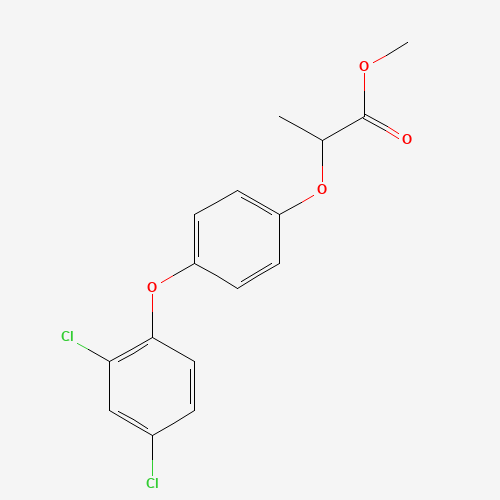
CAS51338-27-3
分子式C16H14Cl2O4
分子量341.19 g/mol
非危品
Diclofop-Methyl can cause cancer and developmental toxicity according to The Environmental Protection Agency (EPA).
科学粮草官-词典编辑部,修订于:2026-07-06
Toxicity
ToxicityEPA Ecotoxicity
Pesticide Ecotoxicity Data from EPA: 61
Ecotoxicity Values
LC50 Coturnix >5000 ppm/5 days
Fate Summary
ATMOSPHERIC FATE: Based on an experimental vapor pressure of approximately 2.5X10⁻⁷ mm Hg at 20 °C(1), dichlorfop-methyl will exist in the vapor and particulate phases in the ambient atmosphere(2). In the vapor phase, it will degrade in the atmosphere by reaction with photochemically produced hydroxyl radicals with an estimated half-life of 21 hrs(3). Physical removal of particulate dichlorfop-methyl from air is likely to occur through wet and dry deposition(SRC).
Soil Adsorption / Mobility
Using a structure estimation method based on molecular connectivity indexes, the Koc for dichlorfop-methyl can be estimated to be about 4000(1). The Koc for dichlorfop-methyl can be estimated to be about 2400 based on an estimated water solubility of 3 mg/L(3) and a regression derived equation(2). Koc for dichlorfop-methyl has also been determined to be 16,000(4). According to a suggested classification scheme(5), these estimated and experimental Koc values suggest that dichlorfop-methyl will be slightly mobile to immobile in soil.
Environmental Biodegradation
In soil, the rate of hydrolysis of dichlorfop-methyl followed the order pH 6.4>7.5>5.5(1). Dichlorfop-methyl appears to be hydrolyzed in soil by hydrolase enzymes associated with viable microorganisms(1). As established in model ecosystems or by direct measurements of soils or waters, dichlorfop-methyl undergoes decarboxylation and ether cleavage reactions in biological systems(2). Dichlorfop-methyl undergoes rapid microbial hydrolysis of the ester bond(3). Dichlorfop, the corresponding acid, was formed and was extensively degraded under aerobic conditions, the final product being CO2(3). Under anaerobic conditions, the degradation proceeded to a small extent, at most, where 3% of the applied radioactivity is accounted for by the degradation product 4-(2,4-dichlorophenoxy)phenol(3). No...
Environmental Bioconcentration
Based upon an experimental water solubility of 3 mg/l(1), the BCF of dichlorfop-methyl can be estimated to be approximately 300 from a regression-derived equation(2). This estimated BCF value suggests moderate bioconcentration in aquatic organisms(SRC).
Volatilization from Water / Soil
The Henry's Law constant for dichlorfop-methyl has been estimated to be 3.8X10⁻⁸ atm-cu m/mole using a structure estimation method(1). This value of Henry's Law constant indicates that dichlorfop-methyl is essentially non-volatile from water(2).
Environmental Abiotic Degradation
The rate constant for the vapor-phase reaction of dichlorfop-methyl with photochemically produced hydroxyl radicals has been estimated to be approximately 18X10-12 cu cm/molecule-sec at 25 °C which corresponds to an atmospheric half-life of about 21 hours at an atmospheric concn of 5X10+5 hydroxyl radicals per cu cm(1,SRC). Dichlorfop-methyl has an aqueous base-catalyzed rate constant of 0.13 l/mol-sec which corresponds to half-lives of 6.3 days at pH 9, 63 days at pH of 8, and 1.7 years at pH of 7(2,SRC). Degradation of dichlorfop-methyl in hydroalcoholic solution is catalyzed by clays and involves a solvotic process which proceeds through a nucleophilic substitution at the carboxyl group and cleavage of the ester bond(3).
Environmental Water Concentrations
SURFACE WATER: In 1984, dichlorfop-methyl was detected in the Turtle River (Canada) at 476 ng/l following a major high water event in late June but was undetectable (<12 ng/l) at other sampling times(1).
Food Survey Values
In three studies (1980-84, 1980-85, and 1989-91) dichlorfop-methyl (detection limit 0.1 ppm) was not found in the fruits and vegetables examined from the United States and Ontario, Canada(1-3).
Artificial Pollution Sources
Dichlorfop-methyl's use as a herbicide(1) will result in its release to the environment through various herbicidal applications(SRC).
Probable Routes of Human Exposure
Herbicides, such as dichlorfop-methyl, can be absorbed into the body by three routes: dermal contact, inhalation, and ingestion(1).
Environmental Fate / Exposure Summary
Dichlorfop-methyl's use as a herbicide will result in its release to the environment through various herbicidal applications. Dichlorfop-methyl has been detected in a Canadian river following a major high water event. If released to soil, dichlorfop-methyl is expected to be slightly mobile to immobile. Several studies have shown that dichlorfop-methyl undergoes rapid microbial hydrolysis in soil to dichlorfop acid, which is fairly stable. If released to water, dichlorfop-methyl will be essentially non-volatile. Dichlorfop-methyl has aqueous base-catalyzed half-lives of 6.3 days at pH 9, 63 days at pH of 8, and 1.7 years at pH of 7. Dichlorfop-methyl will undergo moderate bioconcentration in aquatic organisms and adsorption to sediment will be possible due to high Koc values (2400 to 16,...
Toxicity Data
LC50 (rat) = 8,300 mg/m3/4h
Adverse Effects
Skin Sensitizer - An agent that can induce an allergic reaction in the skin.
RAIS Toxicity Values
Oral Slope Factor Reference: OPP
Acceptable Daily Intakes
OPP RfD= 0.002 mg/kg.
Carcinogen Classification
No indication of carcinogenicity to humans (not listed by IARC).
Non-Human Toxicity Values
LD50 Rat acute oral 580 mg/kg
Non-Human Toxicity Excerpts
Toxic doses produced vomiting in dogs which was life-saving. Not irritating to skin. Formulated product produced corneal opacities and conjunctival irritation in rabbits.
Evidence for Carcinogenicity
Classification of carcinogenicity: 1) evidence in humans: limited; Overall summary evaluation of carcinogenic risk to humans is Group 2B: The agent is possibly carcinogenic to humans. /Chlorophenoxy herbicides; From table/
Antidote and Emergency Treatment
If substantial amounts of chlorophenoxy compounds have been ingested, spontaneous emesis may occur. If vigorous emesis has not occurred, measures should be taken to empty the stomach and limit GI absorption by gastric intubation, aspiration, and lavage, following placement of a cuffed endotracheal tube. Repeated administration of charcoal at half or more the original dosage every 2-4 hr may be beneficial. If gastric aspiration and lavage is not performed due to delay in treatment, and if the patient is fully alert, administer charcoal and laxative orally. Administer iv fluids to accelerate excretion of the chlorophenoxy compound, and to limit concentration of the toxicant in the kidney. A urine flow of 4-6 ml/min is desirable. Iv saline/dextrose has sufficed to rescue comatose patients...