


 一键配货
一键配货
化合物详情
CAS51707-55-2
分子式C9H8N4OS
分子量220.25 g/mol g/mol
危化品
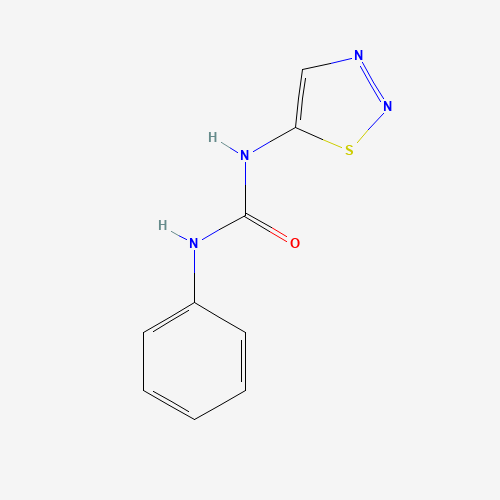
Thidiazuron is a member of ureas.
科学粮草官-词典编辑部,修订于:2026-07-06
Toxicity
ToxicityEPA Ecotoxicity
Pesticide Ecotoxicity Data from EPA: 79
Fate Summary
ATMOSPHERIC FATE: According to a model of gas/particle partitioning of semivolatile organic compounds in the atmosphere(1), thidiazuron, which has a vapor pressure of 2.3X10⁻¹¹ mm Hg at 25 °C(2), is expected to exist solely in the particulate phase in the ambient atmosphere. Particulate-phase thidiazuron may be removed from the air by wet or dry deposition(SRC). Thidiazuron contains chromophores that typically absorb at wavelengths >290 nm(3) and was found to rapidly convert to the photoisomer 1-phenyl-3-(1,2,5-thiadiazol-3-yl)urea under these conditions(4).
Soil Adsorption / Mobility
The Koc of thidiazuron is estimated as 61(SRC), using a log Kow of 1.77(1) and a regression-derived equation(2). According to a classification scheme(3), this estimated Koc value suggests that thidiazuron is expected to have high mobility in soil. The pKa of thidiazuron is 8.86(1), indicating that this compound will partially exist in anion form in the environment and anions generally do not adsorb more strongly to soils containing organic carbon and clay than their neutral counterparts(4). Freundlich adsorption coefficients of three German standard soils: 4.4, 7.3, and 16; one United Kingdom soil: 19; and four United States soils: 1.5, 8.3, 2.0, 1.7, indicated thidiazuron has intermediate mobility(5).
Environmental Biodegradation
PURE CULTURE: Aerobic microbial degradation of thidiazuron and its photoproduct photothidiazuron was found in soil. Thirteen species of microorganisms were examined with Aspergillus versicolor, Torula rosea, and Flavobacter cp. being the most active in degrading thidiazuron. A. versicolor and Penicilliurn cyclopium were most active in degrading photothidiazuron. Radioactive carbon dioxide was formed from thidiazuron-aniline-14C by Oscillatoria sp. but not by Chiorella sp. The recovered compound from the soil (28 day) and pure culture (42 day) studies were 98 and 92.2 percent, respectively, of the parent compound, 14C-thidiazuron(1).
Environmental Bioconcentration
An estimated BCF of 6.8(SRC) was calculated for thidiazuron, using a log Kow of 1.77(1) and a regression-derived equation(2). According to a classification scheme(3), this BCF suggests the potential for bioconcentration in aquatic organisms is low(SRC).
Volatilization from Water / Soil
The Henry's Law constant for thidiazuron is estimated as 3.3X10⁻¹³ atm-cu m/mole(SRC), derived from its vapor pressure, 2.3X10⁻¹¹ mm Hg(1) and water solubility, 20 mg/L(2). This Henry's Law constant indicates that thidiazuron is expected to be essentially nonvolatile from moist soil(SRC) and water surfaces(3). Thidiazuron is not expected to volatilize from dry soil surfaces based upon its vapor pressure.
Environmental Abiotic Degradation
Thidiazuron is not expected to undergo hydrolysis in the environment due to the lack of functional groups that hydrolyze under environmental conditions(1); it was found to be hydrolytically stable at room temperature and pH 5-9(2). Thidiazuron contains chromophores that typically absorb at wavelengths >290 nm(1) and was found to rapidly convert to the photoisomer 1-phenyl-3-(1,2,5-thiadiazol-3-yl)urea(2). An accelerated stability study found no degradation of thidiazuron after storage at 54 °C for 14 days(2).
Ecotoxicity Excerpts
/AQUATIC SPECIES/ Bluegills (Lepomis macrochirus) exposed to 0.1 ppm of thidiazuron-14C cotton defoliant for 28 days under continuous flow conditions accumulated relatively low levels of radiocarbon. The maximum detected was 5.4 ppm in fillet tissue after 1 day. During a 14 day depuration period, radioactivity declined to 1.0 ppm or less. Fractionation of offal and fillet tissues from bluegills collected at 28 days indicated that most of the radioactive material was water soluble, although appreciable amounts of organosoluble radioactive material also were present. When bluegills were injected intraperitoneally with thidiazuron-14C, metabolism and elimination were relatively rapid. Organosoluble radioactive material isolated from fish tissue included thidiazuron, its 2-hydroxyphenyl der...
Artificial Pollution Sources
Thidiazuron's production may result in its release to the environment through various waste streams; its use as a cotton growth regulator(1) and defoliation agent(2) will result in its direct release to the environment(SRC).
Other Environmental Concentrations
Occupational exposure to thidiazuron may occur through inhalation of dust and dermal contact with this compound at workplaces where thidiazuron is produced or used. The general population may be exposed to thidiazuron by dermal contact with this compound near application areas such as cotton fields. (SRC)
Environmental Fate / Exposure Summary
Thidiazuron's production may result in its release to the environment through various waste streams; its use as a cotton growth regulator and defoliation agent will result in its direct release to the environment. If released to air, a vapor pressure of 2.3X10⁻¹¹ mm Hg at 25 °C indicates thidiazuron will exist solely in the particulate phase in the atmosphere. Particulate-phase thidiazuron will be removed from the atmosphere by wet or dry deposition. Thidiazuron contains chromophores that absorb at wavelengths >290 nm, and therefore may be susceptible to direct photolysis by sunlight; it was shown to photolyze rapidly and convert to the photoisomer 1-phenyl-3-(1,2,5-thiadiazol-3-yl)urea under these conditions. If released to soil, thidiazuron is expected to have high mobility based upon...
Symptoms
Minor skin rash, nausea, and weakness (L2080).
Toxicity Data
LD50 > 2 g/kg (L2080).
Health Effects
Relatively few incidents of illness have been reported due to thidiazuron. Since 1992, OPP IDS has only reported 5 incidents as a result of thidiazuron exposure, which all show similar symptoms such as skin rash, nausea, and weakness. However, no medical treatment was required. (L2080)
Adverse Effects
Neurotoxin - Other CNS neurotoxin
Exposure Routes
Dermal; inhalation. (L2080)
Toxicity Summary
The US EPA has found no information indicating thidiazuron shares a common mechanism of toxicity with other substances. (L2080)
RAIS Toxicity Values
Oral Chronic Reference Dose Reference: OPP
Human Toxicity Excerpts
/GENOTOXICITY/ In independently performed mammalian cell cytogenetic (chromosome aberration) assays lymphocyte cultures prepared from human peripheral blood were exposed to Thidiazuron (98.7% a.i., Batch/Lot #: CH107623-02) in dimethyl sulfoxide for 4 hours at concentrations of 0, 9.4, 18.75, 37.5, 75, 150, 200, or 250 ug/mL both in the presence and absence of S9-activation, and for 20 hours at concentrations of 0, 4.7, 9.4, 18.75, 37.5, 75, 150, or 200 ug/mL in the absence of S9-activation. Cells were harvested at 20 hours after initiation of treatment. Thidiazuron was tested up to cytotoxic concentrations (mitotic suppression; 53-60% at 150 ug/mL [+/-S9] at 4 hours of exposure and 51% at 37.5 ug/mL [-S9] at 20 hours of exposure). No significant increases in aberration frequency were o...
Carcinogen Classification
No indication of carcinogenicity to humans (not listed by IARC).
Antidote and Emergency Treatment
/SRP:/ Advanced treatment: Consider orotracheal or nasotracheal intubation for airway control in the patient who is unconscious, has severe pulmonary edema, or is in severe respiratory distress. Positive-pressure ventilation techniques with a bag valve mask device may be beneficial. Consider drug therapy for pulmonary edema ... . Consider administering a beta agonist such as albuterol for severe bronchospasm ... . Monitor cardiac rhythm and treat arrhythmias as necessary ... . Start IV administration of D5W /SRP: "To keep open", minimal flow rate/. Use 0.9% saline (NS) or lactated Ringer's if signs of hypovolemia are present. For hypotension with signs of hypovolemia, administer fluid cautiously. Watch for signs of fluid overload ... . Treat seizures with diazepam or lorazepam ... . Use...









