


 一键配货
一键配货
化合物详情
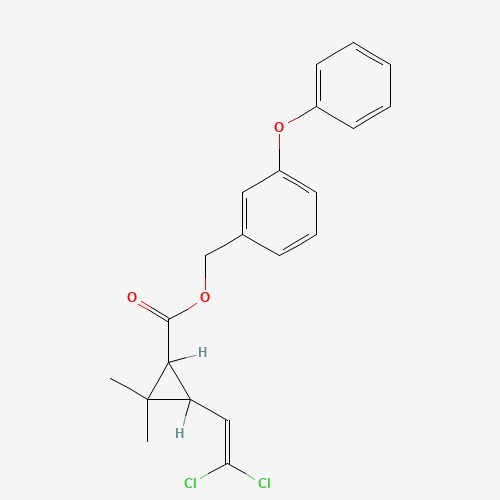
CAS52645-53-1
分子式C21H20Cl2O3
分子量391.29 g/mol g/mol
危化品
Physical Description | Permethrin is a pale brown liquid. Relatively water insoluble. Used as an insecticide.
科学粮草官-词典编辑部,修订于:2026-07-06
Toxicity
ToxicityBody Burden
The concentration of permethrin in the urine of an agricultural worker exposed to the pesticide during application to cabbage was 0 (before application), 0 (after application), 1.8 (6 hrs), 2.8 (17 hrs), 1.4 (26 hrs), 1.9(30 hrs), and 1.6 (40 hrs) ng/mg(1). A person who packed conifer seedlings for 6 hrs in a tunnel in Sweden (whose face was close to the plants) excreted 0.26 ug/mL permethrin acid metabolite in the urine the following morning; in the afternoon, excretion was below the detection limit(2).
EPA Ecotoxicity
Pesticide Ecotoxicity Data from EPA: 143
Fate Summary
ATMOSPHERIC FATE: According to a model of gas/particle partitioning of semivolatile organic compounds in the atmosphere(1), permethrin, which has a vapor pressure of 5.18X10⁻⁸ mm Hg at 25 °C(2), will exist in both the vapor and particulate phases in the ambient atmosphere(SRC). Vapor-phase permethrin is degraded in the atmosphere by reaction with photochemically-produced hydroxyl radicals and ozone(SRC); the half-life for reaction with hydroxyl radicals in air is estimated to be 17 hours(SRC), calculated from its rate constant of 2.3X10⁻¹¹ cu cm/molecule-sec at 25 °C(3); the half-life for reaction with ozone in air is estimated to be 49 days(SRC), calculated from its rate constant of 2.3X10⁻¹⁹ cu cm/molecule-sec at 25 °C(3). Particulate-phase permethrin may be removed from the air by we...
Soil Adsorption / Mobility
Koc values for permethrin range from 10,471 to 86,000 that were measured in a variety of different soils including silt loam, sandy loam, sediments and sand(1); the selected Koc value (for use in modeling) is 39,300(1). Koc values for silt loam (Ohio), sandy loam (Wisconsin), sediment (Georgia), and sand (Florida) were 19,300 (Kd = 236; organic matter, 0.71%), 20,900 (Kd = 217; organic matter, 0.60%), 44,700 (Kd = 401; organic matter, 0.91%), and 60,900 (Kd = 140; organic matter, 0.13%), respectively(1). The Kd for permethrin was measured to be 400 on a red earth soil from Australia with an organic matter content of 1.09%(2) which corresponds to a Koc of about 63,100(SRC). According to a classification scheme(3), these Koc values suggest that permethrin is expected to be immobile in soi...
Environmental Biodegradation
PURE CULTURE: Pure cultures of Bacillus cereus, Pseudomonas fluorescens, and Achromobacter sp. transformed permethrin to 3-(2,2-dichlorovinyl)-2,2-dimethylcyclopropanecarboxylic acid, 3-phenoxybenzyl alcohol, 3-phenoxy benzoic acid, and 4-hydroxy-3-phenoxybenzoic acid; half-life of less than 5 days(1).
Environmental Bioconcentration
The BCF values for permethrin in rainbow trout (Oncorhynchus mykiss) and sheepshead minnow (Cyprinodon vagiegatus) were approximately 560 and 480, respectively(1,2). According to a classification scheme(3), these BCF values suggest the potential for bioconcentration in aquatic organisms is high(SRC). A BCF of 1,900 was also reported for oysters(2). Insect BCF values after 6 hr of exposure to sublethal permethrin concentrations were 18, 30, 7, 4, and 24 for black fly, caddisfly, damsefly, water scavenger, and mayfly, respectively(4).
Volatilization from Water / Soil
The Henry's Law constant for permethrin is estimated as 2.4X10⁻⁶ atm-cu m/mole(SRC) derived from its vapor pressure, 5.18X10⁻⁸ mm Hg(1), and water solubility, 0.0111 mg/L(1). This Henry's Law constant indicates that permethrin is expected to volatilize from water surfaces(2). Based on this Henry's Law constant, the volatilization half-life from a model river (1 m deep, flowing 1 m/sec, wind velocity of 3 m/sec)(2) is estimated as 39 days(SRC). The volatilization half-life from a model lake (1 m deep, flowing 0.05 m/sec, wind velocity of 0.5 m/sec)(2) is estimated as 289 days(SRC). However, volatilization from water surfaces is expected to be attenuated by adsorption to suspended solids and sediment in the water column(SRC). The estimated volatilization half-life from a model pond exceed...
Environmental Abiotic Degradation
The rate constant for the vapor-phase reaction of permethrin with photochemically-produced hydroxyl radicals has been estimated as 2.30X10⁻¹¹ cu cm/molecule-sec at 25 °C(1). This corresponds to an atmospheric half-life of about 17 hours at an atmospheric concentration of 5X10+5 hydroxyl radicals per cu cm(1). The rate constant for the vapor-phase reaction of permethrin with photochemically-produced ozone has been estimated as 2.33X10⁻¹⁹ cu cm/molecule-sec at 25 °C(1). This corresponds to an atmospheric half-life of about 49 days at an atmospheric concentration of 7X10+11 ozone molecules per cu cm(1). In sterile buffer solutions at pH 4, 7 and 9 (25 °C), both cis- and trans-isomers of permethrin were found to be stable at pH 4 and pH 7(2); at pH 9, cis-permethrin had a hydrolysis half-li...
Environmental Water Concentrations
SURFACE WATER: As part of the National Drinking Water Contaminant Occurrence Database (NDOD), permethrin was detected in 3 of 73 ambient spring water samples at an average concentration for positive samples of 0.0133 ug/L (max, 0.02; min, 0.01)(1); permethrin was also detected in 24 of 12,253 other ambient surface water samples at an average concentration for positive samples of 0.0137 ug/L (max, 0.03; min, 0.005)(1). Permethrin was detected 6 hrs post-application at concentrations of 17 and 18 ng/L in 2 of 6 samples from a creek approximately 60-100 m from a potato field where permethrin was applied via aerial spraying(2). In 1996, permethrin concentration in surface waters from agricultural areas in Thailand was 2.81 ug/L(3). The percentage of freshwater samples in England and Wales (...
Milk Concentrations
Very small amounts /of permethrin/ are distributed into milk in animals.
Plant Concentrations
Permethrin was not detected at concentrations greater than 10 ug/kg in 182 fish taken from 2 creeks approximately 60-100 m from potato fields where permethrin was applied via aerial spraying(1).
ICSC Environmental Data
The substance is very toxic to aquatic organisms. This substance does enter the environment under normal use. Great care, however, should be taken to avoid any additional release, for example through inappropriate disposal.
Atmospheric Concentrations
INDOOR AIR: According to a pilot investigation of pesticides in 9 homes in Jacksonville, FL during August of 1985, permethrin was qualitatively detected in the outdoor air (porch or patio) of 2 homes(1). The concentration of cis- and trans-permethrin in household dust ranged between 255-2850 and 365-3850 ug/kg, respectively, for 4 of 7 NJ homes in 1985(2). In 1993, permethrin was detected in the ambient air of insecticide storage and office rooms of a commercial pest control building in North Carolina at a mean concentration of 0.45 ug/cu m(3).
Artificial Pollution Sources
Permethrin's production and registered for use in/on modes of transportation, structures, buildings, pets, and clothing (impregnated and ready to use formulations) may result in its release to the environment through various waste streams(SRC). Additionally, permethrin has non-FIFRA pharmaceutical uses as a pediculicide for the treatment of head lice and scabies(1). Its use in/on numerous food/feed crops, livestock and livestock housing, Public Health Mosquito abatement programs, and numerous indoor and outdoor residential spaces(1) will result in its direct release to the environment(SRC).
Sediment/Soil Concentrations
SOIL: Permethrin was detected in the hydrosoil of a model outdoor pond at a concentration of 1 ug/kg one year after treatment with 15 ug/L permethrin(1). Permethrin was detected 30 days post-application at a concentration of 10 ug/kg in 1 of 3 sediment samples from a creek approximately 60-100 m from a potato field where permethrin was applied via aerial spraying(2). Between 1996-1997, the concentration of permethrin in soil samples from cultivated areas in Thailand ranged from 62.41 to 1,178.40 ug/kg (24 samples)(3). The average concentration of permethrin in the soil collected from 49 agrichemical facilities located throughout Illinois was 190 ug/kg (range, 11 to 4.22X10+5 ug/kg)(4). Yard soil samples collected from 11 homes in Atlanta GA during Jan-April 2006 contained positive cis-...
Probable Routes of Human Exposure
According to a pilot investigation of pesticides in 9 homes in Jacksonville, FL during August of 1985, potential respiratory exposure to permethrin was estimated in 1 home using a personal monitor carried by a resident of each household(1).
Other Environmental Concentrations
In a nationwide survey of 1,131 public and private residential homes conducted by the USEPA and US Dept of Housing and Urban Development, permethrin isomers were detected (detection limit of 0.0018-0.0024 ng/sq cm) in 88-89% of 448-459 floor wipe samples collected between June 2005 and March 2006 at a maximum concentrations of 68 (cis-isomer) and 102 (trans-isomer) ng/sq cm and mean concentrations of 1.4 (cis-isomer) and 2.2 (trans-isomer) ng/sq cm(1). Mean surface concentrations of permethrin measured in a variety of residential homes and child care centers ranged from 0.03 to 3.06 ng/sq cm with 68-100% detection frequencies(1). In 2006, two dust samples were collected 5-8 days apart from each of 13 urban homes in Oakland, California and 15 farmworker homes in Salinas, California, an a...
Environmental Fate / Exposure Summary
Permethrin's production may result in its release to the environment through various waste streams; its use as a broad spectrum insecticide will result in its direct release to the environment. If released to air, a vapor pressure of 5.18X10⁻⁸ mm Hg at 25 °C indicates permethrin will exist in both the vapor and particulate phases in the ambient atmosphere. Vapor-phase permethrin will be degraded in the atmosphere by reaction with photochemically-produced hydroxyl radicals and ozone; the half-lives for these reactions in air are estimated to be 17 hours and 49 days, respectively. Particulate-phase permethrin will be removed from the atmosphere by wet and dry deposition. Permethrin is susceptible to direct photolysis in sunlight. If released to soil, permethrin is expected to have no mobi...
Symptoms
Following oral exposure, severe fine tremor, marked reflex hyperexcitability, sympathetic activation can occur. Nausea, vomiting and abdominal pain commonly occur and develop following ingestion. Sudden bronchospasm, swelling of oral and laryngeal mucous membranes, and anaphylactoid reactions have been reported after inhalation. Hypersensitivity reactions characterized by pneumonitis, cough, dyspnea, wheezing, chest pain, and bronchospasm may occur too . Dermatitis is the main effect of a dermal exposure to permethrin. (T36)
Treatment
Following oral exposure, the treatment is symptomatic and supportive and includes monitoring for the development of hypersensitivity reactions with respiratory distress. Provide adequate airway management when needed. Gastric decontamination is usually not required unless the pyrethrin product is combined with a hydrocarbon. Following inhalation exposure, move patient to fresh air. monitor for respiratory distress. If cough or difficulty breathing develops, evaluate for respiratory tract irritation, bronchitis, or pneumonitis. Administer oxygen and assist ventilation as required. Treat bronchospasm with inhaled beta2 agonist and oral or parenteral corticosteroids. In case of eye exposure, irrigate exposed eyes with copious amounts of room temperature water for at least 15 minutes. If ir...
Interactions
/Nuclear magnetic resonance/ (NMR) combined with pattern recognition was recently introduced as a new technique for rapid xenobiotic toxicity evaluation. In this article, metabolic changes in the biofluid of rats after 90-day oral treatment with propoxur, permethrin and a combination of these two pesticides were investigated. Propoxur dosing induced increased urinary taurine, creatinine and glucose, whereas urinary lactate and acetate were increased in the highest permethrin dose group. Urinary acetate, alanine, lactate and trimethylamine levels were increased in the mixture group, accompanied by decreased urinary tricarboxylic acid cycle intermediates. In addition, the highest dose of the mixture displayed raised 3-D-hydroxybutyrate, acetate and lactate levels in the serum sample. Chro...
Target Organs
Hepatic
Toxicity Data
Oral, rat LD<sub>50</sub>: 430 - 4000 mg/kg Skin, rabbit LD<sub>50</sub>: 2000 mg/kg LD50: 3 801 mg/kg (Oral, Rat) (L857)
Health Effects
As for every type I pyrethroids, permethrin effects typically include rapid onset of aggressive behavior and increased sensitivity to external stimuli, followed by fine tremor, prostration with coarse whole body tremor, elevated body temperature, coma, and death. Paresthesia, severe corneal damage, hypotension and tachycardia, associated with anaphylaxis can also occur following permethrin poisoning. (L857)
Adverse Effects
When used for pediculosis capitis, the rash has been reported as an adverse drug reaction. Localized temporary paresthesia, cutaneous irritation, and allergic contact dermatitis are also possible, yet rare, adverse effects associated with permethrin use. A rare case report exists of a patient presenting with muscle dystonia attributed to 5% topical permethrin.
Exposure Routes
Inhalation (L857); oral (L857); dermal (L857); eye contact (L857). Poorly absorbed through the skin.
Toxicity Summary
Pyrethroids exert their effect by prolonging the open phase of the sodium channel gates when a nerve cell is excited. They appear to bind to the membrane lipid phase in the immediate vicinity of the sodium channel, thus modifying the channel kinetics. This blocks the closing of the sodium gates in the nerves, and thus prolongs the return of the membrane potential to its resting state. The repetitive (sensory, motor) neuronal discharge and a prolonged negative afterpotential produces effects quite similar to those produced by DDT, leading to hyperactivity of the nervous system which can result in paralysis and/or death. Other mechanisms of action of pyrethroids include antagonism of gamma-aminobutyric acid (GABA)-mediated inhibition, modulation of nicotinic cholinergic transmission, enha...
Minimum Risk Level
Intermediate Oral: 0.2 mg/kg/day (Rat) (L857)
Average Daily Intake
The average daily intake (AVDI) of permethrin (total) in 8 population groups in 1984-1996 was determined according to the FDA's monitoring program for chemical contaminants in the U.S. food supply (Total Diet Study or Market Basket Study). In 6-11 month old infants, the AVDI was 44.1 ng/kg-body weight-per day. In 2 yr old toddlers, the AVDI was 12.8 ng/kg-body weight-per day. In 14-16 year old females, the AVDI was 5.5 ng/kg-body weight-per day. In 14-16 year old males, the AVDI was 7.6 ng/kg-body weight-per day. In 25-30 year old females, the AVDI was 7.7 ng/kg-body weight-per day. In 25-30 year old males, the AVDI was 7.0 ng/kg-body weight-per day. In 60-65 year old females, the AVDI was 12.4 ng/kg-body weight-per day. In 60-65 year old males, the AVDI was 11.5 ng/kg-body weight-per d...
RAIS Toxicity Values
Short-term Oral Reference Dose Reference: ATSDR Final
Acceptable Daily Intakes
FAO/WHO ADI: 0.05 mg/kg bw
Carcinogen Classification
3, not classifiable as to its carcinogenicity to humans. (L135)
Drug Induced Liver Injury
References: DOI:10.1016/j.drudis.2019.09.022
1 or Cancer Risk Level 1E-06
Fraction of Contaminant Absorbed Dermally from Soil: 0.1
Evidence for Carcinogenicity
The /Environmental Protection/ Agency classified permethrin as "Likely to be Carcinogenic to Humans" by the oral route. This classification was based on two reproducible benign tumor types (lung and liver) in the mouse, equivocal evidence of carcinogenicity in Long-Evans rats, and supporting structural activity relationships (SAR) information. For the purpose of risk characterization, a low dose extrapolation model (Q1*) was used. The Q1* is 9.6 x 10⁻³ (mg/kg/day)-1 and was derived from the female mouse lung (adenoma and/or carcinoma) tumors
Effects During Pregnancy and Lactation
Relevant published information was not found as of the revision date.
Hazard Quotient Level 3 or Cancer Risk Level 1E-04
Fraction of Contaminant Absorbed Dermally from Soil: 0.1
USGS Health-Based Screening Levels for Evaluating Water-Quality
Reference: Smith, C.D. and Nowell, L.H., 2024. Health-Based Screening Levels for evaluating water-quality data (3rd ed.). DOI:10.5066/F71C1TWP









