


 一键配货
一键配货
化合物详情
CAS52918-63-5
分子式C22H19Br2NO3
分子量505.2 g/mol g/mol
危化品
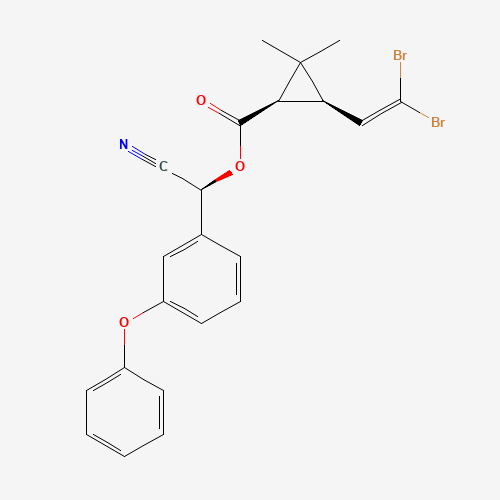
Deltamethrin is a cyclopropanecarboxylate ester obtained by formal condensation between 3-(2,2-dibromovinyl)-2,2-dimethylcyclopropanecarboxylic acid and cyano(3-phenoxyphenyl)methanol. It is the active insecticide of the proinsecticide tralomethrin. It has a role as an antifeedant, an agrochemical, an EC 3.1.3.16 (phosphoprotein phosphatase) inhibitor, a calcium channel agonist and a pyrethroid ester insecticide. It is a nitrile, an aromatic ether, an organobromine compound and a cyclopropanecarboxylate ester. It is functionally related to a cis-3-(2,2-dibromovinyl)-2,2-dimethylcyclopropanecarboxylic acid.
科学粮草官-词典编辑部,修订于:2026-07-06
Toxicity
ToxicityBody Burden
Urine concentrations of deltamethrin of workers spraying deltamethrin insecticide on cotton was 0.01-1.79 ug/collection interval (3-12 hr) for a period up to 72 hr after spraying(1).
EPA Ecotoxicity
Pesticide Ecotoxicity Data from EPA: 80
Fate Summary
ATMOSPHERIC FATE: According to a model of gas/particle partitioning of semivolatile organic compounds in the atmosphere(1), deltamethrin, which has a vapor pressure of 9.3X10⁻¹¹ mm Hg at 25 °C(2), is expected to exist solely in the particulate phase in the ambient atmosphere. Particulate-phase deltamethrin may be removed from the air by wet or dry deposition(SRC).
Soil Adsorption / Mobility
The Koc of deltamethrin, tested in soil and sediment samples, has been found to range from 79,000 to 16,300,000(1-3). According to a classification scheme(4), this Koc range suggests that deltamethrin is expected to be immobile in soil. The mobility of deltamethrin in soil was studied in soil column experiments and by soil thin-layer chromatography (TLC) using a Hagerstown silty clay, a silty clay loam and a Tifton loamy sand(5); deltamethrin was found to be immobile in all soils studied(5). Two hours after dissolved organic carbon (DOC) was added to water solutions of deltamethrin, about 20% of the deltamethrin was sorbed to the DOC(6); after 24 hr, nearly 81% was sorbed to the DOC(6). Laboratory studies have shown that deltamethrin applied to water surfaces or to subsurface water will...
Environmental Biodegradation
AEROBIC: Laboratory and field studies measured deltamethrin soil half-lives of 4.9-6.9 weeks in a sandy clay loam soil(1). A German laboratory study measured a soil half-life of 110 days(2). When applied to soil (in both field and laboratory tests) in high water volumes with a pipette, deltamethrin exhibited initial half-lives of about 5-8 weeks(3); when applied as a spray, disappearance was roughly 2-4 times faster(3). A half-life of 72 days was measured in an organic soil (under laboratory conditions) over a 180-day observation period(4). Half-lives of 35 and 60 days have been reported for German sandy soil and sandy loam soil, respectively(5). Half-lives of deltamethrin sprayed on forage, litter, alfalfa and sweet peppers were 5.9, 17, 3.4 and 1.5-2.0 days, respectively(6-8). Less th...
Environmental Bioconcentration
Log BCFs of 2.62 and 2.7 were reported in Onchorynchus mykiss (rainbow trout)(1). In a pond study using radio-labeled C-14 deltamethrin, fathead minnows (Pimephales promelas) accumulated levels of extractable radioactivity 248-907 times higher than levels in the water at 24-hr after exposure although the nature of the radioactive compounds was not provided(2). In a static system for a 24-hr exposure period, deltamethrin BCFs of about 200 to 1300 were measured for Daphnia magnus(3); observed BCFs decreased with increases in dissolved organic carbon(3). BCF values of 39-305 were measured in larvae of the midge Chronomus tentans in sand, silt or clay sediment water systems(4). According to a classification scheme(5), these BCF values suggest that the potential for bioconcentration in aquat...
Volatilization from Water / Soil
The Henry's Law constant for deltamethrin is estimated as 5.0X10⁻⁶ atm-cu m/mol (SRC) derived from its vapor pressure, 9.3X10⁻¹¹ mm Hg(1), and water solubility, <2X10⁻³ mg/L(1). This low vapor pressure and small Henry's Law constant indicates that deltamethrin may not volatilize substantially from wet surfaces(2). Based on this Henry's Law constant, the volatilization half-life from a model river (1 m deep, flowing 1 m/sec, wind velocity of 3 m/sec)(3) is estimated as 17 days(SRC). The volatilization half-life from a model lake (1 m deep, flowing 0.05 m/sec, wind velocity of 0.5 m/sec)(3) is estimated as 130 days(SRC). However, volatilization from water surfaces is expected to be attenuated by adsorption to suspended solids and sediment in the water column. The estimated volatilization...
Environmental Abiotic Degradation
Deltamethrin was found to be stable to hydrolysis at pH 5 and 7, and had a half-life of 2.5 days at pH 9(1). Deltamethrin was observed to undergo direct photolysis when hexane, acetonitrile-water, or water solutions were exposed to UV radiation >295 nm(2). In aqueous solution, the photolysis rate increased rapidly when a 2% acetone photosensitizer was added(2). Photolysis rates were slower in water than in hexane or acetonitrile-water(2). The photodegradation reaction went through racemization at the alpha position in the alcohol moiety, ester cleavage and reductive bromination(2). When cotton strips impregnated with deltamethrin were exposed to a UV lamp (simulating midday natural sunlight) for a 24-hr period, 31-99% of the initial deltamethrin degraded(3). The fastest degradation rate...
Environmental Water Concentrations
RAIN/SNOW/FOG: Deltamethrin was not detected (0.2 ng/L detection limit) in rainwater samples collected May to July 1997 in the intensive greenhouse horticultural area on the shore of Niewkoopse Plassen, Noorden, The Netherlands(1).
Milk Concentrations
ENVIRONMENTAL: Pyrethroids (permethrin, cyfluthrin, cypermethrin and deltamethrin) were found in the breastmilk of nursing mothers in 3 South African towns. Average levels in breastmilk ranged from 8.3 to 48.4 mcg/L in the 3 towns. The source was thought to be from a dusting powder widely available and used in gardening. The dosage and route of exposure (i.e., topical, inhalation, oral) could not be determined. All milk levels were below the allowable daily limit for permethrin.
Effluent Concentrations
In one aerial deposition study involving spray application from an airplane, peak deposition to the ground was 0.5-1.2 ng/cu cm(1). A site 4 km from the spray area received ground depositions as high as 0.2 ng/cu cm, although most areas outside the spray area received insignificant deposition(1). Deltamethrin was detected in 12% of 33 urban runoff samples with a maximum concentration of 3.5 ng/L, in 11% of 18 publicly owned treatment works samples with a maximum concentration of 2.7 ng/L and was not detected in 57 agricultural drain samples, samples were collected in 2008 and 2009 from the Sacramento-San Joaquin Delta area of CA(2).
ICSC Environmental Data
The substance is very toxic to aquatic organisms. This substance does enter the environment under normal use. Great care, however, should be taken to avoid any additional release, for example through inappropriate disposal.
Atmospheric Concentrations
INDOOR: Deltamethrin was not detected (detection limit 10 ng/cu m) in indoor air after application to control cockroaches (up to 4 applications per year for up to 5 years)(1).
Artificial Pollution Sources
Deltamethrin's production may result in its release to the environment through various waste streams; its use as an insecticide(1) will result in its direct release to the environment(SRC).
Sediment/Soil Concentrations
SOIL: Deltamethrin was not detected in rice-farming soils adjacent to fruit crops treated with deltamethrin in Albufera National Park, Valencia, Spain for the period of April 1996 to Nov 1997(1). Deltamethrin was not detected in 24 agricultural soil samples taken Oct 2006 from open field and plastic shed conditions in Belgrade, Serbia(2).
Probable Routes of Human Exposure
Dermal exposure of deltamethrin to a pilot applying the insecticide while flying an ultra-light aircraft was 10.8 ug/hr(1); a ground-based flagman on duty during the aerial spraying received a dermal exposure of 25 ug/hr(1); dermal exposure to workers manually spraying deltamethrin was 2.8-42.2 mg/hr(1); the 1000-fold exposure difference between hand-held applicators and aerial applicators was due, in part, to work practices of the workers(1). Inhalation exposure of workers involved in spray applications of deltamethrin in greenhouses was measured as 5.2 ug/cu m at the time of spraying and 0.008 ug/cu m 30 min after spraying(2); dermal exposures (chest, back, arms, forearms, hands, legs) ranged from 0.21 to 10.5 ug/100 cu cm(2). Workers packaging deltamethrin in a small importing factor...
Other Environmental Concentrations
A study was conducted to determine the ability of laundry practices used by farm families to remove pesticides from clothing(1). After one wash, 2-18% of initial deltamethrin remained on fabrics(1); after two washes, 1-10% of initial deltamethrin remained on fabrics(1). Cotton strips were coated with deltamethrin and then washed in deionized water for one hr(2). After 4 washings, only 37.7% of initial deltamethrin was removed from the cotton(2). Impregnating the cotton with various paraffin wax and oils (corn, linseed, silicone) before coating with deltamethrin resulted in lower percentages removed when washed (9.9-29.2% removal)(2). Deltamethrin was detected at a maximum concentration of 10 mg/kg in household dust after fighting cockroaches (up to 4 applications per year for up to 5 ye...
Environmental Fate / Exposure Summary
Deltamethrin's production may result in its release to the environment through various waste streams; its use as an insecticide will result in its direct release to the environment. If released to air, a vapor pressure of 9.3X10⁻¹¹ mm Hg at 25 °C indicates deltamethrin will exist solely in the particulate phase in the atmosphere. Particulate-phase deltamethrin will be removed from the atmosphere by wet or dry deposition. If released to soil, deltamethrin is expected to have no mobility based upon Koc values of 79,000 to 16,300,000. Volatilization from moist soil surfaces is expected to be an important fate process based upon an estimated Henry's Law constant of 5.0X10⁻⁶ atm-cu m/mol. Deltamethrin photodegraded as thin-films or when sprayed on potato leaves exposed to sunlight. Deltameth...
Symptoms
Following dermal exposure to deltamethrin, feelings of numbness, itching, burning, stinging, tingling, or warmth may occur, that could last for a few hours. Ddizziness, headache, nausea, muscle twitching, reduced energy, and changes in awareness can reult from inhalation or ingestion of large amounts of deltamethrin. Paralysis can occur after exposure (L857).
Treatment
Following oral exposure, the treatment is symptomatic and supportive and includes monitoring for the development of hypersensitivity reactions with respiratory distress. Provide adequate airway management when needed. Gastric decontamination is usually not required unless the pyrethrin product is combined with a hydrocarbon. Following inhalation exposure, move patient to fresh air. monitor for respiratory distress. If cough or difficulty breathing develops, evaluate for respiratory tract irritation, bronchitis, or pneumonitis. Administer oxygen and assist ventilation as required. Treat bronchospasm with inhaled beta2 agonist and oral or parenteral corticosteroids. In case of eye exposure, irrigate exposed eyes with copious amounts of room temperature water for at least 15 minutes. If ir...
Toxicity Data
LD50: 4123 mg/kg (Oral, Rat) (A563) LD50: >2460 mg/kg (Dermal, Rabbit) (A563)
Health Effects
At high doses, signs of poisoning attributable to deltamethrin include profuse salivation and pulmonary edema, clonic seizures, opisthotonos (i.e., the spine is bent forward such that a supine body rests on its head and heels), coma, and death. At lower doses, commonly observed effects include paresthesia and erythema (L863).
Adverse Effects
Occupational hepatotoxin - Secondary hepatotoxins: the potential for toxic effect in the occupational setting is based on cases of poisoning by human ingestion or animal experimentation.
Exposure Routes
Inhalation (L857); oral (L857); dermal (L857); eye contact (L857).
Toxicity Summary
Both type I and type II pyrethroids exert their effect by prolonging the open phase of the sodium channel gates when a nerve cell is excited. They appear to bind to the membrane lipid phase in the immediate vicinity of the sodium channel, thus modifying the channel kinetics. This blocks the closing of the sodium gates in the nerves, and thus prolongs the return of the membrane potential to its resting state. The repetitive (sensory, motor) neuronal discharge and a prolonged negative afterpotential produces effects quite similar to those produced by DDT, leading to hyperactivity of the nervous system which can result in paralysis and/or death. Other mechanisms of action of pyrethroids include antagonism of gamma-aminobutyric acid (GABA)-mediated inhibition, modulation of nicotinic cholin...
RAIS Toxicity Values
Oral Acute Reference Dose Reference: OPP
Acceptable Daily Intakes
FAO/WHO ADI: 0.01 mg/kg
Carcinogen Classification
3, not classifiable as to its carcinogenicity to humans. (L135)
Evidence for Carcinogenicity
Evaluation: No data were available from studies in humans. There is inadequate evidence for the carcinogenicity of deltamethrin in experimental animals. Overall evaluation: Deltamethrin is not classifiable as to its carcinogenicity to humans (Group 3).









