


 一键配货
一键配货
化合物详情
CAS53112-28-0
分子式C12H13N3
分子量199.25 g/mol g/mol
危化品
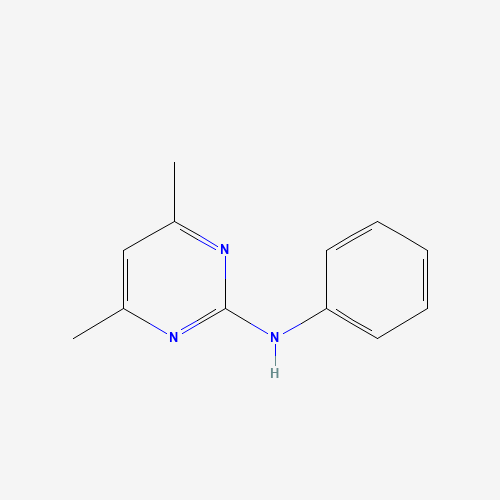
Pyrimethanil is a member of the class of aminopyrimidines that is N-phenylpyrimidin-2-amine carrying two additional methyl substituents at positions 4 and 6. A fungicide used to control grey mould on fruit, vegetables and ornamentals as well as leaf scab on pome fruit. Also commonly employed to control Botrytis cinerea throughout the winemaking process in grapes, must, fermenting must and wine. It has a role as a xenobiotic, an aryl hydrocarbon receptor agonist, an environmental contaminant and an antifungal agrochemical. It is an aminopyrimidine, a secondary amino compound and an anilinopyrimidine fungicide.
科学粮草官-词典编辑部,修订于:2026-07-06
Toxicity
ToxicityEPA Ecotoxicity
Pesticide Ecotoxicity Data from EPA: 37
Fate Summary
The fate of four new fungicides (cyprodinil, fludioxonil, pyrimethanil, and tebuconazole) from the treatment on vine to the production of wine was studied. The influence of clarifying agents (bentonite, charcoal, potassium caseinate, gelatin, and polyvinylpolypyrrolidone) on residue concentrations in wine was also studied. The fungicide residues on grapes showed different decay rates after treatment, with first-order kinetics and half-lives ranging from 8 to 57 days. Grape processing into wine caused considerable residue reduction with cyprodinil (ca. 80%), fludioxonil (ca. 70%), and tebuconazole (ca. 50%) and no reduction with pyrimethanil. The two wine-making techniques employed (with and without maceration) had the same influence on the residue concentrations in wine, except for flud...
Soil Adsorption / Mobility
The Koc of pyrimethanil is estimated as 835(SRC), using a log Kow of 2.84(1) and a regression-derived equation(2). According to a classification scheme(3), this estimated Koc value suggests that pyrimethanil is expected to have low mobility in soil.
Environmental Biodegradation
The half-life of pyrimethanil in laboratory soil column experiments was reported in the range of 27- 82 days(1). The half-life in soils determined from field experiments was in the range of 7-54 days(1).
Environmental Bioconcentration
An estimated BCF of 31 was calculated for pyrimethanil(SRC), using a log Kow of 2.84(1) and a regression-derived equation(2). According to a classification scheme(3), this BCF suggests the potential for bioconcentration in aquatic organisms is moderate.
Volatilization from Water / Soil
The Henry's Law constant for pyrimethanil is estimated as 2.5X10⁻⁶ atm-cu m/mole(SRC) using a fragment constant estimation method(1). This Henry's Law constant indicates that pyrimethanil is expected to volatilize from water surfaces(2). Based on this Henry's Law constant, the volatilization half-life from a model river (1 m deep, flowing 1 m/sec, wind velocity of 3 m/sec)(2) is estimated as 14 days(SRC). The volatilization half-life from a model lake (1 m deep, flowing 0.05 m/sec, wind velocity of 0.5 m/sec)(2) is estimated as 158 days(SRC). Pyrimethanil's Henry's Law constant(1) indicates that volatilization from moist soil surfaces may occur(SRC). Pyrimethanil is not expected to volatilize from dry soil surfaces(SRC) based upon a vapor pressure of 1.65X10⁻⁵ mm Hg at 25 °C(3).
Environmental Abiotic Degradation
The rate constant for the vapor-phase reaction of pyrimethanil with photochemically-produced hydroxyl radicals has been estimated as 2X10⁻¹⁰ cu cm/molecule-sec at 25 °C(SRC) using a structure estimation method(1). This corresponds to an atmospheric half-life of about 2 hours at an atmospheric concentration of 5X10+5 hydroxyl radicals per cu cm(1). Based on absorption spectra of structurally similar compounds(3) pyrimethanil may absorb light greater than 290 nm and undergo direct photolysis in the environment(SRC), but the kinetics of this reaction are unknown. Pyrimethanil is a weak base with a pKa value of 3.52(2), suggesting it may partially exist in the protonated form in acidic waters.
Artificial Pollution Sources
Pyrimethanil's reported production and use as a fungicide(1) may result in its direct release to the environment(SRC).
Probable Routes of Human Exposure
Occupational exposure to pyrimethanil may occur through inhalation and dermal contact with this compound at workplaces where pyrimethanil is produced or used. (SRC)
Environmental Fate / Exposure Summary
Pyrimethanil's reported production and use as a fungicide may result in its direct release to the environment. If released to air, a vapor pressure of 1.65X10⁻⁵ mm Hg at 25 °C indicates pyrimethanil will exist in both the vapor and particulate phases in the ambient atmosphere. Vapor-phase pyrimethanil will be degraded in the atmosphere by reaction with photochemically-produced hydroxyl radicals; the half-life for this reaction in air is estimated to be 2 hours. Particulate-phase pyrimethanil will be removed from the atmosphere by wet and dry deposition. Pyrimethanil may also undergo direct photolysis in the environment, but the kinetics of this reaction are unknown. If released to soil, pyrimethanil is expected to have low mobility based upon an estimated Koc of 835. Volatilization from...
Effect Level
collection=toxvaldb&kind=^EL$
Lethal Dose
collection=toxvaldb&kind=^LD$
Adverse Effects
Occupational hepatotoxin - Secondary hepatotoxins: the potential for toxic effect in the occupational setting is based on cases of poisoning by human ingestion or animal experimentation.
RAIS Toxicity Values
Oral Chronic Reference Dose Reference: OPP
Human Toxicity Excerpts
The alkaline comet assay was used to assess DNA damage in mononuclear leukocytes of farmers before and after a 1-day spraying period with selected pesticides under usual conditions. Two blood samples were collected, one in the morning of the day of spraying (S0) and the second in the morning of the day after (S1). Here, we assessed variations in DNA damage levels between these two sampling times. Four groups of farmers were formed, according to exposure to: (a) various fungicide-insecticide mixtures (including chlorothalonil; group 1, n = 8), (b) the herbicide isoproturon (group 2, n = 11), (c) fungicide triazoles (group 3, n = 14), and (d) a fungicide (chlorothalonil)-insecticide mixture (group 4, n = 8). An increase in DNA damage levels was observed at S1 for groups 1 and 4, who were...
Carcinogen Classification
No indication of carcinogenicity to humans (not listed by IARC).
Reference and Risk Values
collection=toxvaldb&kind=^RRV$
Non-Human Toxicity Excerpts
May be phytotoxic in closed systems at >/= 80% relative humidity on sensitive species (e.g. Solanaceae).
USGS Health-Based Screening Levels for Evaluating Water-Quality
Reference: Smith, C.D. and Nowell, L.H., 2024. Health-Based Screening Levels for evaluating water-quality data (3rd ed.). DOI:10.5066/F71C1TWP









