


 一键配货
一键配货
化合物详情
CAS55219-65-3
分子式C14H18ClN3O2
分子量295.76 g/mol g/mol
危化品
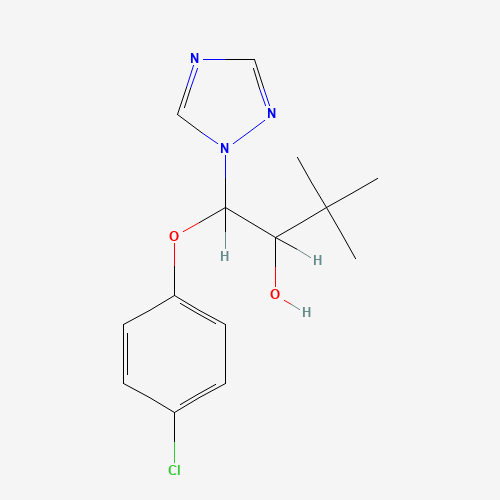
Triadimenol is a member of the class of triazoles that is 3,3-dimethyl-1-(1,2,4-triazol-1-yl)butane-1,2-diol substituted at position O1 by a 4-chlorophenyl group. A fungicide for cereals, beet and brassicas used to control a range of diseases including powdery mildew, rusts, bunts and smuts. It has a role as a xenobiotic metabolite, an EC 1.14.13.70 (sterol 14alpha-demethylase) inhibitor and an antifungal agrochemical. It is a hemiaminal ether, an aromatic ether, a secondary alcohol, a member of monochlorobenzenes, a conazole fungicide and a triazole fungicide.
科学粮草官-词典编辑部,修订于:2026-07-06
Toxicity
ToxicityEPA Ecotoxicity
Pesticide Ecotoxicity Data from EPA: 25
Fate Summary
ATMOSPHERIC FATE: According to a model of gas/particle partitioning of semivolatile organic compounds in the atmosphere(1), triadimenol, which has a vapor pressure of 3.1X10⁻¹⁰ mm Hg at 25 deg(2) is expected to exist solely in the particulate phase in the ambient atmosphere. Particulate-phase triadimenol may be removed from the air by wet or dry deposition(SRC). Triadimenol contains chromophores that absorb at wavelengths >290 nm(3); it undergoes some photodegradation upon solar radiation, at a rate of 2.8X10⁻² umol/sq cm-hr(4).
Soil Adsorption / Mobility
In Germany, triadimenol sediment was sampled at depths of 0-15 cm depth from the pond and analyzed; Kf = 8.3, Kd = 7.6, and Koc = 211 were calculated for triadimenol(1). Koc values were estimated for triadimenol using soil samples from various European sites as follows: Sicily, Italy (992, clay), Peloponnesos, Greece (161, silt loam), Wales, U.K. (231, loam), Normandy, France (150, silt), and Schleswig-Holstein, Germany (568, loamy sand)(2). According to a classification scheme(3), these Koc values suggest that triadimenol is expected to have low to moderate mobility in soil.
Environmental Biodegradation
ANAEROBIC: Triadimenol adsorbed on sediments of a pond had a half-life of 110-375 days(1).
Environmental Bioconcentration
An estimated BCF of 21 was calculated for triadimenol (SRC), using its log Kow of 2.90(1) and a regression-derived equation(2). According to a classification scheme(3), this BCF suggests the potential for bioconcentration in aquatic organisms is low(SRC).
Volatilization from Water / Soil
The Henry's Law constant for triadimenol is estimated as 1.3X10⁻¹² atm-cu m/mole(SRC) derived from its vapor pressure, 3.1X10⁻¹⁰ mm Hg(1), and water solubility, 120 mg/L(2). This Henry's Law constant indicates that triadimenol is expected to be essentially nonvolatile from water surfaces(3). Triadimenol's estimated Henry's Law constant indicates that volatilization from moist soil surfaces is not expected(SRC). The potential for volatilization of triadimenol from dry soil surfaces is not expected based upon its vapor pressure(1).
Environmental Abiotic Degradation
When triadimenol was irradiated with a medium pressure mercury vapor lamp (400W) for 20 days it underwent photolysis. In methanol, photolysis produced two major degradation products, 4-chlorophenol 1-(4-chlorophenoxy)3,3-dimethylbutan-2-one and 1-phenoxy-3,3dimethyl-1-(1,2,4-triazol-l-yl)-butan-2-ol; as a solid deposit on a horosilicate glass system, 50% photodegradation occurred in 20 days. When triadimenol was irradiated for 5h using a quartz apparatus, 90 percent degradation occurred(1). Triadimenol undergoes photoxidation and dechlorination leading to triadimefon and dechlorinated triadimefon, respectively. Triadimenol undergoes photoodegradation at 254 nm (using a 16W low-pressure mercury lamp without filters) but is stable at 313 nm (using a medium-pressue 400W mercury lamp and a...
Environmental Water Concentrations
RAINWATER: Several studies throughout Germany in 1990-1991 detected the presence of triadimenol in rainwater(1).
Ecotoxicity Excerpts
/AQUATIC SPECIES/ ... A rainbow trout (Oncorhynchus mykiss) microsomal aromatase assay /was optimized/ to measure the effects of 43 substances ... on brain and ovarian aromatase activities in vitro. ... 12 compounds were able to inhibit brain and ovarian aromatase activities in a dose-dependent manner with IC50 values ranging from the low nM to the high uM range depending on the substance: steroidal and non steroidal inhibitors of aromatase (4-hydroxyandrostenedione, androstatrienedione, aminogluthethimide), imidazole fungicides (clotrimazole, imazalil, prochloraz), triazole fungicides (difenoconazole, fenbuconazole, propiconazole, triadimenol), the pyrimidine fungicide fenarimol and methylmercury...
Plant Concentrations
Residues of triadimefon, including triadimenol, have been determined in extensive trials on growing cereal plants, e.g. barley, oat and wheat. The majority of residue is in the converted triadimenol form at day 14(1).
Artificial Pollution Sources
Triadimenol's production may result in its release to the environment through various waste streams; its use as a systemic fungicide(1) will result in its direct release to the environment(SRC). In soil, triadimefon degraded with a half-life of 15 days to form triadimenol(2).
Probable Routes of Human Exposure
Occupational exposure to triadimenol may occur through inhalation of dust and dermal contact with this compound at workplaces where triadimenol is produced or used. Monitoring data indicate that the general population may be exposed to triadimenol via ingestion of food and drinking water, and dermal contact with this compound. (SRC)
Environmental Fate / Exposure Summary
Triadimenol's production may result in its release to the environment through various waste streams; its use as a systemic fungicide will result in its direct release to the environment. If released to air, a vapor pressure of 3.1X10⁻¹⁰ mm Hg at 20 °C indicates triadimenol will exist solely in the particulate phase in the atmosphere. Particulate-phase triadimenol will be removed from the atmosphere by wet or dry deposition. Triadimenol contains chromophores that absorb at wavelengths >290 nm; it undergoes photodegradation at 254 nm but is stable at 313 nm. If released to soil, triadimenol is expected to have moderate to low mobility based upon Koc values from 150 to 992. Volatilization from moist soil surfaces is not expected to be an important fate process based upon an estimated Henry...
Interactions
... Rats exposed to 48 mg/kg triadimenol elicited an excitatory effect. A comparison with caffeine (doses of 2.5 and 10 mg/kg) showed that the effect of 2.5 mg/kg caffeine corresponded approximately to that of 12 to 15 mg/kg KWG 0519, in the amphetamine potentiation test 2.5 mg/kg caffeine elicited a similar response as 4 mg/kg KWG 0519, while in the antagonism of ptosis 10 mg/kg caffeine and 12 mg/kg KWG 0519 were comparable. The noeffect dose was 1 mg/kg for caffeine. The findings of this study point to a potential for stimulation of Central Nervous System (CNS).
Toxicity Data
LC50 (rat) = 2,580 mg/m3
Adverse Effects
Occupational hepatotoxin - Secondary hepatotoxins: the potential for toxic effect in the occupational setting is based on cases of poisoning by human ingestion or animal experimentation.
RAIS Toxicity Values
Oral Chronic Reference Dose Reference: OPP
Human Toxicity Excerpts
/ENDOCRINE MODULATION/ Estrogenic activities of 20 selected pesticides ... were examined by estrogen receptor (ER)-dependent MCF-7 cell proliferation assay. Among them, chlordecone, dicofol, methoxychlor, gamma-HCH, fenarimol, EPN, triadimefon, and triadimenol had estrogenic activities, all of which were suppressed by the addition of pure antiestrogen ICI 182,780. ... The antiestrogenic activity of a compound was examined by estimating its suppressive effect on cell proliferation induced by 30 pM 17beta-estradiol. Strongly suspected antiestrogens were captan and myclobutanil ... . Antiestrogenic activities of nitrofen, fenitrothion, fenarimol and triadimefon were also suggested...
Carcinogen Classification
No indication of carcinogenicity to humans (not listed by IARC).
Antidote and Emergency Treatment
/SRP:/ Advanced treatment: Consider orotracheal or nasotracheal intubation for airway control in the patient who is unconscious, has severe pulmonary edema, or is in severe respiratory distress. Positive-pressure ventilation techniques with a bag valve mask device may be beneficial. Consider drug therapy for pulmonary edema ... . Consider administering a beta agonist such as albuterol for severe bronchospasm ... . Monitor cardiac rhythm and treat arrhythmias as necessary ... . Start IV administration of D5W /SRP: "To keep open", minimal flow rate/. Use 0.9% saline (NS) or lactated Ringer's if signs of hypovolemia are present. For hypotension with signs of hypovolemia, administer fluid cautiously. Watch for signs of fluid overload ... . Treat seizures with diazepam or lorazepam ... . Use...









