


 一键配货
一键配货
化合物详情
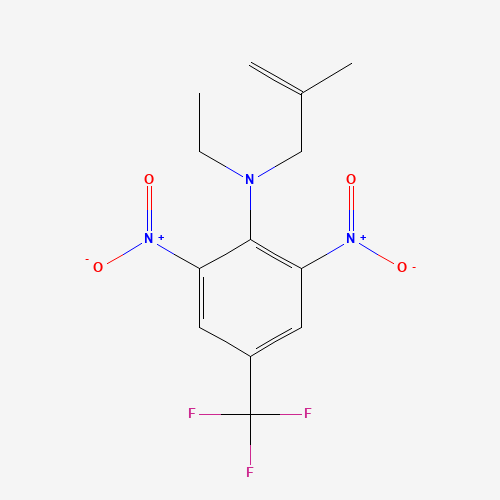
CAS55283-68-6
分子式C13H14F3N3O4
分子量333.26 g/mol
非危品
Ethalfluralin is a C-nitro compound.
科学粮草官-词典编辑部,修订于:2026-07-06
Toxicity
ToxicityEPA Ecotoxicity
Pesticide Ecotoxicity Data from EPA: 70
Fate Summary
ATMOSPHERIC FATE: According to a model of gas/particle partitioning of semivolatile organic compounds in the atmosphere(1), ethalfluralin, which has a vapor pressure of 8.8X10⁻⁵ mm Hg at 25 °C(1) is expected to exist in both the vapor and particulate phases in the ambient atmosphere. Vapor-phase ethalfluralin is degraded in the atmosphere by reaction with photochemically-produced hydroxyl radicals and ozone molecules(SRC). The half-life for this reaction in air is estimated to be 6 hours for hydroxyl radicals and 23 hours for ozone(SRC), calculated from their respective rate constants of 6.9X10⁻¹¹ cu cm/molecule-sec and 1.2X10⁻¹⁷ cu cm/molecule-sec at and 25 °C(SRC) that were derived using a structure estimation method(3). Particulate-phase ethalfluralin may be removed from the air by w...
Soil Adsorption / Mobility
The Koc value of ethalfluralin ranged from 4100 to 8400 in 4 soils(1). According to a classification scheme(2), these Koc values indicate that ethalfluralin should have slight to no mobility in soil(SRC).
Environmental Biodegradation
ANAEROBIC: Ethalfluralin applied to a sandy loam soil at 3 mg/kg had a half-life of 13.8 days under anaerobic conditions(1). The anaerobic aquatic degradation half-life of ethalfluralin applied (0.12 mg/kg) to a sediment/water system obtained from a Mississippi pond was approximately 38 hours(1,2).
Environmental Bioconcentration
BCF values of 1520 (edible tissue), 860 (non-edible tissue), and 1180 (whole fish) were measured in rainbow trout exposed to 0.86 ng/mL of ethalfluralin in a flow-through aquarium over a 28-day exposure period(1). Depuration was rapid, with an elimination half-life of about 3 days when fish were placed in ethalfluralin free water(1). According to a classification scheme(2), these BCF values suggest bioconcentration in aquatic organisms is very high(SRC).
Volatilization from Water / Soil
The Henry's Law constant for ethalfluralin is estimated as 1.3X10⁻⁴ atm-cu m/mole(SRC) derived from its vapor pressure, 8.8X10⁻⁵ mm Hg(1), and water solubility, 0.3 mg/L(1). This Henry's Law constant indicates that ethalfluralin is expected to volatilize from water surfaces(3). Based on this Henry's Law constant, the volatilization half-life from a model river (1 m deep, flowing 1 m/sec, wind velocity of 3 m/sec)(2) is estimated as 10 hours(SRC). The volatilization half-life from a model lake (1 m deep, flowing 0.05 m/sec, wind velocity of 0.5 m/sec)(2) is estimated as 11 days(SRC). Volatilization may be attenuated due to adsorption(SRC). The volatilization half-life from a model pond was estimated as 137 days when adsorption was considered(3). Volatilization from dry soil surfaces is n...
Environmental Abiotic Degradation
The rate constant for the vapor-phase reaction of ethalfluralin with photochemically-produced hydroxyl radicals has been estimated as 6.9X10⁻¹¹ cu cm/molecule-sec at 25 °C(SRC) using a structure estimation method(1). This corresponds to an atmospheric half-life of about 6 hours at an atmospheric concentration of 5X10+5 hydroxyl radicals per cu cm(1). The rate constant for the vapor-phase reaction of ethalfluralin with ozone has been estimated as 1.2X10⁻¹⁷ cu cm/molecule-sec at 25 °C(SRC) that was derived using a structure estimation method(1). This corresponds to an atmospheric half-life of about 23 hours at an atmospheric concentration of 7X10+11 ozone molecules per cu cm(2). Ethalfluralin at a concentration of 9.8 ug/cu m was degraded quickly in a chamber upon exposure to simulated su...
Environmental Water Concentrations
GROUNDWATER: Ethalfluralin was detected in 3.2% of the samples collected from 94 groundwater wells in the Midwestern United States in 1992(1). Ethalfluralin was detected at a maximum concn of 0.09 ug/L in a 1993-1995 study of groundwater from 20 major hydrological basins in the United States(2).
Food Survey Values
Ethalfluralin was analyzed for, but was not detected in the 2000, 2001, 2002, and 2003 FDA Market Basket Survey of domestic and imported food items(1).
Atmospheric Concentrations
Ethalfluralin was detected in 10% of the air samples collected along the Mississippi River from New Orleans, LA to St. Paul, MN at a maximum concn of 0.19 ng/cu m(1).
Artificial Pollution Sources
Ethalfluralin's production may result in its release to the environment through various waste streams; it's use as a selective herbicide for the preemergence control of annual grasses and broadleaf weeds(1) will result in its direct release to the environment(SRC).
Probable Routes of Human Exposure
Occupational exposure to ethalfluralin may occur through inhalation of dust and dermal contact with this compound at workplaces where ethalfluralin is produced or used(SRC). According to the EPA, there is potential exposure to handlers during use of ethalfluralin products. There is a concern about potential exposures arising from mixing and loading liquid or dry flowable formulations, from loading granular formulations, and from applying with groundboom and granular spreader equipment(1).
Environmental Fate / Exposure Summary
Ethalfluralin's production may result in its release to the environment through various waste streams; it's use as a selective herbicide for the preemergence control of annual grasses and broadleaf weeds will result in its direct release to the environment. If released to air, a vapor pressure of 8.8X10⁻⁵ mm Hg at 25 °C indicates ethalfluralin will exist in both the vapor and particulate phases in the atmosphere. Vapor-phase ethalfluralin will be degraded in the atmosphere by reaction with photochemically-produced hydroxyl radicals and ozone molecules. The half-life for this reaction in air with hydroxyl radicals is estimated to be 6 hours and the half-life for this reaction with ozone is estimated as 23 hours. The photolysis half-life of vapor phase ethalfluralin was about 2 hours in a...
Symptoms
Ethalfluralin can cause eye irritation and more severe skin irritation.
Toxicity Data
LC50 (rat) = 4980 mg/m3/4hr
Health Effects
Ethalfluralin causes skin burns and irreversible eye damage. It can also result in changes in liver and kidney weights, blood and cholesterol in animals. Some mutagenicity studies have shown that ethalfluralin was weakly mutagenic.
Adverse Effects
Lacrimator (Lachrymator) - A substance that irritates the eyes and induces the flow of tears.
RAIS Toxicity Values
Oral Slope Factor Reference: OPP
Human Toxicity Excerpts
/SIGNS AND SYMPTOMS/ Causes substantial but temporaiy eye irritation and skin irritation. Harmful if inhaled. Prolonged or frequently repeated skin contact may cause allergic reactions In some individuals. /Technical ethalfuralin/
Carcinogen Classification
No indication of carcinogenicity to humans (not listed by IARC).
Non-Human Toxicity Values
LD50 Rat oral > 5000 mg/kg
USGS Health-Based Screening Levels for Evaluating Water-Quality
Reference: Smith, C.D. and Nowell, L.H., 2024. Health-Based Screening Levels for evaluating water-quality data (3rd ed.). DOI:10.5066/F71C1TWP









