


 一键配货
一键配货
化合物详情
CAS55335-06-3
分子式C7H4Cl3NO3
分子量256.47 g/mol g/mol
危化品
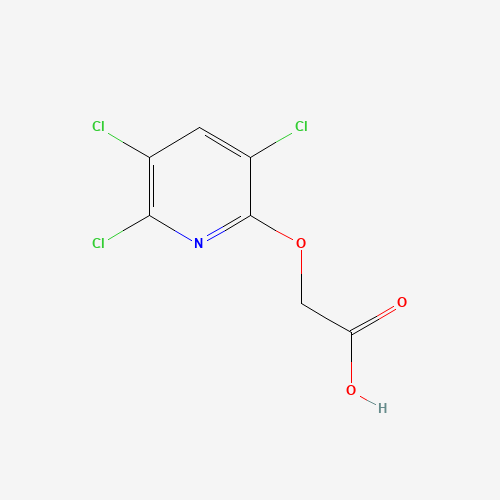
Trichlopyr is a monocarboxylic acid that is (pyridin-2-yloxy)acetic acid substituted by chloro groups at positions 3, 5 and 6. It is an agrochemical used as a herbicide. It has a role as a herbicide, an agrochemical, a xenobiotic and an environmental contaminant. It is a monocarboxylic acid, an aromatic ether and a chloropyridine.
科学粮草官-词典编辑部,修订于:2026-07-06
Toxicity
ToxicityEPA Ecotoxicity
Pesticide Ecotoxicity Data from EPA: 33
Fate Summary
ATMOSPHERIC FATE: According to a model of gas/particle partitioning of semivolatile organic compounds in the atmosphere(1), triclopyr, which has a vapor pressure of 1.26X10⁻⁶ mm Hg at 25 °C(2), will exist in both the vapor and particulate phases in the ambient atmosphere. Vapor-phase triclopyr is degraded in the atmosphere by reaction with photochemically-produced hydroxyl radicals(SRC); the half-life for this reaction in air is estimated to be 2.2 days(SRC), calculated from its rate constant of 4.8X10⁻¹² cu cm/molecule-sec at 25 °C(SRC) that was derived using a structure estimation method(3). Particulate-phase triclopyr may be removed from the air by wet and dry deposition(SRC). Triclopyr contains chromophores that absorb at wavelengths >290 nm(4) and, therefore, may be susceptible to...
Soil Adsorption / Mobility
Based on adsorption/desorption studies using sand, sandy loam, silt loam, and clay loam, triclopyr was considered mobile in soils; Koc values for triclopyr range from 12 to 134 at pH values of 5.0 to 7.7(1,2). Kd values ranged from 0.165 to 0.975 mL/g (pH 5.0 to 7.7)(1,2). Freundlich sorption constants(Kf) evaluated on four soils, 2 silty loams and 2 silty clays, ranged from 0.54 to 1.73 and relative sorption coefficient(Kd) values for triclopyr evaluated on the four soils ranged from 0.08 to 0.61 mL/g (pH 5 to 7)(3). From sorption studies on two soil types, triclopyr has Koc values of 14 and 66 days in clay soils with high organic matter(pH 6.3) and loamy-clay with less organic matter(pH 5.1), respectively(4). These data indicate that pH and organic matter influenced sorption and the m...
Environmental Biodegradation
ANAEROBIC: Triclopyr butoxyethyl ester degraded quantitatively to triclopyr in less than one day (approx 5 hrs) in two sandy loam soils incubated anaerobically (flooding plus nitrogen) for 30 days prior to pesticide addition(1). Triclopyr was then persistent under anaerobic conditions, decreasing to approximately 80% of the applied dose after 365 days; the half-life was approx 1,300 days(1). The only identified degradate was 3,5,6-trichloro-2-pyridinol at max concns of approx 25% of the applied at 365 days post-treatment(1).
Environmental Bioconcentration
An estimated BCF of 3 was calculated for triclopyr(SRC), using an estimated log Kow of 2.53(1) and a regression-derived equation(2). According to a classification scheme(3), this BCF suggests the potential for bioconcentration in aquatic organisms is low(SRC).
Volatilization from Water / Soil
The Henry's Law constant for triclopyr is estimated as 9.7X10⁻¹⁰ atm-cu m/mole(SRC) derived from its vapor pressure, 1.26X10⁻⁶ mm Hg(1), and water solubility, 440 mg/L(1). This Henry's Law constant indicates that triclopyr is expected to be essentially nonvolatile from water surfaces(2). Triclopyr's estimated Henry's Law constant indicates that volatilization from moist soil surfaces is not expected to occur(SRC). Triclopyr is not expected to volatilize from dry soil surfaces(SRC) based upon its vapor pressure(1).
Environmental Abiotic Degradation
The rate constant for the vapor-phase reaction of triclopyr with photochemically-produced hydroxyl radicals has been estimated as 4.8X10⁻¹² cu cm/molecule-sec at 25 °C(SRC) using a structure estimation method(1). This corresponds to an atmospheric half-life of about 3.3 days at an atmospheric concentration of 5X10+5 hydroxyl radicals per cu cm(1). Triclopyr is not expected to undergo hydrolysis in the environment(2). However, triclopyr undergoes photodecomposition with a half-life of <12 hours(2). Triclopyr photodegraded in sterile aqueous buffered solutions at pH 7 with half-lives of 0.6 days (8-9 hours) using natural light and 0.36 days using filtered Hg lamps with samples irradiated continuously(3). The half-lives in river water using natural and artificial light sources were 1.7 and...
Environmental Water Concentrations
RAIN/SNOW/FOG: At a detection limit of 1 ng/L, triclopyr was not detected in any precipitation samples collected monthly from May to Sept 2004 at a rural site surrounded by farms in St. Damase, Quebec, Canada(1).
Effluent Concentrations
Triclopyr was detected at an average concentration of 620 ng/L (max. 3900 ng/L) in 11 of 102 effluent samples collected in 2010 from municipal wastewater facilities in Oregon(1).
ICSC Environmental Data
This substance does enter the environment under normal use. Great care, however, should be taken to avoid any additional release, for example through inappropriate disposal.
Atmospheric Concentrations
RURAL/REMOTE: At a detection limit of 3 pg/cu m, triclopyr was not detected in any air samples collected weekly from May to June and then monthly from June to Sept 2004 at a rural site surrounded by farms in St. Damase, Quebec(1).
Artificial Pollution Sources
Triclopyr's production may result in its release to the environment through various waste streams; its use as an insecticide(1) will result in its direct release to the environment(SRC).
Probable Routes of Human Exposure
Occupational exposure to triclopyr may occur through inhalation and dermal contact with this compound at workplaces where triclopyr is produced or used. Limited monitoring data indicate that the general population may be exposed to triclopyr via ingestion of food containing residues. The greatest potential for dermal and inhalation exposure to triclopyr is expected for herbicide applicators, agricultural workers, and members of the general population that have frequent contact with products containing triclopyr for agricultural or residential use, and are frequently in areas where this chemical is applied.(SRC)
Environmental Fate / Exposure Summary
Triclopyr's production may result in its release to the environment through various waste streams; its use as an herbicide will result in its direct release to the environment. If released to air, a vapor pressure of 1.26X10⁻⁶ mm Hg at 25 °C indicates triclopyr will exist in both the vapor and particulate phases in the atmosphere. Vapor-phase triclopyr will be degraded in the atmosphere by reaction with photochemically-produced hydroxyl radicals; the half-life for this reaction in air is estimated to be 2.2 days. Particulate-phase triclopyr will be removed from the atmosphere by wet and dry deposition. Triclopyr contains chromophores that absorb at wavelengths >290 nm and, therefore, may be susceptible to direct photolysis by sunlight. Triclopyr has photodegradation half-lives of less t...
Symptoms
Eye Exposure: Redness.
Interactions
The purpose of this study was to determine the neurotoxicity of two commonly used herbicides: picloram and triclopyr and the neuroprotective effects of the mitochondria-targeted antioxidant, SS31. Using mouse neuroblastoma (N2a) cells and primary neurons from C57BL/6 mice, we investigated the toxicity of these herbicides, and protective effects of SS31 peptide against picloram and triclopyr toxicity. We measured total RNA content, cell viability and mRNA expression of peroxiredoxins, neuroprotective genes, mitochondrial-encoded electron transport chain (ETC) genes in N2a cells treated with herbicides and SS31. Using primary neurons from C57BL/6 mice, neuronal survival was studied in neurons treated with herbicides, in neurons pretreated with SS31 plus treated with herbicides, neurons tr...
Toxicity Data
LC50 (rat) > 256 ppm/4h
Adverse Effects
Skin Sensitizer - An agent that can induce an allergic reaction in the skin.
Exposure Routes
The substance can be absorbed into the body by inhalation of its aerosol, through the skin and by ingestion.
Toxicity Summary
IDENTIFICATION AND USE: Triclopyr is a solid. It is used as an herbicide that acts via the auxin system in plants. HUMAN EXPOSURE AND TOXICITY: Triclopyr is irritating to skin and eyes. One case report describes patient who ingested triclopyr and developed metabolic acidosis and coma with cardiovascular impairment. ANIMAL STUDIES: In male mice, triclopyr (480 mg/kg/day) caused single cell necrosis of the liver, significant increases in alkaline phosphatase, aspartate transaminase, and alanine transaminase, and enlargement of the liver with dark color. Centrilobular swelling and degeneration of hepatocytes were observed in a dose-dependent fashion at 120 mg/kg/day and above in male mice, along with mild increases in liver enzymes at 240 mg/kg/day. Degeneration of the proximal tubules of...
RAIS Toxicity Values
Oral Chronic Reference Dose Reference: OPP
Human Toxicity Excerpts
/ALTERNATIVE and IN VITRO TESTS/ We investigated whether the uptake of triclopyr (3, 5, 6-trichloro-2-pyridinyloxyacetic acid) and dicamba (3,6-dichloro-2-methoxybenzoic acid) across the apical membrane of Caco-2 cells was mediated via proton-linked monocarboxylic acid transporters (MCTs). The uptake of triclopyr from the apical membranes was fast, pH-, temperature-, and concentration dependent, required metabolic energy to proceed, and was competitively inhibited by monocarboxylic acids such as benzoic acid and ferulic acid (substrates of L-lactic acid-insensitive MCTs), but not by L-lactic acid. Thus, the uptake of triclopyr in Caco-2 cells appears to be mediated mainly via L-lactic acid-insensitive MCTs. In contrast, the uptake of dicamba (a benzoic acid derivative) was slow, and it...
Carcinogen Classification
No indication of carcinogenicity to humans (not listed by IARC).
Evidence for Carcinogenicity
Cancer Classification: Group D Not Classifiable as to Human Carcinogenicity
USGS Health-Based Screening Levels for Evaluating Water-Quality
Reference: Smith, C.D. and Nowell, L.H., 2024. Health-Based Screening Levels for evaluating water-quality data (3rd ed.). DOI:10.5066/F71C1TWP









